
Selecting the right circular saw often presents a frustrating challenge for professionals and dedicated DIYers, as the wrong decision inevitably leads to chronic hand fatigue and compromised cut accuracy. While buyers typically rely on standard tool-procurement budgets and general hardware retail channels to source their equipment, understanding the engineering behind motor orientation is what grants operators a distinct advantage in cutting efficiency, safety, and tool longevity.
As a crucial stipulation, buyers must recognize that motor placement dictates physical weight distribution and cut-line visibility, rather than just subjective comfort. For example, professional framing crews have historically relied on heavy-duty worm drive saws, such as the classic Skilsaw models, to handle demanding plunge cuts and dense lumber that would otherwise bog down standard direct-drive options.
Below, we will analyze the critical distinctions between worm drive and sidewinder saws, evaluating differences in torque, weight, ergonomics, and application suitability to ensure you invest in the optimal tool for your operational needs.
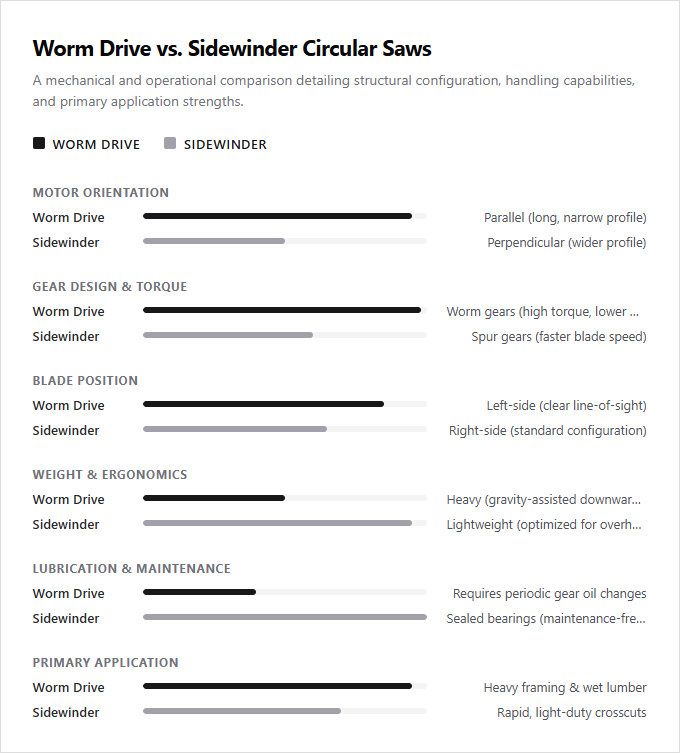
| Factor | Summary |
|---|---|
| Motor Orientation | Worm drive saws position the motor parallel to the blade for a longer, narrower profile, whereas sidewinder saws place the motor perpendicular to the blade. |
| Gear Design and Torque | Worm drive saws utilize a worm gear setup to deliver high torque at lower RPMs, while sidewinder saws employ spur gears to achieve faster blade rotation speeds. |
| Blade Position | Worm drive saws typically feature a left-side blade configuration for better line-of-sight for right-handed users, whereas most sidewinder saws position the blade on the right. |
| Weight and Ergonomics | Sidewinder saws are constructed with lightweight materials for easier overhead handling, while heavier worm drive saws leverage their mass to make gravity-assisted downward cuts. |
| Lubrication and Maintenance | Worm drive saws require periodic gear oil replenishment within an internal oil bath, whereas sidewinder saws feature sealed bearings that require no user maintenance. |
| Primary Application | Worm drive saws excel in heavy-duty framing and cutting wet lumber due to their high torque, while sidewinder saws are preferred for rapid, light-duty crosscuts. |
Worm Drive vs. Sidewinder: Motor Orientation
The primary distinction between worm drive and sidewinder circular saws lies in their motor orientation. In a worm drive saw, the motor is positioned parallel to the blade, utilizing a gear system that transfers power at a right angle. This design creates a longer, narrower profile and positions the blade on the left side, offering an unobstructed line of sight for right-handed users. Conversely, a sidewinder features a perpendicular transverse motor axis positioned directly beside the blade, resulting in a wider, more compact tool with the blade typically on the right.
The parallel motor alignment of the worm drive generates immense torque, making the tool heavier but highly capable of demanding, continuous cuts through dense materials. The perpendicular layout of the sidewinder maximizes blade speed and reduces weight, facilitating rapid, repetitive cuts with less user fatigue. Heavy-duty framing professionals benefit most from the high-torque worm drive, while general contractors and DIY enthusiasts favor the lightweight, maneuverable sidewinder.
Worm vs. Spur Gears: Torque vs. Speed
Worm drive circular saws position the motor parallel to the blade, utilizing a worm gear configuration. This mechanical design reduces rotational speed to deliver exceptional torque, preventing the blade from stalling when cutting through dense, wet, or heavy lumber.
In contrast, sidewinder saws place the motor perpendicular to the blade, employing a spur gear configuration. This direct-drive system achieves significantly higher rotational speeds, facilitating rapid, clean cuts through standard sheet goods while maintaining a lightweight, highly maneuverable profile.
Heavy-duty framing professionals who demand maximum durability and torque typically favor the worm drive, while finish carpenters and DIY enthusiasts seeking maneuverability and fast cutting speeds are better suited for the lightweight sidewinder.
Rear Longitudinal vs. Side Transverse Center of Gravity
Worm drive circular saws feature a motor positioned parallel to the blade, creating a rear-weighted longitudinal center of gravity. This elongated design delivers high torque and exceptional line-of-sight, as the weight is distributed along the length of the tool to help guide straight, downward cuts. The longitudinal balance reduces wrist strain during long rip cuts by allowing the tool's weight to do the work.
Sidewinder saws utilize a motor positioned perpendicular to the blade, establishing a side-weighted transverse center of gravity. This wider design results in a more compact, lighter tool that offers rapid blade speeds. The transverse weight distribution provides stable lateral control and easier handling during overhead or vertical operations.
Heavy-duty framing professionals benefit most from the high-torque, rear-weighted worm drive, whereas general carpenters and DIY users favor the lightweight, transverse-balanced sidewinder for versatile, everyday cutting.
Left vs. Right Blade Visibility for Right-Handed Users
For right-handed users, the spindle orientation of these two circular saw designs fundamentally alters the line of sight during operation. The traditional sidewinder saw positions the blade on the right side of the motor. For a right-handed operator, this orientation places the bulk of the tool securely over the workpiece, but it obscures the cut line behind the motor housing, requiring the user to lean over the tool to track the blade's progress.
In contrast, the worm drive saw features a blade-left configuration. This design provides right-handed users with an unobstructed, direct line of sight to the cutting mark, enhancing precision without awkward body positioning. Heavy-duty worm drive saws are ideal for professional framers who prioritize maximum line-of-sight visibility and high torque, while lighter sidewinders suit DIY enthusiasts and finish carpenters seeking maneuverability and comfortable overhead use.
Oil-bath gear lubrication maintenance versus sealed grease bearings
Worm drive circular saws utilize a rear-positioned motor and a heavy-duty gear system immersed in an oil bath. This configuration requires periodic maintenance, including monitoring fluid levels and replacing the lubricant to ensure optimal heat dissipation and prevent premature gear wear under heavy loads.
Sidewinder saws position the motor parallel to the blade, employing spur gears lubricated by sealed grease bearings. This design offers a maintenance-free experience, as the sealed bearings protect against dust infiltration and eliminate the need for oil changes, though it provides less cooling efficiency during prolonged cutting tasks.
Heavy-duty framing professionals requiring maximum torque are ideal candidates for the high-maintenance worm drive, while residential contractors and DIYers seeking a lightweight, zero-maintenance tool will prefer the sidewinder.
Longitudinal drive shaft power transfer versus direct-drive motor spindle transfer
Worm drive circular saws utilize a motor positioned parallel to the blade, employing a longitudinal drive shaft that transfers power through a 90-degree worm gear. This mechanical configuration increases torque significantly while reducing blade speed, making it highly effective for demanding, high-resistance cutting tasks.
In contrast, sidewinder saws feature a transverse motor configuration where the blade attaches directly to the motor spindle. This direct-drive system maximizes rotational speed and reduces overall tool weight, offering superior maneuverability and faster cutting speeds through standard lumber.
Heavy-duty framing professionals who require high-torque performance for thick materials favor the robust worm drive, while residential carpenters and DIY enthusiasts seeking a lightweight, easy-to-handle tool benefit most from the agile sidewinder.
Amperage Efficiency: Heavy Load vs. High-Speed Light Duty
Worm drive circular saws utilize a rear-positioned motor and a spiral-gear system to maximize torque. Under heavy, sustained loads, such as ripping thick timber, this configuration manages amperage draw with high efficiency, translating electrical power into mechanical force while minimizing heat buildup and motor strain.
In contrast, sidewinder saws feature a side-mounted motor with spur gears designed for high-speed rotation. While highly efficient during rapid, light-duty cutting cycles, the sidewinder draws higher relative amperage and experiences greater resistance when pushed beyond its torque capacity in dense materials.
The high-torque worm drive is ideal for framing contractors and heavy-duty builders requiring relentless cutting power, whereas the lightweight, high-speed sidewinder is best suited for finish carpenters and DIY enthusiasts prioritizing speed and maneuverability.
Leave a comment