
Industrial design engineers often struggle with premature performance degradation and unexpected pressure drops in high-demand air-moving systems. Typically, operators attempt to resolve these thermodynamic inefficiencies by relying on standard motor upsizing or generic volumetric flow charts, which frequently overlook critical internal kinetic dynamics. However, optimizing the blower's impeller metallurgy-specifically choosing between aluminum and cast iron-guarantees a significant leap in dynamic pressure generation and operational efficiency.
Of course, this performance yield is contingent upon the stipulation that system operating temperatures and particulate exposure are strictly monitored. For example, in demanding applications like wastewater aeration and high-vacuum pneumatic conveying, selecting the correct material dictates the system's resistance to thermal expansion and blade erosion.
This article compares the mechanical characteristics of aluminum and cast iron impellers, analyzes their direct influence on dynamic pressure output, and outlines key selection criteria to optimize your regenerative blower's lifecycle.
| Factor | Summary |
|---|---|
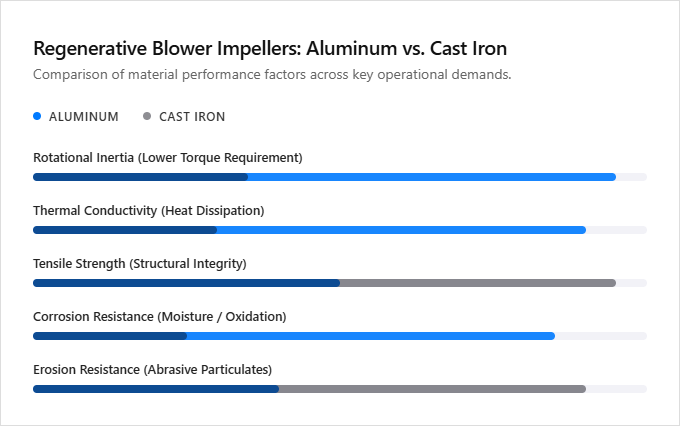
| Rotational Inertia | Aluminum impellers feature a much lower density than cast iron, resulting in reduced rotational inertia that minimizes motor startup torque requirements. |
| Thermal Conductivity | Aluminum possesses superior thermal conductivity compared to cast iron, facilitating rapid heat dissipation to prevent thermal expansion during high-pressure continuous operation. |
| Tensile Strength | Cast iron impellers provide higher ultimate tensile strength and yield strength, preventing structural deformation under extreme centripetal forces. |
| Corrosion Resistance | Aluminum naturally develops a passivating oxide layer that resists moisture, whereas untreated cast iron is highly susceptible to oxidation and rust. |
| Erosion Resistance | Cast iron exhibits superior surface hardness and abrasive wear resistance, making it ideal for regenerative blowers handling airflows with suspended particulate matter. |
Rotational inertia and its effect on transient response acceleration
In regenerative blowers, the choice between an aluminum and a cast iron impeller directly dictates system dynamics. Aluminum impellers, characterized by low material density, exhibit minimal rotational inertia. This reduced inertia allows the blower to achieve rapid transient response and swift acceleration, making it highly responsive to variable speed demands and frequent start-stop cycles.
In contrast, cast iron impellers possess substantial mass, resulting in high rotational inertia. This resistance to changes in speed slows acceleration and transient response times, yet it provides exceptional rotational stability and resistance to thermal deformation under heavy, continuous loads.
Aluminum models are ideal for operators requiring precise, dynamic flow control in automated processes, whereas cast iron units suit industrial engineers managing heavy-duty, continuous-duty applications where thermal and physical durability are paramount.
Maximum peripheral velocity limits governed by centrifugal stress
In regenerative blowers, the choice between aluminum and cast iron impellers is heavily governed by centrifugal stress, which dictates the maximum peripheral velocity limits. Aluminum boasts a superior strength-to-weight ratio, experiencing lower self-induced centrifugal forces at high rotational speeds. This allows aluminum impellers to safely achieve higher tip speeds and greater volumetric efficiency without exceeding the material's yield strength.
Cast iron impellers possess a much higher density, which significantly increases centrifugal stress at elevated velocities, thereby restricting their maximum peripheral speed. However, they provide exceptional thermal stability and resistance to abrasive wear in harsh operating conditions. System designers requiring high-velocity, continuous-duty air shifting benefit most from aluminum impellers, while facility managers overseeing heavy-duty, particulate-laden industrial processes are better served by cast iron.
Thermal Expansion Effects on Axial Clearance and Aerodynamic Slip
The selection between aluminum and cast iron impellers in regenerative blowers depends heavily on their thermal properties. Aluminum possesses a significantly higher coefficient of thermal expansion. Under continuous operation, this thermal expansion reduces the critical axial clearance between the impeller and the blower housing, which decreases aerodynamic slip and enhances pressure efficiency.
In contrast, cast iron's lower thermal expansion maintains highly stable clearance gaps, preventing potential mechanical contact during sudden temperature spikes. Aluminum impellers are ideal for operators seeking high-efficiency, lightweight performance in temperature-controlled systems, while cast iron impellers are best suited for heavy-duty industrial users requiring maximum reliability under severe thermal stress.
Young's Modulus and High-Pressure Impeller Deflection
In regenerative blowers, the choice between aluminum and cast iron impellers depends heavily on how the material handles high differential pressures. Cast iron possesses a significantly higher Young's modulus-approximately 170 GPa compared to aluminum's 70 GPa-providing superior resistance to impeller blade deflection. Under extreme pressure gradients, this structural rigidity prevents mechanical deformation, ensuring the blower maintains critical clearances and optimal aerodynamic performance without risking internal contact.
Aluminum's lower modulus makes it more susceptible to deflection under peak loads, though its lighter weight reduces rotational inertia and lowers startup torque. Aluminum impellers are ideal for operators requiring rapid response times and frequent starts in moderate-pressure systems, whereas cast iron impellers are best suited for industrial engineers managing continuous, heavy-duty operations under extreme differential pressures.
Roughness and Efficiency Effects on Skin Friction Drag
Aluminum impellers are typically manufactured using precision casting, resulting in an exceptionally smooth surface finish. This low surface roughness significantly minimizes skin friction drag losses as air moves through the regenerative blower channels. The reduced boundary layer resistance maximizes aerodynamic efficiency, allowing the system to achieve optimal airflow with lower energy consumption.
Cast iron impellers feature a rougher surface texture inherent to traditional casting processes. This increased surface roughness elevates skin friction drag, which slightly reduces the blower's overall aerodynamic efficiency. Precision-focused engineers requiring maximum energy efficiency should select aluminum impellers, while heavy-industry operators managing rugged, abrasive environments will find cast iron more suitable.
Thermal conductivity rates and their mitigation of density-loss thermal throttling
In regenerative blowers, managing heat build-up is critical to preventing thermal throttling, where rising temperatures decrease intake air density and degrade performance. Aluminum impellers, boasting a high thermal conductivity rate of approximately 200 W/m·K, rapidly dissipate compression heat. This rapid thermal transfer effectively mitigates density-loss thermal throttling, ensuring the blower maintains consistent volumetric efficiency and stable pressure levels during continuous operation.
Cast iron impellers exhibit a much lower thermal conductivity of around 50 W/m·K, which retains heat within the system and increases the likelihood of density-induced performance drops. Aluminum impellers are ideal for operators requiring highly efficient, continuous airflow in temperature-sensitive environments, whereas cast iron impellers are best suited for industrial users managing heavy debris and abrasive materials where structural durability is the primary concern.
Particulate erosion resistance within the high-velocity toroidal flow channels
In regenerative blowers, the high-velocity toroidal flow channels subject the impeller to continuous particulate impact. Aluminum impellers, while offering excellent thermal conductivity and lower rotational inertia, exhibit lower surface hardness. Under consistent exposure to abrasive dust, aluminum experiences accelerated micro-cutting and erosive wear, which gradually degrades the precise blade profiles and reduces pressure efficiency.
Conversely, cast iron impellers provide superior particulate erosion resistance due to their dense, hard material structure. This robust composition minimizes material loss within the high-velocity flow path, preserving the blower's aerodynamic performance during prolonged operation with abrasive media. Light-duty operators handling clean air benefit from the responsive efficiency of aluminum, whereas industrial facility managers processing debris-laden gas streams require the rugged durability of cast iron.
Leave a comment