
Selecting the right woodworking router often leaves craftspeople caught in a frustrating paradox: purchasing a tool that is either too cumbersome for delicate detail work or too weak to handle deep profile cuts. Historically, woodworkers bridged this gap by defaulting to standard multi-base kits or heavy-duty table setups as their primary shop investments.
However, strategically matching your tool to your project scale grants you the exact balance of maneuverability and cutting torque required for flawless execution. It is important to stipulate that motor horsepower ratings alone do not dictate performance; collet capacity-such as the transition from a 1/4-inch shank on a palm router like the Bosch PR20EVS to a 1/2-inch shank on a medium-size DeWalt DW618-plays a critical role in bit stability and vibration reduction.
In this article, we will analyze the pivotal differences between palm and medium-size routers, comparing motor horsepower, collet versatility, and physical handling to help you identify the best fit for your workshop.
| Factor | Summary |
|---|---|
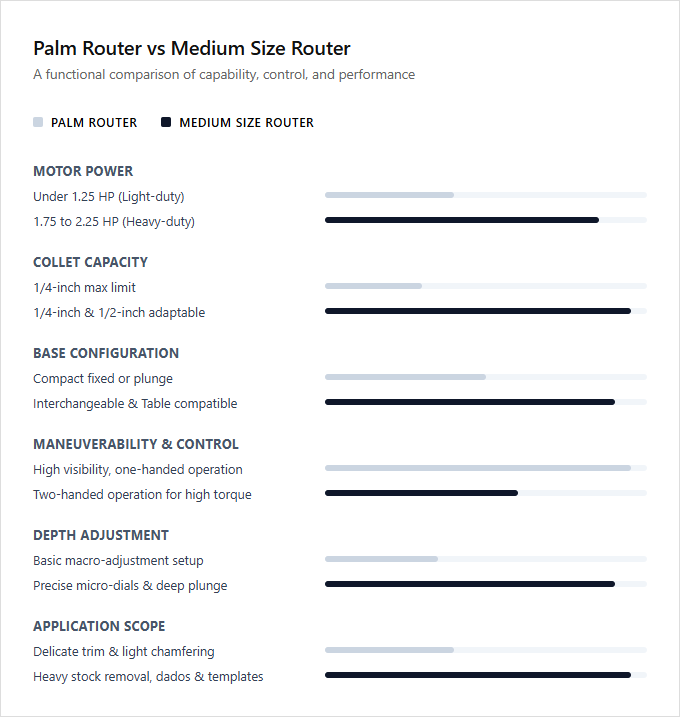
| Motor Power | Palm routers typically feature light-duty motors under 1.25 horsepower (HP), whereas medium-size routers utilize robust motors ranging from 1.75 to 2.25 HP to handle denser lumber. |
| Collet Capacity | Palm routers are generally limited to a 1/4-inch collet, while medium-size routers accommodate interchangeable collets accepting both 1/4-inch and heavy-duty 1/2-inch shank router bits. |
| Base Configuration | Palm routers use compact fixed or plunge bases designed for one-handed operation, whereas medium-size routers often feature interchangeable plunge and fixed bases compatible with router tables. |
| Maneuverability and Control | Palm routers offer excellent visibility and control for delicate edge-profiling and laminate trimming, while medium-size routers require two-handed operation to manage higher torque. |
| Depth Adjustment | Palm routers utilize basic macro-adjustments for shallow cuts, whereas medium-size routers feature precise micro-adjustment dials and deeper plunge capacities for heavy mortising. |
| Application Scope | Palm routers excel at light-duty detail work and chamfering, whereas medium-size routers are ideal for heavy stock removal, dado cutting, and running large-diameter profile bits. |
Medium-size routers accept both 1/4-inch and 1/2-inch collet capacity options
When selecting a woodworking router, understanding the distinction between a palm router and a medium-size router is essential for workshop efficiency. Palm routers are highly maneuverable, compact tools designed for light-duty tasks such as edge-profiling and hinge mortising. In contrast, medium-size routers provide a significant step up in horsepower and adaptability. A key advantage of the medium-size platform is its dual collet capacity, as these machines readily accept both 1/4-inch and 1/2-inch shank router bits.
The ability to utilize 1/2-inch collets allows medium-size routers to run larger profile cutters with greater stability and less vibration than their smaller counterparts. Palm routers, limited to 1/4-inch collets, remain the preferred choice for precise, one-handed control on delicate trim work. Palm routers are ideal for mobile installers and hobbyists focusing on light edge treatment, whereas medium-size routers are best suited for dedicated furniture makers and workshop enthusiasts who require heavy-duty plunge cuts and template routing capabilities.
Palm Routers Limited to 1.25 HP
When selecting a woodworking router, understanding the distinction in motor capability is essential. Palm routers, designed for maneuverability and precision, are limited to a maximum of 1.25 peak horsepower (HP) motors. This power ceiling restricts these compact tools to lighter-duty tasks such as edge profiling, hinge mortising, and shallow grooving where control is prioritized over raw force.
Medium-size routers typically feature robust motors ranging from 1.75 to 2.25 HP. This increased capacity allows them to plunge deeper, drive larger profile bits, and hog out dense hardwoods without stalling or overheating.
Palm routers are ideal for finish carpenters and hobbyists focusing on detailed, freehand trim work, whereas medium-size routers are best suited for workshop furniture makers requiring a versatile machine for heavy joinery and router table applications.
Medium-Size Routers: 1.75 to 2.25 HP
When selecting a woodworking router, the choice between palm and medium-size models depends heavily on power and application. Palm routers offer excellent maneuverability for light edge profiling and detailed trimming. In contrast, medium-size routers feature 1.75 to 2.25 horsepower (HP) ratings for heavy-duty cutting, allowing them to drive larger bits through dense hardwoods without sacrificing rotational speed or precision.
Selecting the appropriate machine depends on specific workshop requirements and project scale. Palm routers are ideal for DIY hobbyists prioritizing control during light trim work, whereas medium-size routers are best suited for furniture makers and professional carpenters requiring a versatile tool for heavy-duty joinery.
Palm routers primarily accommodate 1/4-inch shank diameter router bits
When selecting a woodworking router, understanding the distinction between palm routers and medium-size routers is essential for project success. Palm routers, also known as trim routers, are compact, highly maneuverable tools designed for precision work. These lightweight machines primarily accommodate 1/4-inch shank diameter router bits, making them ideal for light edge profiling, hinge mortising, and detailed veneer trimming where control is paramount.
In contrast, medium-size routers offer increased horsepower and typically accept both 1/4-inch and 1/2-inch collets. This versatility allows them to handle larger cutting bits and denser hardwoods without stalling. Palm routers are best suited for hobbyists and installers prioritizing portability for light-duty detailing, whereas medium-size routers are ideal for furniture makers and workshop woodworkers requiring robust power for heavy-duty template routing and joinery.
Medium-size routers handle larger profile cutters like panel-raiser bits safely
When selecting between a palm router and a medium-size router, the primary considerations are power, control, and cutter capacity. While palm routers excel at light, detailed edge profiling and single-handed operation, they lack the stability required for heavy-duty tasks. Medium-size routers, typically rated between 1.75 and 2.25 horsepower, provide the robust motor and larger base plate necessary to handle larger profile cutters safely.
Spinning wide cutters, such as panel-raiser bits, demands lower rotational speeds and increased torque to prevent dangerous kickback. Medium-size routers feature variable speed controls and rigid plunge or fixed bases, ensuring the stability needed to manage these demanding profiles without compromising operator safety. Highly portable palm routers are best suited for hobbyists and installers performing on-site hinge mortising and light trimming, while versatile medium-size routers are ideal for furniture makers and serious woodworkers tackling cabinetry and architectural millwork.
Constant Speed Control Prevents Router RPM Drops
When choosing between a palm router and a medium-size router, power delivery under load is a critical differentiator. While compact palm routers excel in maneuverability, they can struggle with dense materials. Medium-size routers address this limitation with constant electronic speed control, a feature that monitors motor feedback and automatically increases power to prevent RPM drops during heavy cuts, ensuring a clean, burn-free finish.
Beyond electronics, their physical designs dictate distinct workshop roles. Palm routers are ideal for hobbyists performing detailed, one-handed edge work, while more powerful medium-size routers are suited for professional furniture makers executing deep mortising or table-mounted operations.
Larger Armatures Increase Medium Router Duty Cycles
When selecting between a palm router and a medium-size router, the primary differentiator lies in motor capacity and thermal management. Medium-size routers feature a significantly larger armature, which provides greater physical mass to dissipate heat during operation. This robust construction allows the tool to maintain a higher continuous duty cycle, making it capable of handling prolonged routing sessions under heavy loads without the risk of overheating.
In contrast, palm routers prioritize maneuverability and control, utilizing smaller motors best suited for intermittent, light-duty applications. While highly effective for precise edge-profiling and hinge mortising, they lack the sustained power required for deep, repetitive passes. Detail-oriented trim carpenters and DIY hobbyists will benefit most from the nimble control of a palm router, whereas professional furniture makers and workshop craftsmen requiring sustained, heavy-duty production will find the medium-size router indispensable.
Leave a comment