
Selecting the right impact wrench often presents a frustrating compromise: do you prioritize lightweight maneuverability or raw, unyielding torque? Many technicians struggle with chronic wrist fatigue from over-engineered tools, yet dread the downtime of stalling out on stubborn fasteners.
Traditionally, workshop procurement relies on standard tooling budgets that default to maximum voltage platforms under the assumption that higher power is always superior. However, aligning your tool's voltage to your specific workflow grants operators optimized power-to-weight ratios, directly reducing physical strain while preserving fastener integrity.
As a crucial stipulation, while 18-volt platforms are indispensable for high-torque demands, they are often counterproductive for precision assemblies. For example, a compact 12-volt wrench excels at navigating tight steering columns and under-dash fasteners, whereas an 18-volt powerhouse is required for breaking loose rusted structural suspension lug nuts.
This article will analyze the torque-to-weight ratios, battery runtimes, and practical applications of both 12V and 18V systems, helping you select the optimal tool for your operational needs.
| Factor | Summary |
|---|---|
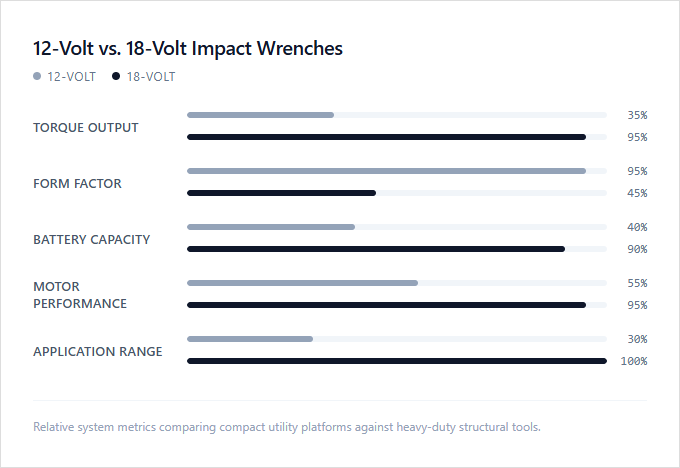
| Torque Output | 18-Volt impact wrenches deliver significantly higher breakaway torque and fastening torque compared to 12-Volt models. |
| Form Factor | 12-Volt models feature a highly compact, lightweight ergonomic chassis that allows superior access to tight spatial clearances. |
| Battery Capacity | The lithium-ion battery packs of 18-Volt platforms provide a much higher Amp-hour rating for sustained performance and extended duty cycles. |
| Motor Performance | 18-Volt systems utilize larger brushless DC motors to generate higher rotational velocity and impacts per minute. |
| Application Range | 12-Volt tools are optimized for low-torque precision fastening, whereas 18-Volt models are engineered for heavy-duty structural bolting. |
18-volt platforms deliver significantly higher peak torque than 12-volt models
When selecting an impact wrench, the voltage platform dictates the tool's overall capability and performance. The primary differentiator lies in power output, where 18-volt platforms deliver significantly higher peak torque than 12-volt models. This disparity allows 18-volt tools to easily loosen stubborn, rusted fasteners and handle heavy-duty applications that would stall a lower-voltage motor.
While 18-volt systems dominate in sheer power, 12-volt impact wrenches prioritize compact efficiency and maneuverability. Although they offer lower torque thresholds, they excel in tight workspaces where larger tools cannot fit. Heavy-duty diesel mechanics and industrial builders require the relentless power of 18-volt systems, whereas automotive interior technicians and DIY hobbyists benefit more from the lightweight, agile design of 12-volt models.
Higher Voltage Boosts Motor Power and Speed
In cordless impact wrenches, nominal voltage is the primary determinant of overall tool performance. A higher nominal voltage directly correlates to increased motor power and rotational velocity. This relationship exists because greater voltage allows the tool's system to draw more electrical energy, enabling the brushless or brushed motor to generate significantly higher torque output and faster rotations per minute under load.
While 12-volt systems offer compact housing and lighter weight for confined spaces, 18-volt platforms deliver the robust force necessary to break loose large, stubborn fasteners. Heavy-duty diesel mechanics and structural steel erectors will find the raw power of the 18-volt platform essential, whereas mobile diagnostic technicians and woodworking hobbyists are better served by the lightweight precision of 12-volt tools.
Defining Fastening Capability: Impact and Energy
When selecting between 12-volt and 18-volt impact wrenches, the primary differentiators of fastening capability are impacts per minute (IPM) and kinetic energy transfer. A 12-volt system typically delivers a high IPM to facilitate rapid, lighter blows, which allows for fast fastening without damaging delicate materials. The lower kinetic energy transfer inherent in these compact motors prevents over-tightening on sensitive components.
The 18-volt platforms utilize larger motors to generate massive kinetic energy per blow. While the frequency of impacts may be comparable to smaller systems, the sheer force transferred during each strike is significantly greater, allowing the tool to break free stubborn fasteners easily. Compact 12-volt models are ideal for precision-focused technicians working in confined spaces, whereas robust 18-volt units are best suited for heavy industrial operators and automotive mechanics requiring maximum torque.
Brushless motor efficiency determines sustained torque output and thermal management
When comparing 12-Volt and 18-Volt cordless impact wrenches, brushless motor efficiency represents the critical differentiator in sustained performance. Brushless technology optimizes energy draw, which directly influences how each voltage platform manages heat dissipation under load. While 12-Volt systems leverage efficient electronics to maximize output within a compact frame, 18-Volt platforms utilize the higher voltage to maintain peak torque over extended periods without thermal throttling. This superior thermal management prevents performance degradation during demanding applications.
The choice between these platforms depends on the specific demands of your work environment. Compact 12-Volt models are ideal for automotive technicians navigating tight engine bays, whereas high-torque 18-Volt units are essential for heavy equipment mechanics and structural contractors requiring relentless power.
Anvil size differences dictate the maximum breakaway torque potential
When comparing 12-volt and 18-volt impact wrenches, the primary performance differentiator lies in their mechanical construction. The anvil size directly dictates the tool's maximum breakaway torque potential. Smaller 12-volt platforms typically utilize 1/4-inch or 3/8-inch anvils, which limits the physical force transfer to protect the compact internal motor components. In contrast, heavy-duty 18-volt models employ larger 1/2-inch or 3/4-inch anvils, enabling robust drive trains to deliver massive rotational force without structural failure.
The physical mass of the anvil determines the socket compatibility and the threshold of energy delivered to the fastener. Compact 12-volt systems are ideal for precision-focused technicians working on delicate assemblies in tight spaces, while high-torque 18-volt units are essential for heavy-duty automotive mechanics and industrial contractors tackling seized structural bolts.
How Amp-Hour Capacity Impacts Torque Duration
When comparing 12-volt and 18-volt impact wrenches, Amp-hour (Ah) capacity is critical for sustaining peak torque under load. While 18-volt systems offer higher raw power, the battery's Ah rating determines how long either tool maintains optimal torque. Higher Ah batteries prevent the rapid voltage drops that occur during heavy fastening, ensuring consistent power delivery throughout demanding tasks.
Choosing between these platforms depends on the specific demands of your work environment. Compact 12-volt models are ideal for interior installers and technicians working in confined spaces, whereas robust 18-volt models are suited for heavy equipment mechanics and construction professionals requiring relentless power for large fasteners.
12V Tools: Power-to-Weight Over Raw Power
When selecting an impact wrench, the choice between 12-volt and 18-volt platforms depends on your specific application needs. 12-volt tools prioritize an optimized power-to-weight ratio over raw fastening power. These compact tools deliver sufficient torque for most everyday fastening tasks while minimizing user fatigue during prolonged overhead use or in confined vehicle engine bays.
18-volt systems offer high torque levels and faster speed configurations to handle heavy-duty applications like suspension work and commercial construction. The increased battery size provides extended runtime at the cost of added tool weight. Lightweight 12-volt models are ideal for precision-focused technicians performing interior assembly or light engine work, while robust 18-volt models suit heavy equipment mechanics and structural contractors requiring maximum torque.
Leave a comment