
For professionals and tradespeople, selecting the right cordless impact wrench often involves navigating a confusing landscape of voltage ratings and torque claims, where choosing the wrong tool leads to stalled fasteners and lost productivity on the job site.
Traditionally, operators rely on standard 18-volt battery platforms as their baseline power source to handle heavy-duty fastening. However, unlocking true operational efficiency grants users the ability to look past marketing labels to secure optimal runtime and peak torque delivery.
Important Stipulation: It is critical to understand that 18V and 20V Max systems operate at the exact same 18-volt nominal level under working load; the "20V Max" rating merely represents the initial battery surge before the tool is engaged.
In demanding applications-such as removing seized automotive lug nuts or driving heavy lag bolts-motor efficiency and anvil design dictate performance far more than the voltage sticker. This guide demystifies the 18V vs. 20V Max debate, analyzes torque mechanics, and helps you select the precise impact wrench for your workflow.
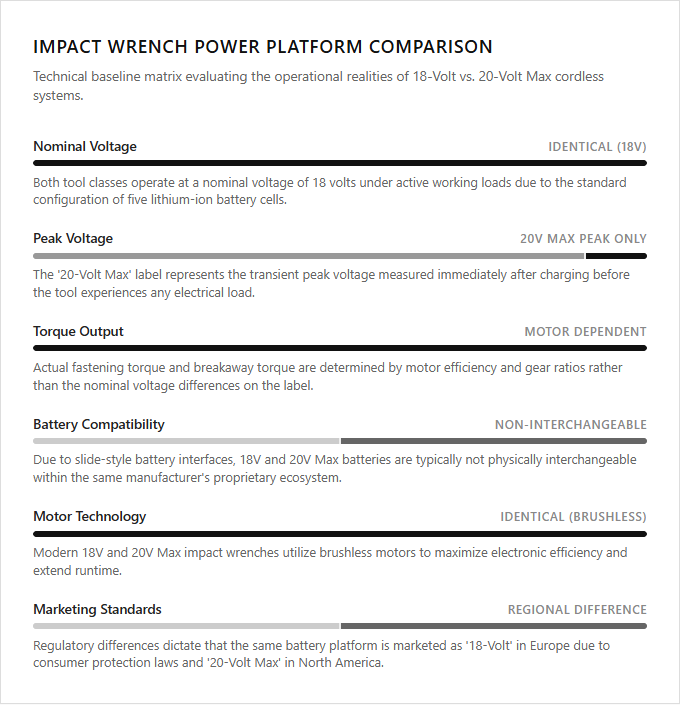
| Factor | Summary |
|---|---|
| Nominal Voltage | Both tool classes operate at a nominal voltage of 18 volts under active working loads due to the standard configuration of five lithium-ion battery cells. |
| Peak Voltage | The "20-Volt Max" label represents the transient peak voltage measured immediately after charging before the tool experiences any electrical load. |
| Torque Output | Actual fastening torque and breakaway torque are determined by motor efficiency and gear ratios rather than the nominal voltage differences on the label. |
| Battery Compatibility | Due to slide-style battery interfaces, 18V and 20V Max batteries are typically not physically interchangeable within the same manufacturer's proprietary ecosystem. |
| Motor Technology | Modern 18V and 20V Max impact wrenches utilize brushless motors to maximize electronic efficiency and extend runtime. |
| Marketing Standards | Regulatory differences dictate that the same battery platform is marketed as "18-Volt" in Europe due to consumer protection laws and "20-Volt Max" in North America. |
Identical nominal voltage under load despite different marketing labels
When selecting a cordless impact wrench, the distinction between 18-volt and 20-volt max models is primarily a matter of marketing terminology rather than actual power output. A 20-volt max battery is rated at its peak startup voltage measured immediately after a full charge. Once the tool is engaged under a working load, the operating tension drops to its nominal rating of 18 volts. Because both systems utilize the exact same five-cell lithium-ion cell configuration, they deliver identical torque and speed performance during operation.
Choosing between these two options should depend on battery ecosystem compatibility rather than the voltage label. Heavy-duty automotive professionals requiring maximum torque are best served by the robust build quality of premium 18-volt platforms, while home DIY enthusiasts will find the lighter, budget-friendly 20-volt max lines perfectly suited for weekend maintenance tasks.
Brushless motor efficiency for maximizing sustained fastening torque
When comparing 18-volt and 20-volt max impact wrenches, the primary distinction lies in marketing nomenclature rather than operating voltage, as both systems deliver identical nominal power under load. The integration of brushless motor technology is the critical factor in maximizing sustained fastening torque. By eliminating physical brush friction, brushless motors optimize energy draw and significantly reduce heat buildup, allowing the tool to maintain peak torque output during prolonged fastening applications.
This electronic efficiency ensures that 18-volt brushless platforms deliver consistent, reliable power for demanding structural tasks without premature battery drain. Standard 18-volt brushless models are ideal for industrial trade professionals requiring prolonged endurance on commercial job sites, whereas 20-volt max options are well-suited for automotive hobbyists and residential DIY users seeking high initial power for intermittent, heavy-duty projects.
Maximizing Kinetic Energy Transfer via Rotation and Impact
When selecting an impact wrench, understanding the distinction between 18-volt and 20-volt max platforms is essential. Under load, both systems operate at an identical nominal 18 volts. However, 20-volt max tools often leverage advanced motor designs to sustain higher rotational speeds (RPM) and greater impacts per minute (IPM). This combination optimizes kinetic energy transfer, allowing the tool to loosen stubborn fasteners rapidly by delivering frequent, high-energy blows to the anvil.
The 18-volt platform maintains a highly consistent torque curve, while the 20-volt max system provides superior initial burst power. General contractors and automotive technicians will find the sustained efficiency of standard 18-volt tools perfectly suited for daily assembly tasks, whereas heavy-duty industrial mechanics benefit most from the peak power of 20-volt max models.
Nut-busting breakaway torque limits versus continuous fastening torque ratings
When comparing 18-volt and 20-volt max impact wrenches, understanding torque metrics is essential. The nominal 18V and peak 20V Max ratings share identical operating voltages under load, yet their torque specifications differ. Continuous fastening torque measures the sustained force applied during assembly, ensuring fasteners are tightened to precise specifications. In contrast, nut-busting breakaway torque represents the short, high-energy surge designed to break free stubborn, rusted, or over-tightened bolts.
Tool manufacturers optimize these ratings differently across platforms to target specific applications. Heavy-duty automotive technicians requiring maximum breakaway power to remove seized suspension bolts benefit most from the high peak limits of 20V Max systems, while general construction professionals prioritizing sustained runtime and uniform torque for repeated fastening cycles are ideal candidates for standard 18-volt platforms.
Battery cell impedance and Ampere-hour capacity affecting voltage sag
The distinction between 18-Volt and 20-Volt Max impact wrenches lies primarily in branding, as both systems utilize five lithium-ion cells in series. Under heavy load, the actual power output depends heavily on battery cell impedance and Ampere-hour (Ah) capacity. High-capacity Ah packs feature lower internal resistance, which directly minimizes voltage sag during demanding fastening applications.
This reduction in impedance allows the tool to maintain higher operational voltage and consistent torque output. Standard 18V platforms are ideal for industrial maintenance professionals requiring sustained duty cycles and platform compatibility, whereas 20V Max systems suit automotive enthusiasts prioritizing high initial breakaway torque for stubborn bolts.
Friction ring versus detent pin anvil connections impacting torque transmission
When evaluating 18-volt and 20-volt max impact wrenches, users should note that both platforms operate at an identical nominal 18-volt level under load. Actual tool performance and torque transmission are heavily dictated by the anvil connection style rather than the battery label. Friction ring, or hog ring, anvils utilize a pressurized O-ring to hold sockets, allowing rapid manual swaps but introducing minor radial play that can slightly dampen peak vibrational torque transfer.
In contrast, detent pin anvils employ a spring-loaded pin that mechanically locks the socket into a fixed position. This rigid connection minimizes energy dissipation, ensuring maximum and consistent torque transmission during demanding fastening applications. Friction ring models are ideal for automotive mechanics requiring frequent socket size changes, whereas detent pin configurations are best suited for structural steelworkers and industrial contractors who prioritize absolute socket retention and safety at elevated heights.
Speed and Thermal Control for Peak Duty Cycle
When selecting between an 18-Volt and a 20-Volt Max impact wrench, understanding the underlying system technology is crucial. Under load, both platforms deliver nominal 18-volt operation, but their sustained performance relies heavily on advanced internal electronics. High-tier models integrate electronic speed control to dynamically adjust motor output, preventing fastening damage while optimizing battery efficiency under varying resistance.
To maintain a peak duty cycle, these tools employ sophisticated thermal overload protection that monitors motor temperature during heavy-duty applications. This preventative technology manages heat dissipation to avoid damage, ensuring consistent torque delivery over extended use. The 18-volt platform is highly suitable for general contractors seeking a lightweight, standardized system for daily assembly, whereas the 20-volt max option serves industrial automotive mechanics requiring sustained maximum breakaway torque for stubborn fasteners.
Leave a comment