
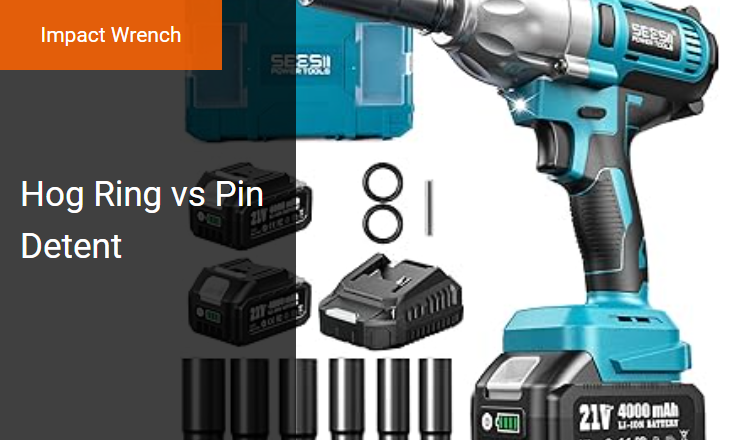
Few things disrupt a high-torque fastening job faster than a socket that constantly slips off your impact wrench-or, conversely, one that requires a hammer and drift pin just to release.
While buyers typically prioritize standard specifications like peak torque and battery ecosystems, they often overlook the critical connection point: the anvil. Choosing the right socket retention mechanism is vital because it grants operators seamless control over their workflow efficiency and safety.
However, we must stipulate that there is no one-size-fits-all solution; the ideal choice depends entirely on your specific application. For instance, commercial automotive technicians require rapid socket swaps, whereas structural steel erectors need the absolute security of a locked-on socket at heights.
This article compares Hog Ring (friction ring) and Pin Detent anvils across key metrics-durability, retention strength, and ease of use-to help you make the optimal choice for your toolbox.
| Factor | Summary |
|---|---|
| Retention Mechanism | The hog ring utilizes a friction-based split ring on the anvil to hold sockets, whereas the pin detent relies on a spring-loaded pin that engages with a matching recess in the socket drive. |
| Socket Change Efficiency | Hog ring anvils facilitate rapid, tool-free socket swaps, whereas pin detent systems require a pin-release tool or thin object to depress the locking pin for socket removal. |
| Working Safety | Pin detent mechanisms provide a secure positive lock that prevents sockets from falling, making them ideal for high-elevation scaffolding work where dropped objects are a critical hazard. |
| Wear and Longevity | The elastomeric O-ring and metal ring of a hog ring anvil suffer from mechanical wear and require periodic replacement, while the internal spring of a pin detent anvil generally boasts a longer service life. |
| Socket Compatibility | Pin detent anvils require specific impact-rated sockets featuring a retention hole aligned with the pin, whereas hog ring anvils are universally compatible with standard impact sockets. |
| Target Applications | Automotive technicians prefer hog ring impact wrenches for frequent socket size transitions, whereas industrial construction workers favor the safety of pin detent systems. |
Tool-Free Socket Changes with Hog Ring Anvils
When selecting an impact wrench, the choice of anvil type significantly affects workflow efficiency. Hog ring anvils utilize a friction ring to facilitate rapid, tool-free socket changeover. This design relies on a split-ring mechanism that holds the socket in place through friction, allowing operators to swap socket sizes quickly by hand without the need for additional alignment or pin-depressing tools.
Conversely, pin detent systems employ a spring-loaded pin that fits into a matching hole in the socket, offering a highly secure attachment that prevents accidental slippage during heavy vibration. Automotive technicians and general mechanics who frequently switch socket sizes throughout the day are ideal candidates for the hog ring, while steel erectors and utility workers operating at heights prefer the pin detent for its absolute safety and retention.
Pin Detent System Locking Mechanism
When selecting an impact wrench, the choice between a hog ring and a pin detent anvil significantly impacts socket security and workflow efficiency. Pin detent systems employ a spring-loaded pin to provide positive lock engagement with the socket retention hole. This mechanism ensures maximum safety, virtually eliminating the risk of sockets slipping off during high-vibration operations or overhead work.
Conversely, hog ring anvils utilize a friction ring to hold accessories in place, allowing for rapid, tool-free socket changes. While this friction-based system offers convenience, it lacks the absolute locking security provided by the pin mechanism. Hog ring models are ideal for automotive technicians who change socket sizes frequently throughout the day, whereas pin detent models are best suited for industrial operators and construction workers who prioritize absolute socket retention and safety at elevated heights.
O-Ring Wear Reduces Friction Ring Retention
When selecting an impact wrench anvil, the choice between a hog ring and a pin detent system significantly affects socket retention and tool longevity. Hog rings, or friction rings, utilize an elastomer O-ring beneath a split metal ring to hold sockets in place. Over time, this elastomer experiences mechanical wear from repeated friction, which reduces the retention force and necessitates periodic replacement to prevent sockets from falling off.
The pin detent system employs a spring-loaded pin that locks securely into a matching socket hole, offering superior retention and resistance to wear. Automotive technicians requiring rapid, frequent socket changes typically choose the hog ring system, whereas utility workers and heavy industrial operators prioritizing absolute socket security under high-vibration conditions are best suited for the pin detent design.
Tool Required for Pin Detent Socket Decoupling
When selecting an impact wrench, the choice between a hog ring and a pin detent anvil significantly impacts workflow efficiency. The hog ring, or friction ring, facilitates rapid, tool-free socket changes by allowing the user to simply pull the socket on and off. In contrast, the pin detent mechanism utilizes a spring-loaded pin that securely locks the socket into place, requiring a manual release tool, such as a pin punch or a thin rod, to depress the pin before the socket can be decoupled.
This structural distinction dictates the ideal environment for each anvil type. Automotive mechanics who frequently swap socket sizes throughout the day benefit most from the quick-change capability of the hog ring, whereas structural steelworkers and technicians working at heights require the secure, positive lock of the pin detent to prevent dangerous socket drops.
Pin Detent Anvils for Safe Overhead Fastening
When selecting an impact wrench, the choice between a hog ring and a pin detent anvil directly impacts jobsite safety and efficiency. For overhead structural fastening applications, safety regulations and strict risk-management protocols mandate the use of pin detent anvils. This design utilizes a spring-loaded pin to lock the socket securely in place, preventing hazardous socket drops from high elevations.
Hog ring anvils rely on friction, allowing operators to change sockets quickly by hand, which is highly efficient for ground-level tasks. In contrast, pin detent systems require a tool to release the socket, offering maximum retention under heavy vibration. High-elevation ironworkers require the absolute security of pin detents, while automotive technicians benefit from the rapid socket swaps of hog rings.
Hog Rings Enable Any-Angle Socket Engagement
Impact wrench anvils typically feature either a hog ring or a pin detent system to secure socket attachments. The hog ring configuration is highly valued for its efficiency, as it allows socket engagement at any angular orientation on the drive square. Operators can press the socket onto the anvil immediately without aligning a specific retention hole, significantly reducing downtime during multi-step fastening applications.
The pin detent system utilizes a spring-loaded pin that must align precisely with the matching hole in the socket wall. This mechanism provides an exceptionally secure lock that prevents sockets from detaching under heavy vibration. Hog ring tools are ideal for automotive technicians who change socket sizes frequently, while pin detent models are suitable for structural ironworkers who prioritize safety and socket retention when working at heights.
Stress Concentration in Pin Detent Anvils Under Torque
When selecting an impact wrench, the choice between a hog ring and a pin detent anvil significantly affects durability and socket retention. Pin detent anvils utilize a spring-loaded pin securing mechanism, which requires drilling a cross-hole through the anvil. Under high shear torque, this cross-hole acts as a stress concentration point, potentially compromising the structural integrity of the metal over time.
Hog ring anvils employ a friction ring that maintains a solid steel profile, offering superior resistance to heavy, repetitive torque spikes. Hog rings are ideal for automotive technicians who change sockets frequently, whereas pin detents suit industrial millwrights who require secure, semi-permanent socket attachment at height.
Leave a comment