
Selecting the wrong fastening tool often leads to stripped fasteners, damaged workpieces, and hours of wasted labor on stubborn, seized bolts. Before upgrading, many tradespeople and DIYers rely on standard tool investments-such as traditional cordless drills or manual socket sets-assuming these baseline workshop acquisitions can handle any heavy-duty task.
However, stepping up to a dedicated high-torque square-drive impact wrench grants users an unparalleled mechanical advantage, breaking free stubborn fasteners in seconds. To manage expectations, we must stipulate that raw power requires precise control; excessive torque without proper handling can easily shear bolt heads. This balance is critical in demanding projects like automotive suspension teardowns or structural steel assembly.
This article will contrast the impact wrench with the impact driver, analyze which tool best suits your specific projects, and share advanced techniques to help you master high-torque square-drive applications.
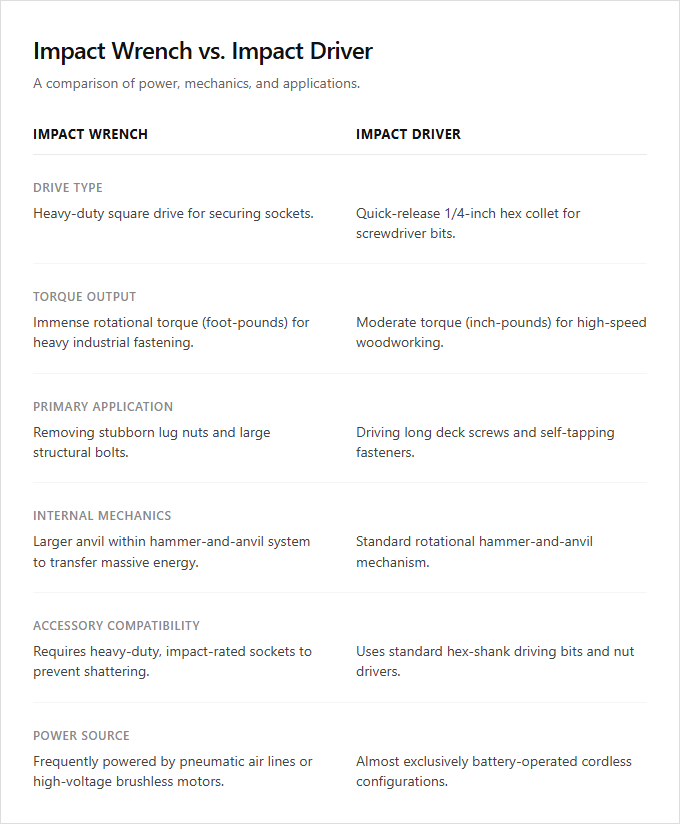
| Factor | Summary |
|---|---|
| Drive Type | An impact wrench features a heavy-duty square drive for securing sockets, whereas an impact driver utilizes a quick-release 1/4-inch hex collet for driving screwdriver bits. |
| Torque Output | Impact wrenches deliver immense rotational torque measured in foot-pounds for heavy industrial fastening, while impact drivers produce moderate torque measured in inch-pounds for high-speed woodworking applications. |
| Primary Application | The primary application of an impact wrench is removing stubborn lug nuts and large structural bolts, whereas an impact driver is optimized for driving long deck screws and self-tapping fasteners. |
| Internal Mechanics | Regarding internal mechanics, both tools utilize a rotational hammer-and-anvil mechanism, but the impact wrench features a larger anvil to transfer massive kinetic energy impulses. |
| Accessory Compatibility | Impact wrenches require heavy-duty, impact-rated sockets to prevent shattering under load, whereas impact drivers typically use standard hex-shank driving bits and nut drivers. |
| Power Source | In terms of power source, high-end impact wrenches are frequently powered by pneumatic air lines or high-voltage brushless motors, while impact drivers are almost exclusively battery-operated cordless tools. |
Impact Wrench vs. Driver: Anvil and Collet Differences
While impact wrenches and impact drivers appear similar, their output mechanisms serve distinct mechanical purposes. Impact wrenches utilize a heavy-duty square drive anvil, typically in half-inch or three-quarter-inch sizes, designed to transfer massive torque directly to heavy sockets without slipping. In contrast, impact drivers feature a quarter-inch hex collet engineered for quick-change driver bits, prioritizing speed and rotational control for driving fasteners.
The robust square drive of the wrench handles high-torque demands like structural bolting and automotive chassis work, while the hex collet of the driver excels in precision fastening. Heavy-duty mechanics and industrial technicians require the brute force of an impact wrench, whereas carpenters, cabinet makers, and DIY enthusiasts are better suited for the versatile control of an impact driver.
Impact Wrench vs. Impact Driver: Torque Comparison
While impact wrenches and impact drivers share a similar internal mechanism, their power outputs serve vastly different applications. The primary distinction lies in their torque capabilities. Impact wrenches are engineered to deliver massive breakaway torque measured in foot-pounds, which is essential for loosening seized fasteners and handling heavy-duty bolted joints. In contrast, impact drivers utilize lower rotational torque measured in inch-pounds, prioritizing speed and control to prevent over-tightening.
The choice between these tools depends entirely on the scale of your project. Automotive mechanics and heavy equipment technicians require the immense power of the impact wrench for chassis and suspension work, whereas carpenters, general contractors, and DIY homeowners benefit most from the precision of the impact driver for fastening screws and light-duty drilling.
Pair High-Torque Wrenches with Chrome Molybdenum Sockets
While both tools utilize rotational impacts to deliver high torque, the impact wrench and impact driver serve distinct mechanical purposes. The high-torque, square-drive impact wrench is engineered for heavy-duty fastening and must be paired exclusively with Chrome Molybdenum (Cr-Mo) impact-rated sockets. Standard chrome vanity sockets lack the ductility required to withstand these intense concussive forces and will fracture under the extreme rotational load.
In contrast, the impact driver features a quarter-inch hex collet designed for driving screws and smaller fasteners with high speed and moderate torque. Heavy-duty mechanics and structural steelworkers require the immense power of the impact wrench for securing large bolts, whereas carpenters and cabinet installers are better suited to the precision and rapid fastening of the impact driver.
Anvil Retention: Hog Rings vs. Detent Pins
While impact drivers utilize a quarter-inch hex chuck for driving screws, impact wrenches employ a square-drive anvil designed for heavy-duty fastening. The anvil retention mechanism on a square-drive impact wrench typically uses either a friction hog ring for quick socket changes or a detent pin for secure retention.
The friction hog ring allows operators to swap sockets rapidly with a simple pull, maximizing efficiency during repetitive tasks. The detent pin system requires a manual tool to release the socket, offering maximum security against accidental detachment. Automotive mechanics who frequently switch socket sizes benefit most from the hog ring, whereas structural steelworkers working at heights require the absolute security of the detent pin.
How Impact Wrenches Loosen Seized Fasteners
While both tools deliver high torque, the impact wrench is engineered for heavy-duty applications. It utilizes a robust rotary hammer and anvil mechanism that generates extreme rotational impacts per minute. This powerful mechanical delivery is specifically optimized for breaking free stubborn, rusted, or seized fasteners that standard tools cannot budge.
In contrast, the impact driver features a lighter mechanism designed for driving screws and smaller fasteners into wood or metal. Heavy-duty automotive mechanics and industrial technicians require the immense torque of an impact wrench, whereas carpenters, general contractors, and DIY enthusiasts are better served by the versatility and precision of an impact driver.
How Professional Impact Wrenches Maintain High Torque
While both tools deliver rotational force coupled with concussive blows, impact wrenches and impact drivers serve distinct operational demands. Professional-grade high-torque impact wrenches utilize brushless motors or pneumatic power to maintain sustained torque output, making them indispensable for heavy-duty industrial fastening. These robust tools feature a square drive designed for large sockets, delivering massive force to loosen seized fasteners and secure structural steel.
Impact drivers utilize a quarter-inch hex collet to drive screws and smaller fasteners with high rotational speed and moderate torque. Heavy-duty mechanics and industrial assemblers require the immense power of an impact wrench, whereas carpenters, electricians, and DIY enthusiasts are better suited to the precision and control of an impact driver.
Mastering Impact Wrenches: Preventing Fastener Shearing
While both impact drivers and impact wrenches employ rotational blows to deliver high torque, their operational capacities differ significantly. The impact wrench is engineered for heavy-duty industrial fastening, delivering immense force that requires careful regulation. Mastering this high-torque power tool requires utilizing variable-speed triggers and electronic torque settings to prevent shearing high-tensile fasteners during assembly.
Conversely, the impact driver features a quarter-inch hex collet optimized for driving screws and lighter fasteners. Home DIYers and finish carpenters are best suited for the precision of the impact driver, while industrial mechanics and heavy equipment technicians require the raw power of the impact wrench.
Leave a comment