
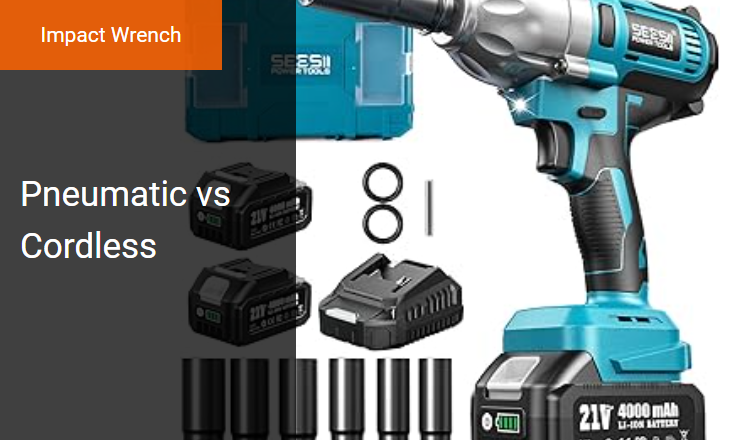
Selecting the right impact wrench often presents a frustrating compromise between raw torque output and operational mobility. For industrial operators and automotive technicians alike, choosing an incompatible platform leads to costly workflow bottlenecks and excessive operator fatigue.
Traditionally, facility managers bridge this capability gap by relying on established infrastructure, such as central shop-compressor lines or standard AC electrical grids. However, properly aligning your tool selection to your specific workflow grants unparalleled mechanical advantage and immediate labor savings. It is important to stipulate that peak torque specifications alone do not dictate real-world performance; factors like pneumatic CFM supply and battery thermal limits must also be managed. For instance, heavy-duty fleet maintenance facilities historically favor pneumatic systems, whereas mobile roadside service crews increasingly rely on high-output cordless platforms.
This article analyzes pneumatic and cordless impact wrenches, evaluating their torque-to-weight ratios, duty cycles, and long-term cost of ownership to guide your purchasing decision.
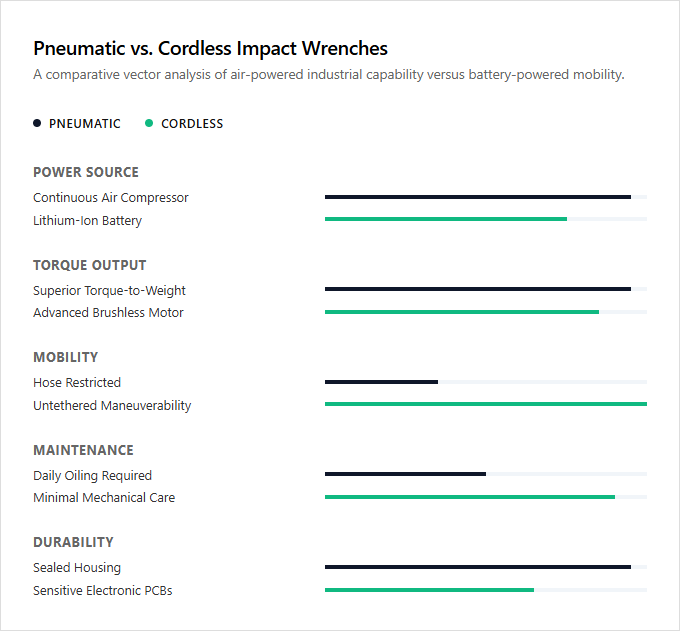
| Factor | Summary |
|---|---|
| Power Source | Pneumatic impact wrenches rely on a continuous supply of compressed air from an external compressor, whereas cordless models utilize high-capacity lithium-ion batteries for portable energy storage. |
| Torque Output | Pneumatic wrenches generally offer a superior torque-to-weight ratio for heavy-duty industrial applications, while modern cordless wrenches leverage advanced brushless motors to achieve comparable rotational force. |
| Mobility | Cordless wrenches provide unrestricted maneuverability for untethered operation in tight spaces, whereas pneumatic tools are limited by the physical constraints and weight of an air hose. |
| Maintenance | Pneumatic tools require daily lubrication with pneumatic tool oil to prevent wear on internal rotors, while cordless models require minimal mechanical maintenance but necessitate battery duty-cycle management. |
| Durability | Pneumatic wrenches feature a highly durable, sealed housing with a high duty cycle suitable for harsh environments, whereas cordless alternatives contain sensitive electronic printed circuit boards that are more vulnerable to moisture and impacts. |
Powerful, Lightweight Pneumatic Wrenches for Industrial Use
When selecting industrial impact wrenches, the choice between pneumatic and cordless models depends heavily on the demands of the work environment. Pneumatic impact wrenches deliver a superior power-to-weight ratio, making them highly efficient for prolonged, high-intensity industrial use. Because they rely on an external air supply rather than an onboard motor and battery, these tools remain lightweight and run cool during continuous operation.
Cordless impact wrenches offer excellent mobility by eliminating restrictive air hoses. Although battery-powered models provide impressive torque, the added weight of the battery pack can increase operator fatigue during extended shifts. High-volume automotive mechanics and industrial assembly technicians require the relentless endurance of pneumatic systems, while mobile service operators and construction contractors are best served by the portable flexibility of cordless designs.
Portable Lithium-Powered Cordless Impact Wrenches
Pneumatic impact wrenches have long been the industry standard for high-torque applications, relying on a continuous supply of compressed air to deliver consistent power. However, modern cordless impact wrenches offer a highly competitive alternative by utilizing high-voltage lithium-ion battery platforms. These advanced battery systems provide maximum portability, allowing technicians to operate efficiently without the constraints of air hoses or stationary compressors.
While pneumatic models offer an exceptional power-to-weight ratio and infinite runtime, cordless units now rival their torque output due to advancements in brushless motor technology. Pneumatic tools remain ideal for industrial assembly lines and heavy-duty automotive shops with established air infrastructure, whereas cordless models are best suited for mobile mechanics, roadside assistance teams, and operators requiring maximum agility across various work sites.
Continuous CFM for Peak Pneumatic Torque
Selecting between pneumatic and cordless impact wrenches requires balancing raw power against mobility. Pneumatic impact wrenches are renowned for their high power-to-weight ratio, but their performance depends entirely on the air supply. To maintain peak torque output, these systems require continuous and stable air volume delivery, measured in Cubic Feet per Minute (CFM). Any restriction in air flow or drop in CFM directly diminishes the tool's fastening capabilities, making a heavy-duty compressor infrastructure essential.
Cordless impact wrenches deliver superior mobility by eliminating hoses and external power sources altogether. While modern battery technology provides impressive torque, performance can gradually decline as the battery charge depletes. Stationary automotive technicians in fully equipped service bays benefit most from the consistent power of pneumatic tools, while mobile roadside mechanics and field technicians require the unrestricted portability of cordless models.
Advanced Brushless Cordless Tools with Smart Control
Choosing between pneumatic and cordless impact wrenches depends on the specific operational environment and performance requirements. While pneumatic models offer continuous power from an air compressor, modern cordless impact wrenches feature advanced brushless motors. These digital systems integrate electronic speed and torque management, allowing users to precisely program fastening parameters to prevent over-tightening and material damage.
Pneumatic alternatives deliver a superior power-to-weight ratio for stationary workshop environments without the added weight of a battery. In contrast, cordless options provide unmatched mobility and intelligent control for on-the-go applications. Pneumatic wrenches are ideal for stationary automotive technicians requiring relentless high-duty-cycle power, whereas cordless models best suit mobile mechanics and field technicians who prioritize portability and precise torque control.
Pneumatics Eliminate Thermal Overload in Continuous Fastening
When selecting an impact wrench for high-duty cycles, power delivery and thermal management are critical factors. Pneumatic impact wrenches excel in continuous-use environments because they rely on compressed air rather than internal electric motors. This mechanical design eliminates the risk of electric motor thermal overload during continuous fastening, allowing operators to run the tool indefinitely under heavy loads without performance degradation.
In contrast, cordless impact wrenches offer unmatched mobility and eliminate air hose hazards, though their electric motors and lithium-ion batteries require monitoring during prolonged, high-torque applications to prevent heat buildup. Industrial mechanics requiring uninterrupted power for heavy assembly thrive with pneumatic systems, whereas mobile technicians and roadside assistance operators benefit most from the portability of cordless models.
Low Battery Reduces Impact Wrench Breakaway Torque
When comparing pneumatic and cordless impact wrenches, power consistency remains a critical differentiator. Pneumatic models deliver sustained, unchanging torque as long as the air compressor maintains its pressure. In contrast, cordless impact wrenches experience a gradual reduction in breakaway torque as the battery charge depletes, meaning their maximum fastening and loosening power decreases during extended work sessions.
While cordless options offer unmatched mobility and eliminate hose clutter, they require managed charging cycles to maintain peak performance. Industrial shop mechanics requiring continuous, high-torque output for heavy-duty assembly benefit most from pneumatic systems, whereas mobile service technicians and roadside assistance operators favor the portable convenience of cordless models.
Inline Lubrication for Pneumatic Tool Protection
When selecting between pneumatic and cordless impact wrenches, the power source dictates both performance and maintenance requirements. Pneumatic models deliver exceptional power-to-weight ratios but depend on a continuous compressed air supply. To ensure tool longevity, these air-powered systems require consistent inline lubrication to protect the delicate internal rotary vane mechanism from friction, heat, and moisture-induced wear.
Cordless impact wrenches utilize advanced battery technology, eliminating air hoses and the need for daily oiling. While battery packs add to the tool's overall weight, modern brushless motors offer impressive torque alongside superior on-site portability. Stationary automotive technicians in fully equipped workshops favor the high endurance of pneumatic systems, while mobile mechanics and utility workers benefit most from the cord-free flexibility of battery-powered models.
Leave a comment