
Every professional tradesperson has experienced the frustration of a drill bit slipping mid-cut, marring the workpiece and damaging the tool shank under heavy load. To prevent this, operators often rely on standard high-voltage drills or default hand-tightening methods, assuming raw motor power is the ultimate solution to bit slippage.
However, optimizing your tool's interface grants you the critical advantage of maximum torque transfer, ensuring safer, more efficient drilling. It is important to stipulate that while modern keyless chucks offer unmatched speed during bit changes, high-torque tasks have rigid physical requirements. For example, running a heavy-duty hole saw through structural steel or driving large self-feeding spade bits requires an unyielding grip that hand-tightening cannot sustain.
Below, we will analyze the engineering differences between keyless and keyed chucks, evaluate their respective clamping mechanics, and provide a definitive guide to selecting the optimal system for your high-torque applications.
| Factor | Summary |
|---|---|
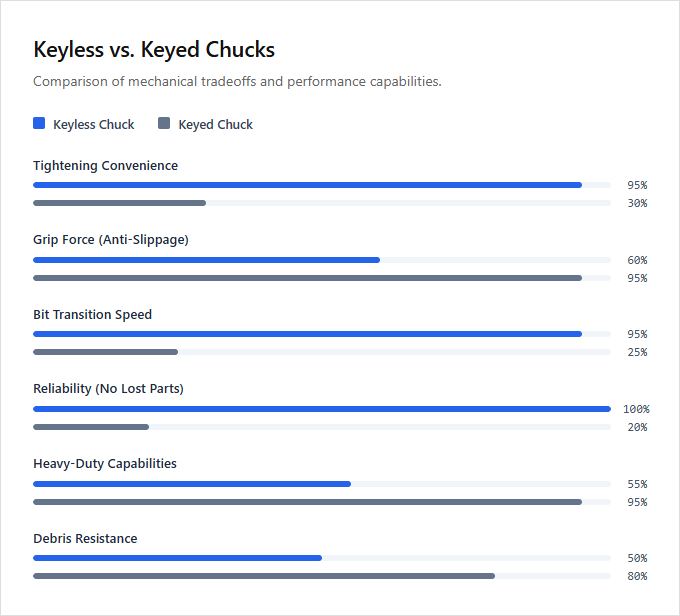
| Tightening Mechanism | While a keyed chuck utilizes a geared chuck key to mechanically tighten the jaws, a keyless chuck relies on manual hand-tightening torque to secure the accessory. |
| Bit Slippage | Keyed chucks provide superior gripping force that prevents rotational slippage under high-torque applications, whereas keyless chucks are more prone to shank slippage under heavy loads. |
| Operational Efficiency | Keyless chucks drastically reduce downtime by allowing rapid, tool-free bit transitions, unlike the slower manual adjustment required by a keyed mechanism. |
| Risk of Tool Loss | Operating a keyed chuck introduces the risk of misplaced chuck keys which can halt productivity, a failure mode completely mitigated by the integrated collar of a keyless spindle design. |
| Heavy-Duty Performance | Keyed chucks are highly preferred for rigorous stationary drilling presses and impact-heavy masonry work due to their robust mechanical locking capability. |
| Debris Resistance | The enclosed sleeve design of keyless chucks is often more susceptible to internal grit contamination, whereas the open gear teeth of keyed chucks are easier to clear of abrasive construction debris. |
Mechanical advantage of geared key tightening
When selecting a drill, the primary distinction lies between keyless and keyed chucks. Keyed chucks utilize a geared key to tighten the jaws around the drill bit. This geared mechanism provides a significant mechanical advantage, multiplying manual torque to generate an immense gripping force that prevents bit slippage during high-resistance drilling applications.
In contrast, keyless chucks rely entirely on manual hand-tightening, which prioritizes speed but lacks the mechanical leverage of a geared system. Keyed chucks are highly suited for industrial operators performing heavy-duty, high-torque tasks, while keyless chucks are ideal for general contractors and DIY enthusiasts who require frequent, rapid bit changes.
Dynamic rotational slippage prevention under heavy loads
When operating under heavy rotational loads, the mechanical advantage of a keyed chuck provides superior resistance against dynamic slippage. The manual key allows operators to apply high torque directly to the chuck jaws, locking the drill bit securely in place. This positive mechanical engagement ensures the bit remains stationary within the chuck during demanding, high-torque drilling tasks in dense materials.
In contrast, modern keyless chucks utilize hand-tightening mechanisms, often paired with an automatic spindle lock, offering rapid bit changes. While highly efficient, they can occasionally slip under extreme resistance compared to their keyed counterparts. Keyed chucks are ideal for heavy-duty industrial operators requiring maximum grip reliability, whereas keyless chucks suit general contractors and DIY enthusiasts prioritizing speed and convenience.
Micro-vibration resistance of keyed locking systems
In high-torque drilling applications, the mechanical advantage of a keyed chuck provides superior resistance to micro-vibrations. High-frequency oscillations generated during heavy-duty masonry or metal drilling can cause standard keyless chucks to gradually back off and loosen. A keyed locking system utilizes a physical gear-and-pinion mechanism to exert immense, uniform clamping force, ensuring the drill bit remains securely locked despite sustained, intense vibrations.
While keyless chucks rely on hand-tightening torque for rapid bit changes, they lack the positive locking mechanism needed to withstand severe axial forces over prolonged periods. Keyless chucks are ideal for DIY enthusiasts and general contractors performing frequent bit swaps on light-to-medium tasks, whereas keyed chucks are best suited for industrial operators and heavy-duty masonry workers requiring maximum slip prevention under extreme loads.
Maximum clamping torque limits at the jaw-to-shank interface
Keyed chucks utilize a mechanical key to leverage gear teeth, delivering exceptionally high clamping torque at the jaw-to-shank interface. This positive mechanical engagement prevents drill bit slippage during high-stress applications, such as boring through dense metals or masonry.
Keyless chucks rely on manual hand-tightening force, sometimes assisted by an internal ratcheting mechanism. While advantageous for rapid transitions, their maximum clamping torque at the interface is inherently lower, which can lead to rotational slippage under extreme resistance.
Heavy-duty construction professionals requiring maximum torque transmission benefit most from keyed chucks, whereas general contractors and DIY enthusiasts prioritizing speed and convenience are ideal users for keyless chucks.
Carbide jaw insert integration for enhanced surface friction
The choice between keyless and keyed drill chucks often hinges on the grip strength required for high-torque applications. Modern high-performance chucks of both types increasingly integrate carbide jaw inserts. These brazed carbide inserts significantly enhance surface friction against the drill bit shank, preventing slippage under heavy loads and reducing wear on the chuck jaws themselves.
While keyless chucks offer rapid, hand-tightened bit changes, keyed chucks utilize a mechanical key to provide maximum tightening torque, which is further optimized by the carbide gripping surfaces. High-torque keyed chucks with carbide inserts are ideal for industrial machinists performing heavy-duty, repetitive metal drilling, whereas carbide-integrated keyless chucks best serve busy contractors who require both rapid bit transitions and professional-grade holding power.
Concentricity and radial runout tolerances under high axial thrust
Keyed chucks provide exceptional mechanical advantage through manual gear tightening, which maintains strict concentricity and minimizes radial runout under heavy axial thrust. In high-load operations where the drill is subjected to intense downward pressure, this mechanical lock prevents the jaws from slipping, ensuring precise rotation and preventing bit deviation.
Keyless chucks rely on hand-tightening torque or internal clutching mechanisms. Under extreme axial thrust, these systems can experience minor jaw displacement, resulting in higher radial runout than their keyed counterparts. Keyed chucks suit industrial machinists and structural fabricators requiring maximum precision under high loads, while keyless chucks are ideal for contractors and DIY enthusiasts prioritizing rapid bit changes for general-duty tasks.
Self-tightening mechanism dynamics in premium keyless designs
Keyed chucks rely on manual leverage to secure drill bits, offering robust torque resistance. Conversely, modern keyless chucks utilize advanced engineering to match this holding power. Premium keyless designs feature an internal self-tightening mechanism where the resistance of the drilling application itself forces the chuck jaws to grip tighter. This dynamic system utilizes the rotational force of the drill to continuously increase grip intensity during operation, preventing bit slippage under heavy loads.
While keyed chucks remain the benchmark for high-torque stationary applications, premium keyless options provide comparable reliability with superior efficiency. Keyed chucks are ideal for traditional machinists requiring maximum static security, whereas premium keyless designs suit fast-paced contractors and DIY enthusiasts who demand rapid bit changes without sacrificing grip strength.
Leave a comment