
For tradespeople and DIY enthusiasts alike, few setbacks are more frustrating than a cordless drill losing torque mid-task or dying before the job is complete. To combat this, operators traditionally rely on purchasing higher-voltage models or maintaining a costly rotation of spare batteries.
However, optimizing your tool's output requires a deeper look; mastering battery chemistry is what truly grants users maximum runtime and sustained torque. While Lithium-Ion (Li-Ion) and Nickel-Cadmium (NiCd) both drive heavy-duty drilling, their efficiency rests on a critical stipulation: performance is strictly dictated by discharge rates and thermal tolerance. For example, a Li-Ion pack delivers fade-free power until depletion, whereas a NiCd cell handles extreme temperatures better but suffers from capacity-limiting "memory effect."
This article compares the electrochemistry of Li-Ion and NiCd, evaluates their performance under heavy load, and outlines how to choose the right battery platform to maximize your cordless drill's efficiency.
| Factor | Summary |
|---|---|
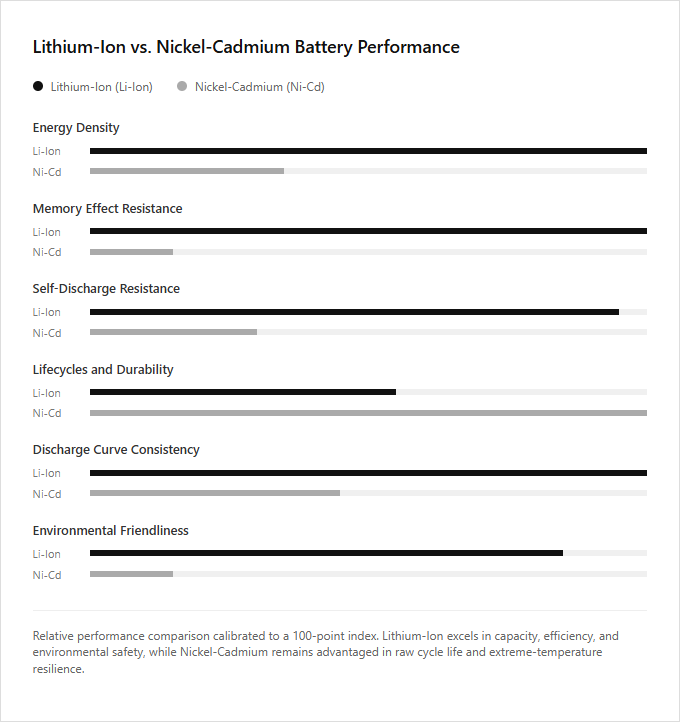
| Energy Density | Lithium-Ion batteries offer a much higher energy density compared to Nickel-Cadmium, allowing drill power tools to be lighter and more compact while delivering equivalent power. |
| Memory Effect | Nickel-Cadmium batteries suffer from voltage depression, commonly known as the memory effect, which permanently reduces their charge capacity if they are repeatedly recharged before being fully discharged. |
| Self-Discharge Rate | Lithium-Ion batteries have a remarkably low self-discharge rate, meaning a cordless drill will retain most of its charge even after sitting idle in a toolbox for months. |
| Lifecycles and Durability | Nickel-Cadmium batteries can withstand a higher number of charge-discharge cycles and perform better in extreme thermal environments than their Lithium-Ion counterparts. |
| Discharge Curve | Lithium-Ion batteries maintain a flat discharge curve to provide consistent voltage and maximum drill speed until the cell is completely depleted, whereas Nickel-Cadmium batteries suffer from gradual power fade during use. |
| Environmental Impact | Nickel-Cadmium batteries contain toxic heavy metals that pose severe ecological hazards, requiring strict recycling procedures that are less critical for relatively safer Lithium-Ion chemistry. |
How Lithium-Ion Reduces Cordless Drill Weight
When selecting cordless drill power tools, the battery chemistry is a critical factor influencing both performance and ergonomics. Lithium-ion technology provides a significantly higher specific energy density compared to nickel-cadmium. This chemical advantage allows lithium-ion batteries to store more energy in a smaller footprint, drastically reducing the overall weight of the cordless drill and minimizing operator fatigue during prolonged use.
In contrast, nickel-cadmium batteries are heavier and exhibit a lower energy density, though they maintain a reputation for durability in extreme temperatures. Modern cordless drills favor lithium-ion for its lack of memory effect and consistent power delivery throughout the charge cycle. Professionally active contractors benefit most from lightweight lithium-ion drills for daily overhead tasks, while budget-conscious DIY hobbyists undertaking occasional heavy-duty projects in cold environments may still find value in robust nickel-cadmium alternatives.
NiCd Suffers Memory Effect, Li-Ion Does Not
When selecting cordless drill power tools, understanding battery chemistry is crucial for long-term performance. Nickel-Cadmium (NiCd) batteries are durable but suffer from voltage depression caused by the memory effect. This phenomenon occurs when a battery is repeatedly recharged before being fully discharged, causing the cell to limit its maximum energy capacity. Lithium-Ion (Li-Ion) technology remains unaffected by this memory effect, allowing users to charge the battery at any stage of discharge without degrading its performance.
Lithium-Ion batteries also offer a higher energy density and a lower self-discharge rate compared to Nickel-Cadmium options. NiCd batteries are best suited for budget-conscious professionals working in extreme temperature environments, while Li-Ion batteries are ideal for active contractors and DIY enthusiasts who require lightweight, low-maintenance tools with consistent power delivery.
Lithium-Ion: Always Ready After Long Storage
When selecting a cordless drill, the battery chemistry determines both performance and operational readiness. Lithium-ion technology features a much lower self-discharge rate compared to Nickel-Cadmium. This key advantage allows a Lithium-ion drill to retain its charge and remain ready for immediate use even after months of storage, whereas Nickel-Cadmium batteries lose their charge rapidly when left idle.
Beyond charge retention, Lithium-ion batteries offer a higher energy density, resulting in a lighter tool weight and a longer overall lifespan. Nickel-Cadmium batteries, while heavier and subject to memory effect, provide robust durability in extreme temperatures and high-drain applications. Lithium-ion drills are ideal for occasional DIY users who require a dependable tool ready at a moment's notice, while Nickel-Cadmium models remain suitable for budget-conscious professionals working daily in demanding, heavy-duty environments.
Lithium-Ion: Consistent Torque Until Depletion
When selecting battery technology for cordless drills, the choice between Lithium-Ion (Li-Ion) and Nickel-Cadmium (Ni-Cad) significantly impacts performance. Lithium-ion batteries excel due to their flat discharge curve. Unlike legacy chemistries, a Li-Ion drill delivers consistent voltage and maximum torque throughout the entire charge cycle. The tool operates at peak efficiency until the battery is completely depleted, preventing the gradual loss of drilling power during operation.
In contrast, Nickel-Cadmium batteries experience a steady decline in voltage as they discharge, resulting in a noticeable drop in drill torque during use. While Ni-Cad packs are highly durable and perform well in extreme temperatures, they are heavier and suffer from capacity loss over time. High-frequency professionals requiring sustained, fade-free power benefit most from Lithium-Ion, whereas budget-conscious users performing occasional, light-duty maintenance may find Nickel-Cadmium suitable.
Why Lithium-Ion Batteries Require Management Systems
When selecting battery technologies for cordless drills, the distinction between Lithium-Ion (Li-ion) and Nickel-Cadmium (Ni-Cd) lies in their energy density and safety architecture. Lithium-ion cells deliver high energy output but require an integrated battery management system (BMS) to actively regulate voltage and prevent thermal runaway during operation. This electronic circuitry ensures the tool operates within safe parameters, mitigating risks associated with overheating and overcharging.
Conversely, Nickel-Cadmium batteries rely on a simpler, chemically robust design that tolerates deep discharges without sophisticated monitoring, though they are heavier and subject to memory effect. Contractors demanding lightweight, fade-free performance for prolonged daily use will benefit most from Lithium-Ion drills, whereas occasional users seeking a durable, cost-effective tool for intermittent tasks in extreme temperatures are well-suited for Nickel-Cadmium models.
Nickel-Cadmium: High Surge, Rapid Voltage Drop
When selecting cordless drill power tools, understanding the electrochemical differences between Lithium-Ion and Nickel-Cadmium (NiCad) batteries is essential for optimal performance. Nickel-cadmium cells are engineered with an extremely low internal resistance, which allows them to deliver the high surge currents required for heavy-duty drilling tasks. However, this chemistry suffers from a rapid voltage drop during use, causing the tool's power to decrease abruptly rather than maintaining a steady output.
In contrast, Lithium-Ion batteries offer a much flatter discharge curve, providing consistent power throughout the cycle, alongside a higher energy density and lighter weight. Professional contractors facing demanding, high-torque applications often benefit from the rugged, high-discharge nature of Nickel-Cadmium, while DIY enthusiasts and general users typically prefer Lithium-Ion for its lightweight handling and steady performance during prolonged storage.
Lithium-Ion: Longer Lifespan Without Cadmium Toxicity
When selecting cordless drill power tools, the battery chemistry represents a critical decision point. Lithium-ion (Li-ion) technology has largely superseded Nickel-Cadmium (NiCad) due to its superior efficiency and energy density. Notably, lithium-ion cells deliver a significantly longer overall cycle life, enduring more charge-discharge cycles before capacity degrades. Furthermore, they eliminate the severe environmental hazards associated with cadmium toxicity, making them a more sustainable option for modern operations.
While NiCad batteries offer robust performance in extreme temperatures and high-current applications, they suffer from a "memory effect" and rapid self-discharge when idle. Lithium-ion batteries maintain their charge over extended periods of inactivity and provide consistent power output throughout the discharge cycle. Professionally active contractors benefit most from the lightweight reliability of lithium-ion, while budget-conscious DIY users seeking heavy-duty, cold-weather resilience may still find value in traditional NiCad options.
Leave a comment