
Achieving a flawless surface finish without sacrificing rapid material removal remains a persistent struggle for professional woodworkers and refinishers, who frequently battle costly swirl marks and surface gouges. While standard equipment funding sources often limit workshops to a single, multi-purpose sander, navigating the choice between geared and free-spinning designs requires a strategic understanding of tool mechanics.
Selecting the appropriate dual-action configuration grants operators the unique capability to transition seamlessly from aggressive stock leveling to ultra-fine, paint-ready finishing. Stipulation: achieving these results is strictly dependent on matching the pad's rotation mechanism to the specific density of your workpiece. Industry-standard benchmarks, such as the Festool Rotex series, prove that the right mechanism drastically reduces labor times.
This article provides an in-depth comparison of geared orbital and free-spinning random orbital sanders, analyzing their mechanical differences, removal rates, and finish qualities to guide your next tooling investment.
| Factor | Summary |
|---|---|
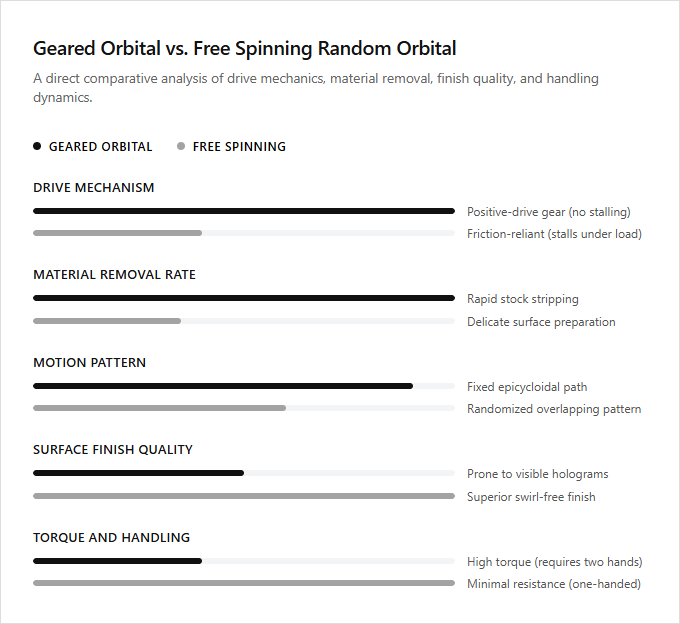
| Drive Mechanism | Geared orbital sanders utilize a positive-drive gear train to prevent pad stalling under load, whereas free-spinning random orbital sanders rely on friction and inertia which can cause rotation to stop under heavy pressure. |
| Material Removal Rate | Geared orbital models deliver a significantly higher rate of stock removal, making them ideal for rapid stripping, while free-spinning models excel at delicate, incremental surface preparation. |
| Motion Pattern | Geared orbit sanders trace a fixed epicycloidal path for consistent cutting, whereas free-spinning sanders produce an unpredictable, randomized overlapping pattern. |
| Surface Finish Quality | Free-spinning random orbital sanders are superior for achieving a swirl-free finish because their random scratch pattern minimizes visible holograms in the wood or paint. |
| Torque and Handling | Geared orbital sanders generate high rotational torque that requires two hands to control, while free-spinning sanders exhibit minimal resistance and allow for easy, one-handed operation. |
Forced Rotation Prevents Sander Pad Stalling
When selecting between sanders, the primary distinction lies in how the pad rotates under pressure. Free-spinning random orbital sanders rely on centrifugal force, which makes them susceptible to pad stalling when heavy downward pressure is applied. In contrast, geared orbital sanders utilize a forced rotation mechanism that mechanically drives both the orbital and rotational movements. This gear-driven design prevents pad stalling under load, ensuring consistent material removal and high efficiency even during demanding tasks.
While free-spinning models are highly regarded for producing swirl-free finishes on delicate surfaces, geared sanders offer superior aggression for rapid stock removal and leveling. Professional refinishers and boat builders tackling heavy-duty coating removal are best suited for the relentless power of geared orbital sanders, whereas fine woodworkers and hobbyists prioritizing ultra-smooth paint preparation will find the free-spinning random orbital sander ideal for their needs.
Random Orbital Motion for a Hologram-Free Finish
Choosing between a geared orbital sander and a free-spinning random orbital sander depends on the required balance of material removal and surface refinement. The primary advantage of the free-spinning design lies in its dual-action movement. Its random orbital motion creates a non-repetitive scratch pattern, which effectively prevents directional sanding marks to guarantee a hologram-free finish.
Geared orbital sanders employ a forced-rotation drive mechanism that maintains consistent rotation under load, preventing stalling during heavy pressure. This mechanical connection delivers aggressive cutting power but demands greater technique to avoid surface marring. Geared models are ideal for heavy-duty restoration specialists needing rapid paint or stock removal, whereas free-spinning sanders are best suited for finishing carpenters and automotive detailers aiming for flawless, high-gloss results.
Constant-Speed Gear Drive for Aggressive Stock Removal
In professional surface preparation, choosing between a geared orbital sander and a free-spinning random orbital sander is a matter of prioritizing speed versus finish. Geared orbital sanders utilize a forced rotation system where a gear-driven positive drive maintains a constant orbital stroke rate under load. This mechanical coupling ensures the pad never bogs down, delivering aggressive stock removal and rapid leveling of stubborn materials.
Free-spinning random orbital sanders rely on a centrifugal clutch, which allows the pad speed to vary based on downward pressure. This design greatly reduces the risk of gouging, making it highly effective for delicate final finishing. Heavy-duty restoration specialists and boat builders will benefit most from the relentless power of the geared orbital, while cabinetmakers and fine finishers will find the free-spinning model essential for achieving flawless surfaces.
Physics of Free-Spinning Sander Pad Rotation
Geared orbital sanders utilize a direct mechanical drive to force pad rotation, maintaining a consistent, aggressive removal rate even under heavy pressure. In contrast, free-spinning random orbital sanders rely on fluid physics during operation. Centrifugal force and inertia dictate the pad rotation speed of free-spinning sanders, as the offset counterweight flings the pad outward while inertia maintains the rotation until surface friction creates a stabilizing drag.
This dynamic friction-based mechanism prevents deep swirling marks by allowing the pad to stop spinning if too much downward pressure is applied. Professional carpenters and installers requiring rapid material removal on flat surfaces find geared orbital sanders indispensable, while automotive refinishers and hobbyists seeking a flawless, swirl-free finish on delicate veneers are best suited for free-spinning random orbital sanders.
Backing Plate Brake Prevents Startup Surface Gouging
Selecting between geared orbital and free-spinning random orbital sanders depends on the required material removal rate and finish quality. Geared orbital sanders utilize a driven rotation for aggressive stock removal, maintaining consistent movement under load. Conversely, free-spinning random orbital sanders rely on centrifugal force, which risks rapid pad rotation when lifted off the workpiece. To mitigate this risk, premium free-spinning models incorporate an integrated backing plate brake. This braking mechanism controls pad speed during tool startup, effectively preventing surface gouging when the sander first contacts the workpiece.
The choice between these two distinct mechanisms aligns with specific project demands and operator expertise. Geared orbital sanders are ideal for professional restorers requiring rapid material removal, whereas free-spinning models are best suited for woodworkers and refinishers seeking flawless, delicate finishes.
Controlling Lateral Pull in Geared Orbital Sanders
Geared orbital sanders utilize a direct gear connection that forces both rotation and oscillation simultaneously. This mechanical drive delivers high rotational torque, preventing the pad from stalling even under heavy downward pressure. Because of this continuous, powerful rotation, the tool exhibits a distinct lateral pull that requires active user guidance and physical control to maintain a steady path.
Free-spinning random orbital sanders rely on a bearing system where rotation is driven by centrifugal force and friction. This design eliminates aggressive lateral resistance, offering a smoother, self-regulating experience that requires very little steering effort. Geared orbital models are ideal for heavy-duty professionals requiring rapid stock removal, while free-spinning variants suit woodworking enthusiasts and finishers seeking effortless control and swirl-free final surfaces.
Orbit Diameter: Balancing Speed and Finish
When selecting a random orbital sander, the choice between geared orbital and free-spinning designs depends heavily on how the eccentric orbit diameter manages the balance between stock removal and surface finish. Geared orbital sanders utilize a forced-rotation drive that maintains a consistent, aggressive orbit size, preventing stalling under load to maximize cutting speed. Free-spinning models, conversely, rely on centrifugal force, allowing the orbit diameter to dynamically adjust and minimize aggressive cutting to ensure a smoother scratch pattern.
Larger eccentric orbit diameters in geared sanders excel at rapid material leveling, while smaller orbits in free-spinning units are designed for ultra-fine, swirl-free finishing. Geared orbital sanders are best suited for heavy-duty restoration professionals requiring rapid stock removal, whereas free-spinning random orbital sanders are ideal for woodworkers and automotive detailers aiming for a flawless, high-gloss final finish.
Leave a comment