
For industrial procurement managers and fabricators, premature motor burnout and frequent tool maintenance represent a persistent drain on jobsite productivity. Historically, operations have relied on standard capital funding sources to repeatedly replace worn-out tools and consumables, accepting operational downtime as an unavoidable cost of heavy-duty metalworking. However, transitioning to advanced tool architectures grants operators unprecedented runtime and thermal efficiency, fundamentally shifting the economics of fleet procurement.
As a crucial stipulation, realizing these efficiency gains requires matching the motor design to your specific operational demands; for example, high-torque brushless grinders excel in continuous-use masonry cutting, while brushed alternatives may still offer a cost-effective solution for intermittent metal polishing. This guide delivers a consultative comparative analysis of brushed versus brushless angle grinders. We will examine critical performance vectors-including heat dissipation, power-to-weight ratios, and total cost of ownership-to help you select the optimal tool configuration for maximum efficiency.
| Factor | Summary |
|---|---|
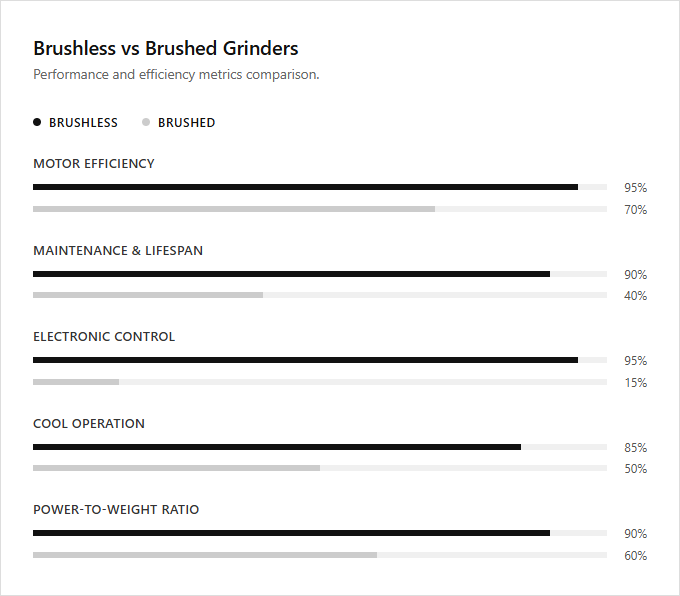
| Motor Efficiency | Brushless grinders achieve higher energy efficiency and run cooler because they eliminate the friction and voltage drop associated with physical carbon brushes. |
| Maintenance and Lifespan | Brushed grinders require periodic replacement of wearing parts, whereas brushless models feature an enclosed design that prevents ingress of abrasive dust, significantly extending the tool's duty cycle. |
| Electronic Control | Brushless grinders utilize an electronic commutator and microprocessor to continuously adjust power delivery based on real-time load feedback, preventing tool stalling. |
| Heat Generation | Without the friction of brushes sliding against a commutator, brushless motors generate significantly less thermal energy, reducing the risk of armature burnout during prolonged heavy-duty cutting. |
| Power-to-Weight Ratio | The absence of physical brushes and a mechanical commutator allows brushless grinders to deliver higher torque density in a much lighter, more compact tool footprint. |
Frictionless Commutation Eliminating Drag and Energy Loss
Selecting the right angle grinder requires understanding the underlying motor technology. Traditional brushed grinders rely on physical carbon brushes that press against a rotating commutator to deliver power. In contrast, brushless grinders employ an electronic controller to manage power distribution. This frictionless commutation replaces physical contact, effectively eliminating the mechanical drag and parasitic energy loss inherent in brushed systems.
By removing physical wear points, brushless motors operate cooler, maintain higher torque under load, and offer significantly longer lifespans with virtually zero maintenance. Brushed grinders remain a cost-effective alternative, though they require periodic brush replacements and experience reduced efficiency over time. Heavy-duty industrial operators requiring maximum runtime and zero maintenance will benefit most from brushless grinders, while budget-conscious DIYers or occasional users will find brushed models sufficient for sporadic tasks.
Phase and PWM Optimized Electronic Speed Controllers
Traditional brushed grinders rely on physical carbon brushes and mechanical commutation, which inherently limits energy efficiency and speed control. In contrast, brushless grinders employ advanced integrated electronic speed controllers that continuously optimize current phase alignment. By utilizing sophisticated pulse-width modulation (PWM), these controllers dynamically adjust power delivery to the stator coils based on real-time resistance, drastically reducing thermal energy waste and sustaining high torque under load.
While brushed models offer a cost-effective, straightforward design, brushless alternatives provide superior longevity and consistent performance under extreme operating conditions. Standard brushed units are highly suitable for occasional DIY hobbyists performing light-duty cutting, whereas brushless grinders are indispensable for industrial fabricators and professional contractors requiring relentless daily performance and smart power management.
Zero-Excitation Permanent Magnet Rotor Design
When comparing brushed and brushless angle grinders, the fundamental distinction lies in how electrical energy is converted into mechanical power. Traditional brushed grinders rely on carbon brushes and an electromagnetic armature, which requires a continuous excitation current to generate a magnetic field. This process inherently introduces friction, heat, and electrical resistance, leading to energy loss.
In contrast, brushless grinders employ a permanent magnet rotor design. By utilizing permanent magnets on the shaft, these tools eliminate the excitation current power consumption required by electromagnetic armatures. This engineering advancement ensures optimal energy efficiency, cooler operation, and significantly longer runtime per battery charge.
Heavy-duty industrial operators requiring continuous, high-efficiency performance will benefit most from brushless models, while occasional DIY users may find the lower initial cost of traditional brushed grinders sufficient for intermittent tasks.
Enhanced Cooling Limits Winding Resistance Under Continuous Load
In high-demand grinding applications, the primary differentiator between motor technologies lies in thermal management. Traditional brushed grinders generate substantial heat through physical friction between carbon brushes and the commutator. This elevated temperature increases the electrical resistance of the copper windings, which diminishes tool efficiency and performance under sustained load.
Brushless grinders eliminate this mechanical friction, allowing for vastly superior thermal dissipation. Because the stator windings remain cooler without the internal heat source of brushes, the tool prevents the escalation of copper resistance, maintaining consistent torque and power output during continuous loading.
Standard brushed grinders are highly suitable for budget-conscious DIY enthusiasts performing intermittent, light-duty tasks, while brushless grinders are the superior choice for professional fabricators and industrial operators requiring relentless, heavy-duty performance.
Sensor-Based Closed-Loop Torque-to-Speed Control
Brushless angle grinders represent a significant technological advancement over traditional brushed models, primarily due to their integration of smart electronic controls. Unlike brushed grinders that suffer from rotational drag and friction under heavy loads, brushless motors utilize advanced closed-loop feedback systems. These systems employ internal sensors to continuously monitor the spindle's speed, instantly adjusting the power input to maintain a constant torque-to-speed ratio even as the grinding workload fluctuates.
Brushed grinders lack this digital regulation, resulting in noticeable deceleration and increased heat generation when facing heavy resistance. The sensor-driven efficiency of brushless tools ensures optimal power delivery and a longer motor lifespan by preventing thermal overload. Brushed models are highly suitable for DIY hobbyists who require an affordable tool for occasional light utility work, whereas brushless grinders are engineered for professional fabricators and contractors who demand sustained performance and reliability under heavy daily workloads.
Eliminating Brush-Commutator Arcing and Voltage Drop
In angle grinders, the transition from brushed to brushless motor technology represents a significant engineering advancement. Brushed grinders rely on physical carbon brushes pressing against a rotating commutator to deliver electrical current. This interface inherently introduces a voltage drop due to contact resistance and generates ionization arcing, which wastes energy as heat and degrades internal components over time.
Brushless grinders eliminate the brush-commutator interface entirely, utilizing electronic controllers to manage the electromagnetic field. Removing this physical contact point prevents voltage drops and eradicates ionization arcing, resulting in cooler operation, higher torque efficiency, and a significantly longer tool lifespan. Heavy-duty industrial operators requiring continuous, high-demand performance benefit most from brushless models, while occasional DIY hobbyists may find the lower upfront cost of traditional brushed grinders sufficient for intermittent tasks.
Superior Power-to-Weight Ratio for Maximum Grinding Power
When comparing angle grinders, the distinction between brushless and brushed motors centers on efficiency and power delivery. Brushless grinders eliminate the friction and heat loss associated with physical carbon brushes. This design achieves a superior power-to-weight ratio that maximizes the transfer of kinetic energy directly to the spindle and grinding wheel, maintaining consistent RPM under heavy loads.
While brushed motors are traditional and economical, their mechanical contact reduces overall energy output and requires ongoing maintenance. Brushed models are suitable for occasional DIY hobbyists performing light home repairs, while brushless grinders are designed for trade professionals demanding sustained, heavy-duty metal fabrication and concrete cutting.
Leave a comment