
Achieving the perfect anchor profile without prematurely wearing down expensive nozzle components is a constant struggle for industrial surface preparation professionals. While operations often rely on standard capital funding sources and operational budgets to finance high-volume, generic slag or glass consumables, these standard options frequently compromise long-term efficiency and finish quality.
Upgrading to premium metallic abrasives grants operators unmatched control over surface cleanliness and profile depth. However, this transition carries the strict stipulation that your sand blaster equipment must be properly configured to handle the heavier bulk density of metallic media. For instance, heavy-duty applications like marine hull restoration and structural steel fabrication rely on this precise media calibration to ensure protective coatings adhere correctly.
Below, we evaluate the distinct metallurgical characteristics of Steel Grit versus Steel Shot, outlining their impact on surface profile, processing speed, and equipment wear to help you optimize your blasting operations.
| Factor | Summary |
|---|---|
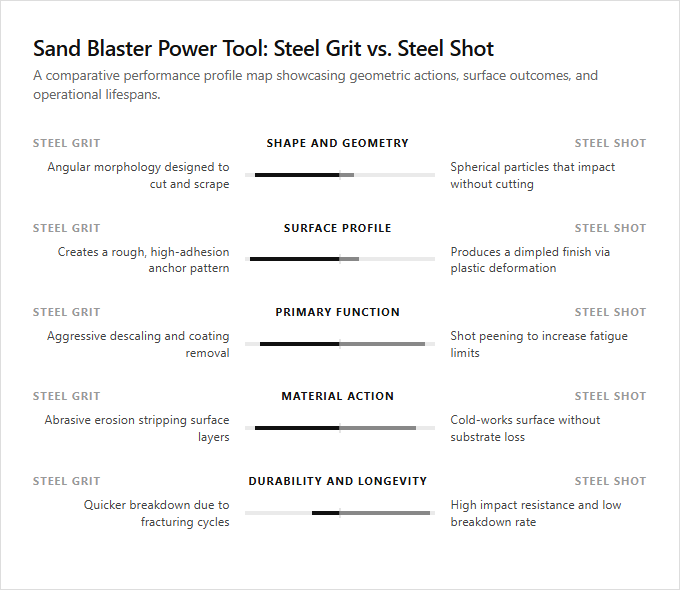
| Shape and Geometry | Steel grit features an angular morphology designed to cut and scrape surfaces, whereas steel shot consists of spherical particles that impact the target without cutting. |
| Surface Profile | Steel grit creates a rough anchor pattern ideal for subsequent coating adhesion, while steel shot produces a dimpled finish through plastic deformation. |
| Primary Function | Grit is primarily utilized for aggressive descaling and rust removal, whereas shot is used for shot peening to increase the fatigue limit of metal components. |
| Material Action | Steel grit acts via abrasive erosion to strip coatings and contaminate layers, while steel shot cold-works the metal surface without significant substrate loss. |
| Durability and Longevity | Steel shot exhibits high impact resistance and a low breakdown rate due to its rounded structure, outlasting the quicker fracturing cycles of angular steel grit. |
Grit vs. Shot: How Shape Determines Anchor Profile
When utilizing a sand blaster, the selection between steel grit and steel shot directly dictates the resulting anchor profile of the substrate. Steel grit features an angular morphology that aggressively cuts through tough coatings and mill scale, carving a sharp, jagged etch pattern into the surface. This deep, high-profile roughness is essential for promoting maximum mechanical adhesion of subsequent protective coatings.
In contrast, steel shot possesses a spherical geometry that impacts the metal by peening rather than cutting. This round shape produces a dimpled, matte finish while relieving tensile stress within the metal, cleaning the surface without significant material loss. Industrial painters requiring heavy-duty coating adhesion typically opt for the aggressive cutting action of steel grit, whereas automotive restorers and metal fabricators focusing on stress-relief and gentle cleaning favor the peening performance of steel shot.
Steel Grit Cuts, Steel Shot Compresses
Steel grit is an angular abrasive highly valued for aggressive cleaning and profiling. Its performance relies on specific hardness grades measured on the Rockwell C scale, where higher ratings indicate a harder material that maintains sharp edges under pressure. This hardness directly dictates cutting efficiency, allowing the abrasive to rapidly strip heavy scale, rust, and stubborn coatings from metallic surfaces.
Conversely, steel shot consists of spherical particles designed for impact rather than erosion. The rounded shape strikes the workpiece to induce sub-surface compressive stress, a process known as shot peening. This action strengthens the metal substrate, improving resistance to fatigue and preventing stress corrosion cracking in high-load components.
Industrial coaters requiring deep surface anchors for paint adhesion benefit most from steel grit, whereas structural engineers and automotive manufacturers aiming to extend the service life of metal parts find steel shot ideal.
Grit vs. Shot: Coating and Scale Removal Mechanisms
Steel grit features sharp, angular particles that facilitate a precise micro-cutting mechanism. This aggressive shearing action is highly efficient for stripping heavy coatings, thick epoxies, and stubborn rust from metallic substrates, creating an etched surface profile that optimizes subsequent paint adhesion.
Steel shot consists of round, spherical media that utilize plastic deformation rather than cutting. Upon high-velocity impact, the shot repeatedly dimples the metal surface, a process that effectively fractures and removes brittle mill scale while peening the underlying substrate to relieve tensile stresses.
Industrial refinishers requiring maximum mechanical bonding for new coatings are best suited for steel grit, whereas structural steel fabricators and metal-peening specialists are the ideal users for steel shot.
Optimizing Grit Size for High-Performance Coating Adhesion
In industrial surface preparation, choosing between steel grit and steel shot is critical for achieving the precise anchoring profile. Steel grit, with its angular geometry, aggressively etches the substrate to produce a sharp, jagged topography. Conversely, spherical steel shot impacts the surface to create a dimpled profile, effectively peening the metal to relieve tensile stress. Selecting specific media sizes directly optimizes the Rz surface roughness parameters, which is essential for ensuring the mechanical interlocking and long-term adhesion of high-performance protective coatings.
Different operational requirements dictate which media is appropriate for a project. Angular steel grit is ideal for coating specialists and painters who require deep, textured profiles for heavy-duty epoxy adhesion, while spherical steel shot is best suited for structural engineers and fabricators focused on metal fatigue resistance and descaling.
Steel Shot Work-Hardens to Outlast Steel Grit
In industrial abrasive blasting, selecting the correct media between steel shot and steel grit significantly influences both the final surface finish and overall media longevity. Round steel shot is highly durable because structural impacts during operation work-harden the steel, which progressively increases its fatigue life over multiple cycles. In contrast, the sharp, angular particles of steel grit undergo progressive fracturing upon impact, constantly breaking down into smaller, sharp fragments to maintain an aggressive cutting edge.
This distinct physical degradation profile dictates the optimal operational applications for each media type. Industrial operators seeking aggressive rust removal and anchor pattern creation benefit from steel grit, whereas automotive and aerospace technicians requiring surface stress relief, peening, and metal conditioning are best suited for steel shot.
Spherical Shot: Superior Durability and Lower Consumption
When selecting blasting media, the choice between steel shot and steel grit significantly impacts operating costs. Spherical steel shot offers superior cyclic durability compared to angular steel grit. Because the rounded shape of the shot resists fracturing upon impact, it maintains its structural integrity over repeated cycles. This resilience results in a much lower abrasive consumption rate, making steel shot a highly cost-effective option for high-volume surface treatment.
While steel grit features an angular geometry designed to aggressively etch surfaces, it breaks down more rapidly. High-production industrial facilities seeking efficient surface peening and cleaning prefer steel shot, whereas coating specialists and fabricators requiring deep mechanical anchors for paint adhesion typically choose steel grit.
Grit vs. Shot: Impact on Blast Machine Wear
When selecting abrasive media for industrial blasting, the physical characteristics of steel grit and steel shot dictate both the surface finish and equipment longevity. Steel grit features sharp, angular edges designed for aggressive cutting and contaminant removal. However, this high-velocity grit significantly accelerates blast machine liner wear and nozzle erosion. In contrast, the spherical shape of steel shot results in a low-friction rebound, preserving internal machine components and extending the operational lifespan of nozzles.
Choosing between these media depends on the specific requirements of the project and the tolerance for equipment maintenance. Fabricators requiring rapid rust stripping and deep profiling favor steel grit, while manufacturing specialists focusing on metal peening and surface strengthening benefit from the durability of steel shot.
Leave a comment