
Achieving a pristine finish during surface preparation often leaves operators struggling with an inefficient workflow, excessive media waste, and challenging cleanup. Before allocating workshop capital or exploring traditional equipment financing-the standard funding sources for workshop upgrades-it is essential to analyze your specific production bottlenecks.
Selecting the precise blasting setup grants operators unmatched media reclamation efficiency and significantly reduced cycle times. As a necessary stipulation, however, professionals must recognize that no single abrasive blaster is a universal solution; a system optimized for delicate alloy wheel refinishing behaves quite differently than one built for heavy-duty structural steel prep.
To help maximize your equipment investment, this guide provides a direct comparison between stationary blast cabinets and mobile portable sandblasters. We will examine key differences in containment, capacity, and versatility, helping you select the ideal tool for your surface preparation requirements.
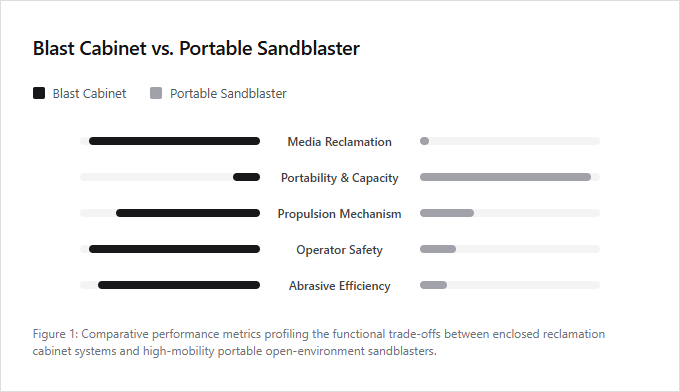
| Factor | Summary |
|---|---|
| Media Reclamation | Blast cabinets feature an enclosed design that facilitates abrasive media reclamation, whereas portable sandblasters release media directly into the open environment. |
| Portability and Capacity | Portable sandblasters provide high mobility for in-situ blasting of oversized structures, while blast cabinets are stationary and restricted by their internal chamber dimensions. |
| Propulsion Mechanism | Blast cabinets frequently utilize a siphon-feed system that requires less air volume, whereas portable units often rely on high-pressure direct vessel systems. |
| Operator Safety | Portable sandblasters require operators to wear specialized blast hoods and respirators, whereas blast cabinets confine the hazards within a sealed viewing chamber. |
| Abrasive Efficiency | Blast cabinets maximize the cost-efficiency of reusable abrasives like silicon carbide, while portable setups often utilize disposable media due to the difficulty of recovery. |
Media Recycling: Blast Cabinets vs. Portable Sandblasters
When selecting professional surface preparation equipment, the primary distinction between a blast cabinet and a portable sandblaster lies in media efficiency and containment. Blast cabinets utilize integrated media reclamation systems to automatically recycle abrasive grit, separating dust from reusable media within a closed loop. This containment system minimizes consumable costs and maintains a clean, hazard-free workshop environment.
In contrast, portable sandblasters typically operate on a total-loss basis, where the abrasive media is discharged directly onto the workpiece and is generally not recovered. While this method requires more media, it provides the unrestricted mobility necessary for treating large, stationary structures. Stationary blast cabinets are ideal for workshop technicians performing high-precision component refurbishment, whereas portable sandblasters are best suited for mobile contractors undertaking large-scale field restorations.
How Portable Sandblasters Maintain Continuous Abrasive Flow
When selecting abrasive blasting equipment, the choice between a blast cabinet and a portable sandblaster depends heavily on the scale of the workpiece and the required mobility. Blast cabinets are self-contained, stationary units designed for processing smaller components within a sealed chamber that recycles media. In contrast, portable sandblasters rely on high-capacity pressure vessels to sustain a continuous, pressurized abrasive flow over large surfaces, operating without the physical constraints of an enclosure.
The pressurized design of portable systems ensures consistent velocity and media delivery for heavy-duty, on-site surface preparation. Stationary cabinets offer a clean, contained environment ideal for intricate workshop tasks. Stationary cabinets are best suited for automotive restorers and precision machinists working on small parts, while portable sandblasters are ideal for industrial contractors and mobile operators tackling large-scale structures.
Dust Control: Cabinet vs. Portable Blasting
Blast cabinets provide a highly contained environment for abrasive media, making them a staple for indoor workshops. To maintain necessary internal visibility during operation, these systems require dedicated dust collection systems equipped with cartridge filters to continuously extract fine particulates. This configuration ensures a clean workspace and protects the operator from inhaling hazardous airborne debris.
In contrast, portable sandblasters operate without a physical enclosure, relying instead on open-air natural ventilation or integrated wet-blasting suppression methods to control dust. This design prioritizes mobility and adaptability for treating large, immobile surfaces. Stationary cabinets are best suited for detailed component restorers working in dedicated workshops, while portable blasters are ideal for mobile contractors and industrial operators managing outdoor structural maintenance.
Portable Sandblasters Require Higher CFM Than Cabinets
When selecting abrasive blasting equipment, the air compressor requirement is a critical differentiator between blast cabinets and portable sandblasters. Portable units typically feature larger nozzle orifices designed for rapid coverage, demanding significantly higher Cubic Feet per Minute (CFM) ratings from your compressor to maintain effective velocity. Blast cabinets utilize smaller, standard guns with restricted nozzles that operate efficiently on much lower, workshop-friendly CFM levels while recycling the abrasive media within an enclosed space.
The choice between these systems depends entirely on your workspace constraints and project scale. Stationary blast cabinets are ideal for hobbyists and precision restorers working on smaller, contained components, while portable sandblasters are suited for mobile contractors and industrial operators tackling large, outdoor structures.
Blast Cabinets: Sealed Containment for Operator Safety
When selecting abrasive blasting equipment, workshop safety and media containment are primary considerations. Blast cabinets feature a sealed containment enclosure designed to protect the operator from direct exposure to hazardous airborne particulates and high-velocity media rebound. This fully enclosed design continuously recycles the abrasive material internally, keeping the surrounding workspace clean while safeguarding the user's respiratory health during operation.
In contrast, portable sandblasters offer unmatched mobility for large, stationary structures but lack built-in containment, requiring operators to use comprehensive personal protective equipment in open-air environments. Cabinet models are ideal for precision workshop technicians refinishing small, handheld components, whereas portable units are best suited for industrial contractors managing large-scale outdoor restoration projects.
Abrasive Feed: Portable Blasters vs. Cabinets
When selecting abrasive blasting equipment, understanding the distinct media delivery mechanisms of blast cabinets and portable sandblasters is essential. Portable sandblasters operate as pressurized vessels, utilizing heavy-duty abrasive metering valves at the base of the pot to precisely regulate the media flow into the high-pressure air stream. This direct-pressure design delivers high-velocity impact, making it highly efficient for heavy rust and scale removal on large, stationary structures.
Blast cabinets typically employ suction-feed induction guns to siphon media. These systems use compressed air to create a vacuum that draws the abrasive up from the hopper into the gun nozzle, offering a contained environment and continuous media recycling for smaller components. Portable blasters are ideal for mobile restoration contractors tackling large-scale outdoor projects, while blast cabinets suit automotive technicians and hobbyists requiring precise, mess-free detailing on localized parts.
Direct-Pressure Blasting Delivers Superior Kinetic Energy
When selecting abrasive blasting equipment, the propulsion mechanism determines the efficiency of material removal. Portable sandblasters typically utilize direct-pressure systems, which pressurize the media vessel itself. This design delivers significantly higher kinetic energy to the target substrate than the gravity or siphon-fed configurations standard in most blast cabinets, which rely on suction to draw media into the airflow.
While containment cabinets offer excellent media reclamation for localized workshop tasks, they lack the high-velocity impact of pressurized portable units. Stationery cabinets are ideal for precision component restorers and workshop hobbyists, whereas portable pressure blasters are suited for industrial contractors and heavy machinery operators requiring maximum stripping efficiency on large-scale surfaces.
Leave a comment