
Achieving a perfectly prepped surface can be incredibly frustrating when your abrasive blaster constantly clogs, pulses, or lacks the velocity required to strip tough coatings. While standard shop equipment budgets or traditional capital funding sources often allocate flat rates for generic pneumatic upgrades, selecting the wrong delivery system quickly drains these resources through operational inefficiency and wasted media.
Fortunately, choosing the correct system configuration grants operators up to four times the working velocity and significant media recovery savings. This performance leap is, however, strictly stipulated on matching the blaster to your compressor's actual CFM output. For example, while heavy industrial yards rely on direct pressure systems for rapid rust removal on structural steel, automotive restoration shops often utilize suction-feed setups for delicate sheet metal etching.
Below, we analyze the critical differences between Direct Pressure and Suction Feed blasters, evaluating their mechanical designs, air consumption rates, and practical applications to help you secure the optimal tool for your facility.
| Factor | Summary |
|---|---|
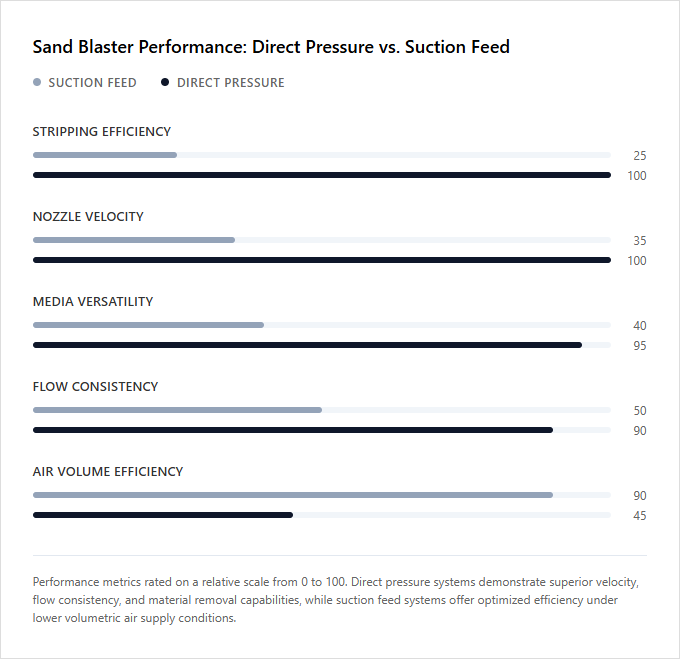
| Propulsion Mechanism | Suction systems use a dual-hose gun to draw media via vacuum pressure created by the Venturi effect, while direct pressure systems utilize a pressurized pot to push the abrasive-air mixture through a single hose. |
| Nozzle Velocity | Direct pressure systems achieve significantly higher kinetic energy and nozzle velocity because the air and media are pre-mixed under pressure, whereas suction feed velocity is restricted by the vacuum generation process. |
| Abrasive Flow Rate | Direct pressure blasters deliver a consistent and adjustable mass flow rate of abrasive, whereas suction feed units often experience fluctuating feed rates due to reliance on siphon feed mechanics. |
| Compressed Air Demand | Suction feed systems operate efficiently with lower volumetric flow rates measured in CFM (cubic feet per minute), while direct pressure setups require high-CFM compressors to maintain continuous vessel pressurization. |
| Stripping Efficiency | Direct pressure offers superior productivity and faster surface profile preparation, stripping coatings up to four times faster than the lower-velocity suction feed systems. |
| Media Compatibility | Direct pressure easily conveys heavy, high-density metallic abrasives like steel shot, whereas suction feed is typically limited to lighter media such as glass beads or organic agricultural grits. |
Pressurized blast pot vessel capacity versus siphon induction gun mechanism
Direct pressure sandblasters utilize a pressurized blast pot vessel that forces abrasive media directly through the nozzle at high velocities. This high-capacity design ensures rapid coverage and maximum impact energy, making it highly efficient for demanding surface preparation and thick coating removal.
Suction feed systems employ a siphon induction gun mechanism, using compressed air to create a vacuum that draws media from an unpressurized hopper. This configuration allows for continuous, albeit lower-velocity, operation without the need to depressurize a vessel for refilling. Direct pressure units are best suited for industrial contractors requiring rapid, heavy-duty rust removal, whereas suction feed models are ideal for hobbyists performing detail work and light workshop restoration.
Abrasive acceleration velocity and impact kinetic energy
Suction feed systems rely on the Venturi effect to pull abrasive media into the airflow, resulting in lower acceleration velocities and moderate impact kinetic energy. In contrast, direct pressure systems utilize a pressurized vessel to push media directly through the blast hose and nozzle. This direct propulsion achieves significantly higher acceleration velocity, maximizing the impact kinetic energy of the abrasive particles upon the target substrate for rapid material removal.
These distinct physical mechanics dictate specific operational applications. Suction feed blasters are ideal for hobbyists and light-duty technicians requiring precise control on delicate surfaces, whereas direct pressure systems are suited for industrial contractors demanding high-efficiency, heavy-duty coating removal.
Compressed Air Volume Requirements in CFM
Suction feed sandblasters operate by using compressed air to create a vacuum that pulls abrasive media into the airflow. Because this process relies on induction, it requires a continuous velocity of air but operates efficiently at lower volume thresholds. Typically, suction systems demand between 4 to 15 CFM, making them highly compatible with smaller, standard shop compressors.
Direct pressure systems utilize a pressurized vessel to push the media directly into the blast hose. This mechanism requires a much larger volume of air to sustain the pressurized environment, often demanding 15 to over 100 CFM. This high CFM requirement necessitates industrial-grade compressors to maintain optimal blasting velocity during extended operations.
Suction feed units are ideal for DIY hobbyists performing light-duty restoration, while direct pressure systems are best suited for industrial contractors requiring rapid, high-volume surface preparation.
Siphon draw reliance on the Venturi effect to pull media
Suction feed sandblasters, also known as siphon systems, rely on the Venturi effect to operate. As compressed air passes through the blast gun, it creates a high-velocity stream that generates a vacuum, pulling the abrasive media up from a separate container into the airflow. Because some kinetic energy is consumed during this drawing process, the resulting blast stream is gentler compared to alternative systems.
Direct pressure systems utilize a pressurized vessel to force the media directly into the hose line. This design eliminates the need for a siphon draw, delivering the abrasive at a much higher velocity to maximize surface cutting power and efficiency.
Direct pressure units are ideal for industrial contractors requiring rapid material removal on heavy-duty projects, whereas suction feed systems are best suited for hobbyists and workshop enthusiasts performing detail work or light rust removal.
Precise flow regulation using an abrasive metering valve
Direct pressure and suction feed systems represent the two primary configurations in abrasive blasting. Direct pressure units force media under pressure through the abrasive metering valve into the air stream, enabling highly precise flow adjustments and dense media delivery. Suction systems rely on the Venturi effect to pull media through the valve, resulting in a simpler but less responsive regulation of the abrasive flow.
Fine-tuning the media-to-air ratio via the metering valve optimizes consumption and prevents nozzle clogging. Industrial contractors requiring rapid, high-production stripping benefit most from the heavy-duty capabilities of direct pressure systems, whereas hobbyists and workshop DIYers find suction feed setups more suitable for light-duty etching and localized rust removal.
Nozzle dynamics utilizing specialized convergent-divergent nozzles
Industrial sandblasting utilizes distinct abrasive delivery systems that govern nozzle dynamics. Suction-feed systems rely on the Venturi effect, drawing media into the airflow at the nozzle. This mechanism limits kinetic energy, as the pressure differential restricts particle acceleration even when utilizing specialized convergent-divergent nozzles. Direct pressure vessels push pre-mixed air and media through the line, allowing convergent-divergent nozzles to fully expand the gas and accelerate particles to supersonic velocities for maximum kinetic impact.
The choice between these configurations depends on the specific demands of the surface preparation task. Suction-feed setups are ideal for light-duty hobbyists and detail-oriented workshop technicians, whereas high-velocity direct pressure systems are best suited for industrial contractors requiring rapid, heavy-duty paint and rust removal.
Compatibility with high-density media like steel grit versus lightweight abrasives
Direct pressure sand blasters utilize a pressurized vessel to push abrasive media through the nozzle at high velocity. This robust mechanism provides the necessary force to propel high-density media like steel grit, making it highly effective for heavy-duty paint stripping and industrial rust removal.
In contrast, suction feed systems rely on the Venturi effect to draw abrasive into the airflow. This gentle delivery method is highly compatible with lightweight abrasives such as glass beads or walnut shells, preventing damage to delicate substrates during precision cleaning.
Direct pressure systems are suited for industrial contractors requiring rapid surface preparation with heavy abrasives, while suction feed systems are ideal for hobbyists or detail-oriented technicians performing delicate restoration work.
Leave a comment