
Contractors and structural engineers frequently struggle with selecting the wrong tool for concrete penetration, a critical misstep that leads to fractured substrates, ruined bits, and blown project timelines. While standard funding sources-such as capital expenditure budgets and equipment financing programs-provide the means to secure heavy machinery, allocating those resources to the incorrect tool can quickly drain margins.
Securing the appropriate equipment grants operators unmatched precision and structural safety, with the essential stipulation that percussive impact and rotary diamond abrasion serve entirely different mechanical purposes. For instance, deploying a Hilti TE-70 rotary hammer for heavy anchor bolts requires a vastly different approach than utilizing a Husqvarna diamond core rig for a 4-inch utility conduit.
To optimize your tooling strategy, this guide provides an in-depth comparison of core drills versus rotary hammers, outlining their distinct mechanics, specific material applications, and cost-efficiencies to ensure you deploy the right tool for your next job.
| Factor | Summary |
|---|---|
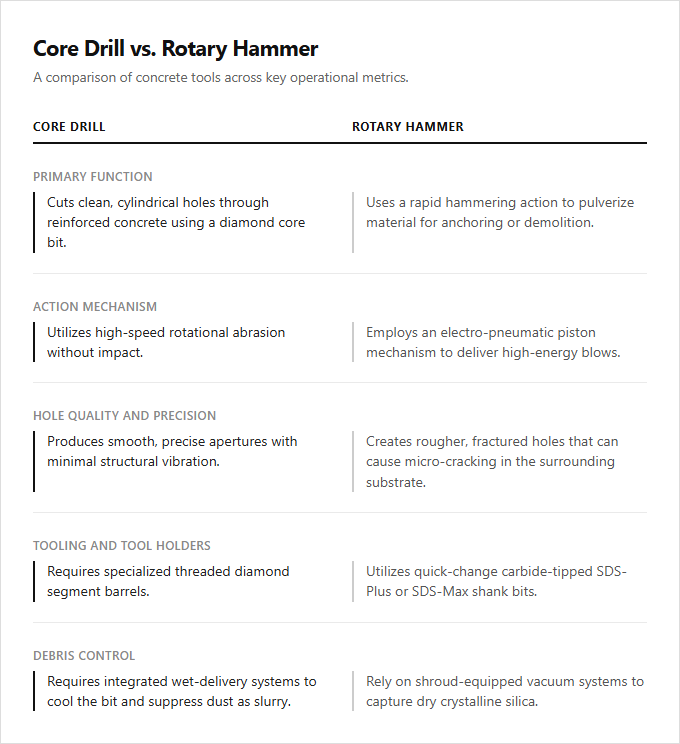
| Primary Function | While a core drill is designed to cut clean, cylindrical holes through reinforced concrete using a diamond core bit, a rotary hammer uses a rapid hammering action to pulverize material for anchoring or demolition. |
| Action Mechanism | Core drills utilize high-speed rotational abrasion without impact, whereas rotary hammers employ an electro-pneumatic piston mechanism to deliver high-energy blows. |
| Hole Quality and Precision | A core drill produces smooth, precise apertures with minimal structural vibration, while a rotary hammer creates rougher, fractured holes that can cause micro-cracking in the surrounding substrate. |
| Tooling and Tool Holders | Core drills require specialized threaded diamond segment barrels, whereas rotary hammers utilize quick-change carbide-tipped SDS-Plus or SDS-Max shank bits. |
| Debris Control | Core drilling typically requires integrated wet-delivery systems to cool the bit and suppress dust as slurry, while rotary hammers rely on shroud-equipped vacuum systems to capture dry crystalline silica. |
Rotary Hammer Impact vs. Core Drill Rotation
Selecting the appropriate concrete power tool requires understanding the mechanical differences between a rotary hammer and a core drill. A rotary hammer utilizes an electro-pneumatic impact mechanism, where an internal piston compresses air to drive a striker directly into the drill bit. This rapid hammering action shatters dense masonry, allowing the bit to quickly penetrate the material for anchoring or demolition tasks.
A core drill relies entirely on high-torque rotational movement paired with diamond-tipped barrels to grind away material. This continuous, non-impact rotation preserves structural integrity while producing large, precise cylindrical openings. Rotary hammers are ideal for general contractors performing quick anchor installations, while core drills are suited for utility professionals requiring clean, large-diameter penetrations through reinforced concrete.
Carbide-tipped SDS-max drill bits versus diamond segment matrix core bits
Rotary hammers paired with carbide-tipped SDS-max bits excel at rapid, high-impact drilling through concrete and masonry. This system utilizes a percussive hammering action to pulverize material, making it highly efficient for drilling anchor holes and performing medium-duty demolition. Conversely, core drills employing diamond segment matrix core bits rely on a rotary-only grinding action to cut clean, large-diameter cylindrical holes. This method preserves structural integrity by eliminating impact vibration and easily slices through heavy steel rebar.
Selecting the correct system depends on the specific project requirements and trade demands. Rotary hammers are ideal for general contractors and electricians needing fast, versatile anchoring solutions, whereas diamond core drills are best suited for mechanical plumbers and dedicated concrete scanning specialists requiring precise, non-destructive penetrations through reinforced slabs.
Percussive micro-fracturing of concrete versus non-impact abrasive shearing
Rotary hammers utilize a mechanical piston to deliver high-energy impact directly to the masonry bit. This rapid hammering action causes percussive micro-fracturing of the concrete substrate, allowing the bit to quickly break through and clear the pulverized debris. This method is highly efficient for rapid penetration and anchoring.
In contrast, core drills employ a non-impact, rotary-only mechanism paired with diamond-impregnated segments. This process relies on high-speed abrasive shearing, grinding away the concrete to produce clean, large-diameter cylindrical openings while preserving structural integrity. Structural engineers and commercial plumbers require the precise, vibration-free operation of core drills for utility penetrations, whereas general contractors favor the speed of rotary hammers for anchoring and light demolition.
Dry flute dust evacuation versus integrated water swivel cooling systems
Rotary hammers and core drills utilize distinct mechanisms to manage heat and debris during concrete drilling. Rotary hammers rely on a dry flute dust evacuation system, where the spiral geometry of the bit mechanically channels dust upward and out of the hole. This dry method is highly efficient for rapid, smaller-diameter drilling where water containment is a priority.
Core drills employ an integrated water swivel cooling system that delivers continuous water directly through the spindle to the diamond cutting face. This wet system suppresses dust, cools the bit, and flushes out concrete slurry during deep, large-diameter operations. Masonry installers requiring quick, dry anchoring typically opt for the rotary hammer, while mechanical contractors drilling precise, heavy-duty utility penetrations rely on the core drill.
Mechanical slip clutch protection against high-torque binding
Both core drills and rotary hammers encounter extreme high-torque binding when drilling into reinforced concrete. To mitigate the risk of sudden tool rotation and operator injury, both systems utilize a mechanical slip clutch. In a rotary hammer, this clutch instantly disengages the drive shaft when the drill bit binds on rebar, preventing violent physical kickback. Core drills, operating under sustained, high-torque loads, employ heavy-duty slip clutches engineered to manage continuous friction and prevent motor burnout during deep, large-diameter drilling.
The mechanical tolerances of these safety systems dictate their primary applications. Professional mechanical contractors requiring large, precise penetrations benefit most from the continuous slip-torque protection of core drills, while general construction workers performing rapid anchoring and concrete demolition rely on the responsive, sudden-impact protection of rotary hammers.
Hammer Fracturing vs. Smooth Cutting of Rebar
Rotary hammers rely on a rapid, high-impact hammering mechanism that fractures concrete through brute force. While highly efficient for standard masonry, this percussive action struggles when encountering embedded steel rebar. The repeating hammer blows can cause carbide-tipped bits to bind, shatter, or deflect upon hitting steel, which halts progress and transfers severe vibrational stress to the operator.
In contrast, a diamond core drill operates with a smooth, non-impact rotary action. Its specialized diamond-segmented barrels grind through both concrete and steel reinforcement seamlessly, leaving clean, structurally sound cylindrical openings without micro-fracturing the surrounding substrate. Professional demolition specialists and structural installers requiring precise, vibration-free penetrations through heavy rebar choose core drills, whereas general contractors performing quick anchoring tasks in non-reinforced masonry are best served by rotary hammers.
Shallow anchor-bolt hole preparation versus large-diameter deep core extraction
Selecting the appropriate concrete power tool depends heavily on the scale and precision of the required penetration. Rotary hammers excel at rapid, high-impact drilling for shallow anchor-bolt holes, utilizing specialized carbide-tipped bits to pulverize concrete efficiently. In contrast, core drills are engineered for large-diameter, deep core extraction, utilizing diamond-tipped hollow barrels to cleanly slice through aggregate and steel reinforcement without inducing structural vibration.
While rotary hammers rely on percussive force for fast, smaller anchoring points, core drills employ high-torque rotational speed to preserve the integrity of surrounding concrete during major utility installations. Commercial plumbers and HVAC installers benefit most from the precision of core drills, whereas general concrete contractors and steel erectors favor rotary hammers for high-volume structural anchoring.
Leave a comment