
For concrete contractors, managing hazardous respirable crystalline silica dust during grinding operations remains a constant, high-stakes struggle. Standard shop vacuums frequently clog, leading to lost suction, premature motor failure, and dangerous airborne dust exposure that threatens worker health.
While many businesses look to standard capital equipment budgets or general overhead to fund these vital upgrades, leveraging specialized safety grants and state-level workers' compensation safety funds grants employers the immediate capability to offset these acquisition costs while maintaining regulatory compliance.
However, a key educational stipulation must be made: true OSHA Table 1 compliance requires more than just a "HEPA" label; it demands a fully sealed system with an automated filter-cleaning mechanism. Industry-standard solutions like the Husqvarna S26 and the Bosch VAC090A demonstrate the engineering required to safely manage fine concrete particulates.
In this analysis, we will compare HEPA dust extractors against standard shop vacuums, evaluating filtration mechanics, OSHA compliance guidelines, and long-term return on investment.
| Factor | Summary |
|---|---|
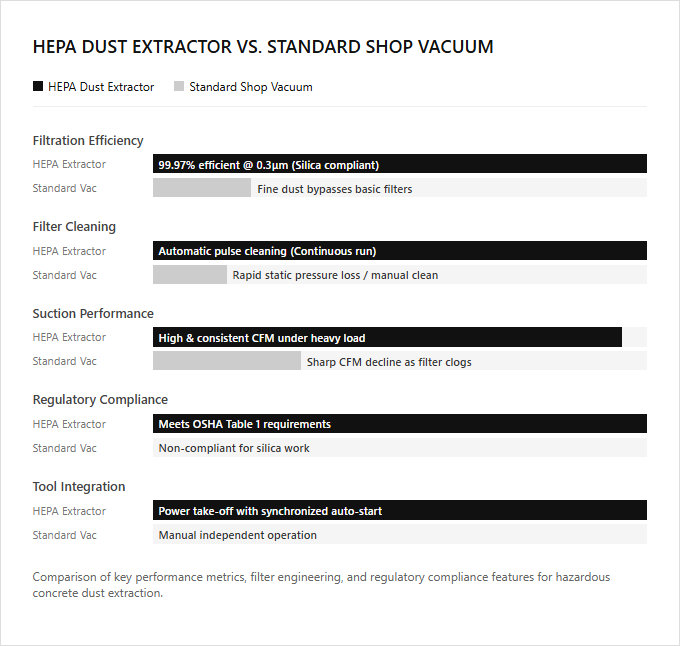
| Filtration Efficiency | HEPA dust extractors capture 99.97% of particles down to 0.3 microns to mitigate hazardous respirable crystalline silica, whereas standard shop vacuums allow these fine particulates to bypass basic paper filters and exhaust back into the ambient air. |
| Filter Cleaning | Dust extractors utilize automatic pulse cleaning mechanisms to prevent filter blinding from fine concrete dust, while standard shop vacuums suffer from rapid static pressure drop and require manual cleaning. |
| Suction Performance | Extractors maintain a high and consistent volume of airflow, measured in cubic feet per minute (CFM), and static water lift under heavy dust loads, whereas standard shop vacuums experience a sharp decline in CFM as the main filter clogs. |
| Regulatory Compliance | HEPA dust extractors are engineered to meet OSHA Table 1 standards for silica dust control, whereas standard shop vacuums lack the certified filtration required to comply with legal permissible exposure limits. |
| Tool Integration | Extractors feature integrated power take-off receptacles that enable synchronized auto-start functionality with connected concrete power tools, a feature absent in standard shop vacuums. |
HEPA filtration efficiency rating of 99.97% down to 0.3 microns
When managing concrete dust on a professional jobsite, the distinction between a HEPA dust extractor and a standard shop vacuum is critical. While both tools collect debris, only a certified HEPA dust extractor guarantees a filtration efficiency rating of 99.97% down to 0.3 microns. This rigorous standard ensures that hazardous respirable crystalline silica particles, which easily bypass standard shop vacuum filters, are safely trapped within the containment system.
Standard shop vacuums often exhaust fine concrete dust back into the air and suffer from rapid filter clogging. In contrast, HEPA extractors feature sealed housings and automated filter-cleaning mechanisms designed to maintain high airflow under heavy dust loads while meeting strict OSHA compliance regulations.
Standard shop vacuums are ideal for DIY homeowners tackling occasional garage cleanups, whereas certified HEPA dust extractors are essential for professional masonry and concrete contractors who require daily, regulatory-compliant silica dust control.
Automated electromagnetic pulse filter cleaning mechanism
During concrete grinding and drilling, standard shop vacuums quickly lose suction because fine silica dust rapidly clogs the filter. Professional HEPA dust extractors resolve this issue through an automated electromagnetic pulse filter cleaning mechanism. This system uses targeted blasts of air to automatically knock dust from the filter during operation, maintaining continuous airflow and ensuring the vacuum complies with OSHA silica dust regulations.
Standard shop vacuums lack this self-cleaning technology, requiring frequent manual filter cleaning that interrupts workflow and increases dust exposure. Standard shop vacuums are suitable for DIY homeowners tackling occasional, non-hazardous workshop cleanup, while professional HEPA dust extractors with automatic pulsing are designed for commercial contractors performing heavy-duty concrete dust extraction daily.
OSHA Table 1 compliant CFM-to-blade-inch airflow ratio
When cutting or grinding concrete, dust management is critical for safety and regulatory compliance. OSHA Table 1 strictly mandates specific airflow rates based on tool size to control respirable crystalline silica. Specifically, concrete grinding and sawing operations require a dust extraction system capable of delivering at least 25 CFM per inch of blade or wheel diameter to effectively capture hazardous particles at the source.
Standard shop vacuums lack the filtration integrity and sustained airflow necessary to meet these standards, as concrete dust quickly clogs their filters and drops the CFM below safe limits. Certified HEPA dust extractors feature automated filter-cleaning mechanisms and sealed filtration chambers designed to maintain the required CFM-to-blade-inch ratio under heavy loads. Professional masonry contractors undertaking commercial silica-producing projects require certified HEPA extractors to ensure legal compliance, while DIY homeowners performing basic, non-hazardous workshop cleanups are better suited for standard shop vacuums.
Continuous-feed negative-pressure bagging system
In concrete surface preparation, managing hazardous silica dust requires specialized equipment. While a standard shop vacuum relies on basic open canisters that release dust during disposal, a professional HEPA dust extractor utilizes a continuous-feed negative-pressure bagging system. This system allows operators to seal and discard collected dust without exposing themselves or the environment to airborne particles, maintaining a constant vacuum seal throughout the bag-changing process.
HEPA dust extractors also feature certified multi-stage filtration to capture fine particles, preventing the rapid filter clogging and loss of suction common in standard vacuums. Standard shop vacuums are best suited for general DIYers performing light, intermittent cleanup of non-hazardous workshop debris, whereas HEPA extractors with continuous-feed bagging are essential for professional concrete contractors who must maintain strict OSHA compliance and dust-free commercial job sites.
Cyclonic pre-separator particulate stratification
In concrete resurfacing and cutting applications, standard shop vacuums rapidly lose suction because fine silica dust immediately clogs the cartridge filter. Professional HEPA dust extractors overcome this limitation by utilizing a cyclonic pre-separator to achieve particulate stratification. This process uses centrifugal force to spin the incoming air stream, forcing larger concrete chips and heavy dust outward and downward into a collection bin before the airflow reaches the primary filtration media.
This stratification prevents ultra-fine dust from blinding the HEPA filter, ensuring consistent static pressure and continuous dust capture at the tool shroud. Certified masonry contractors requiring strict OSHA compliance and continuous operation rely on HEPA extractors with cyclonic separation, whereas general homeowners performing basic workshop cleanup are well-suited for standard shop vacuums.
Differential pressure drop monitoring indicator
Professional HEPA dust extractors designed for concrete applications feature a differential pressure drop monitoring indicator. This specialized component measures the pressure variance before and after the filter to detect airflow restriction before suction drops. When fine silica dust begins to clog the element, the sensor alerts the operator to initiate the filter cleaning cycle, maintaining continuous OSHA compliance and optimal dust containment.
Standard shop vacuums lack these sophisticated monitoring sensors, relying instead on manual airflow assessment which often results in premature clogging and hazardous dust bypass. Industrial masonry contractors and certified remediation specialists require the safety and regulatory compliance of HEPA extractors with differential monitoring, whereas residential DIYers and general clean-up crews are well-suited to the simpler operation of standard shop vacuums.
Hermetically sealed motor housing bypass prevention
When managing hazardous concrete silica dust, the critical differentiator between a standard shop vacuum and a certified HEPA dust extractor lies in the integrity of the motor housing. Standard shop vacuums typically lack a hermetical seal, allowing fine dust particles to bypass the filtration system through structural gaps under high pressure, which risks motor damage and airborne contamination.
Professional HEPA dust extractors utilize a hermetically sealed motor housing to prevent any air bypass. This engineering forces all intake air directly through the filtration media, ensuring that microscopic concrete dust cannot escape back into the environment. While standard vacuums are suitable for residential hobbyists cleaning general jobsite debris, sealed HEPA extractors are required for commercial concrete contractors executing OSHA-compliant cutting and grinding operations.
Leave a comment