
Selecting the wrong interface for heavy-duty rotary hammers often leads to costly jobsite downtime, accelerated bit wear, and frustrating fleet incompatibility. When navigating these procurement decisions, contractors typically look to standard capital equipment budgets or tooling finance programs to fund their fleets. However, choosing the correct drive system grants operators a significant competitive edge-maximizing torque transfer and minimizing labor hours.
As an important educational stipulation, neither system is universally superior; rather, utility depends on your existing inventory and specific application demands. For instance, heavy-duty applications using the Bosch SDS-max® SpeedXtreme bits showcase different wear cycles compared to classic Spline-drive equivalents from Milwaukee.
In this guide, we provide a comprehensive technical comparison of Spline and SDS Max drive systems, evaluating their torque transmission, bit availability, and overall cost-efficiency to streamline your next tooling acquisition.
| Factor | Summary |
|---|---|
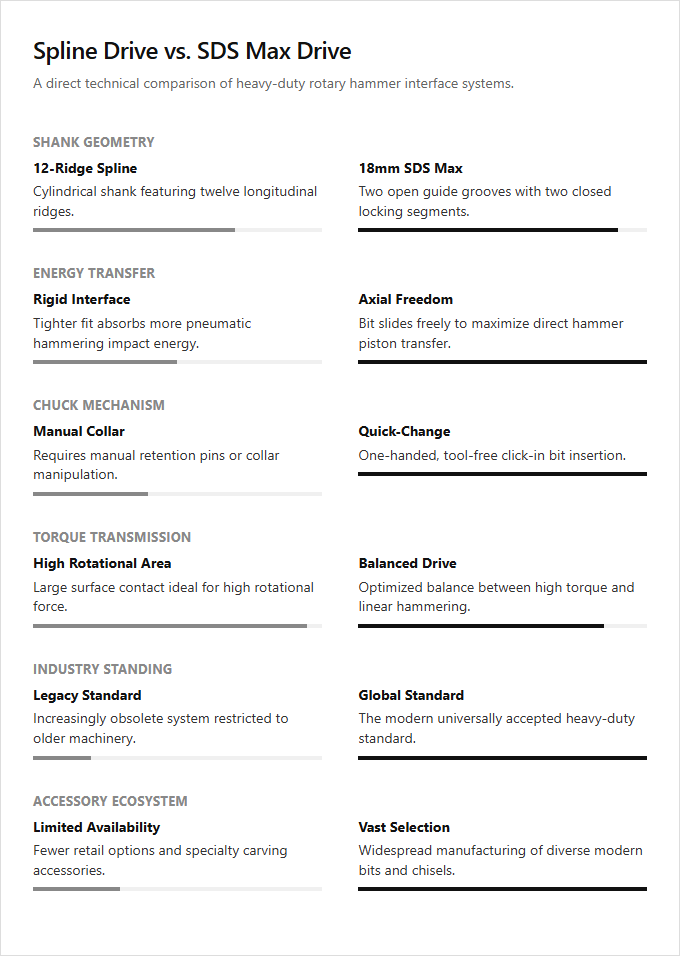
| Shank Geometry | Spline drives utilize a cylindrical shank featuring twelve longitudinal ridges, whereas SDS Max employs an 18mm diameter shank with two open guide grooves and two closed locking segments. |
| Energy Transfer | SDS Max maximizes electro-pneumatic impact energy by allowing the bit to slide axially within the chuck, whereas Spline drives have a more rigid connection that absorbs more hammering force. |
| Chuck Mechanism | SDS Max features a quick-change, tool-free chuck for rapid bit insertion, whereas Spline drive systems require manual collar manipulation or retention pins to secure the bit. |
| Torque Transmission | Spline drives excel at high rotational torque transfer due to the large surface area of the interlocking ridges, while SDS Max balances rotational torque with linear chiseling freedom. |
| Industry Standardization | SDS Max has become the globally accepted manufacturing standard for heavy-duty rotary hammers, rendering the legacy Spline drive system increasingly obsolete. |
| Accessory Ecosystem | The widespread adoption of SDS Max offers a vast selection of modern carbide-tipped drill bits and demolition chisels, whereas Spline drive accessories have limited retail availability. |
SDS Max vs. Spline Shank Differences
When selecting concrete power tools, understanding the shank connection is crucial for performance. The primary distinction between SDS Max and Spline drive systems lies in their physical engineering. The SDS Max features an 18mm shank diameter with asymmetrical grooves designed for secure locking and high energy transfer. In contrast, the Spline system utilizes a cylindrical shaft with raised external ridges to engage the chuck.
Each system serves distinct operational preferences on the job site. High-volume commercial contractors prioritizing rapid, tool-free bit changes and maximum impact energy will benefit most from SDS Max, whereas traditional masonry specialists maintaining older, high-torque tool fleets are best suited for Spline drive systems.
SDS Max: Sliding-Slot Design Optimizes Torque
When selecting heavy-duty concrete power tools, professionals frequently compare Spline and SDS Max drive systems. SDS Max represents a significant engineering advancement, optimizing torque transmission through a unique sliding-slot design. This mechanism allows the drill bit to move axially independent of the chuck's rotation, minimizing energy loss and maximizing impact force during demanding demolition tasks.
In contrast, the older Spline drive system relies on a series of ridges to transfer rotational force. While Spline drives remain effective for standard drilling, they lack the advanced impact efficiency and quick-change convenience of the modern SDS Max standard. Spline drives are well-suited for traditionalists seeking cost-effective tools for basic masonry, whereas SDS Max is ideal for high-production commercial contractors requiring maximum power and speed.
SDS Max Outperforms Spline in Impact Energy Efficiency
In heavy-duty concrete drilling, the connection interface between the rotary hammer and the drill bit determines overall performance. While both Spline and SDS Max drives are designed for demanding masonry applications, their power transmission mechanisms differ. Specifically, the pneumatic piston impact energy transfer, measured in Joules, is significantly more efficient in SDS Max systems than in older Spline systems. The SDS Max design allows the bit to play freely within the chuck, minimizing kinetic energy loss and delivering maximum striking force directly to the working material.
Spline drives rely on a rigid, slotted engagement that can result in higher friction and accelerated wear under high-torque conditions. In contrast, the cylindrical shank and locking grooves of the SDS Max system optimize power transmission, ensuring consistent impact velocity during deep hole drilling. Spline systems remain a practical, cost-effective choice for traditional operators performing occasional light-duty masonry tasks, whereas SDS Max is the industry standard for professional contractors requiring maximum productivity and durability on intensive demolition sites.
SDS Max vs. Spline: Automatic vs. Manual Chucks
When selecting heavy-duty concrete power tools, the choice between shank drive systems significantly impacts job site efficiency. The SDS Max drive system is engineered for modern productivity, featuring a quick-change, automatic locking chuck mechanism. Operators simply insert the bit until it clicks securely into place, minimizing downtime and eliminating the need for manual adjustments during bit changes.
In contrast, the traditional Spline drive system requires manual collar alignment to secure the accessory. Users must physically pull back the chuck sleeve and align the splines, a process that is highly reliable but demands more time and physical effort. The SDS Max system is ideal for high-volume commercial contractors requiring rapid tool transitions, while the Spline drive remains well-suited for legacy operators who prioritize heavy, continuous demolition and utilize existing tool inventories.
SDS Max Replaces Spline as Rotary Hammer Standard
In the heavy-duty concrete drilling industry, the transition from Spline drive to SDS Max drive represents a significant technological evolution. While both systems were designed to handle high-torque demolition and drilling tasks, SDS Max has established itself as the globally recognized ISO standard. This standardization ensures universal compatibility across major tool brands and offers superior power transfer efficiency, rendering the older Spline drive a legacy format with diminishing manufacturer support.
The SDS Max system features an advanced, tool-free locking mechanism that prevents bit slippage and optimizes energy impact during intense operation. Contractors requiring maximum productivity and access to a vast ecosystem of modern accessories will find SDS Max indispensable for daily commercial masonry, whereas maintenance crews servicing older, existing tool fleets may still rely on legacy Spline equipment.
Spline vs. SDS Max: Comparing Friction and Wear
When selecting heavy-duty concrete rotary hammers, the connection interface between the tool and the bit significantly impacts performance and maintenance. Spline drive systems rely on flat, raised keys to transfer torque, which subjects the connection points to high mechanical friction and accelerated wear over time. In contrast, the SDS Max drive system features a cylindrical shank with specialized slots designed to facilitate a self-lubricating action during operation, drastically reducing heat and extending component life.
The friction inherent in spline systems requires frequent manual lubrication to prevent premature failure, whereas the SDS Max design is highly efficient at shedding concrete dust and maintaining optimal energy transfer. Industrial contractors requiring maximum tool longevity and low maintenance for daily high-volume drilling benefit most from SDS Max, while utility operators managing older, legacy fleets find spline drive tools suitable for occasional, specialized applications.
SDS Max Hollow Drill Bits for Dust Extraction
When selecting heavy-duty concrete rotary hammers, the choice between Spline and SDS Max drive systems dictates overall project efficiency and safety. While Spline remains a reliable legacy standard for traditional drilling, SDS Max has become the industry benchmark for modern engineering. Tool manufacturers now prioritize the SDS Max platform for advanced accessory development, especially regarding jobsite dust control.
Modern hollow drill bits, designed to connect directly to integrated vacuum systems for immediate silica dust extraction, are primarily manufactured for SDS Max tool holders. This specific compatibility allows operators to maintain high drilling speeds while effortlessly complying with strict occupational health and safety regulations.
Traditional Spline systems are best suited for independent contractors maintaining older tool fleets for basic demolition work, whereas SDS Max is the ideal choice for commercial construction professionals requiring maximum safety compliance, versatility, and dustless drilling technology.
Leave a comment