
Achieving perfectly parallel, repeatable rip cuts is a persistent challenge for woodworkers, often resulting in wasted premium stock and alignment frustration. When upgrading shop machinery to solve this, operators typically justify the expense through standard funding sources, such as capital equipment reserves or small business loans. However, the true return on investment hinges on the fence system, which grants operators the absolute precision needed to eliminate manual double-checking.
As a stipulation, even the most robust fence system requires systematic calibration and regular maintenance to sustain peak accuracy. For example, high-demand workshops rely on the rack-and-pinion system of the DeWalt DWE7491RS or the heavy-duty Biesemeyer-style T-square on SawStop cabinet saws to maintain tolerance levels under heavy use.
This article provides an analytical comparison of Rack and Pinion versus T-Square fences. We will evaluate their lockup mechanisms, micro-adjustability, long-term durability, and overall suitability for your specific woodworking applications.
| Factor | Summary |
|---|---|
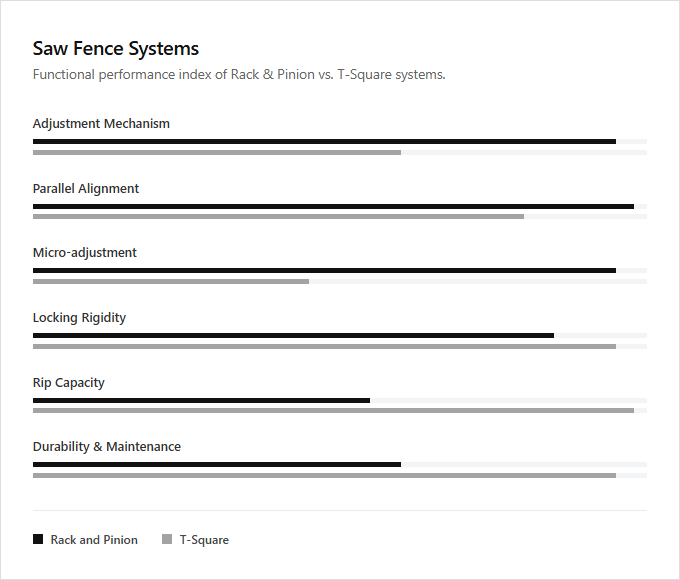
| Adjustment Mechanism | The rack and pinion system utilizes a gear-and-track mechanism for synchronized movement, whereas the T-square system slides freely along a front guide tube before manual locking. |
| Parallel Alignment | Rack and pinion fences maintain parallel alignment automatically via dual-rail synchronization gears, while T-square fences rely on a self-squaring three-point locking system to align with the miter slot. |
| Micro-adjustment | Fine-tuning on a rack and pinion fence is achieved through a dial-actuated pinion gear, whereas T-square adjustments require manual nudging and visual alignment against a cursor tape scale. |
| Locking Rigidity | T-square fences clamp securely to the front rail using a cam-action lever for high rigidity, while rack and pinion fences lock both the front and rear rails simultaneously to prevent deflection under heavy stock feed rates. |
| Rip Capacity and Footprint | T-square fences are highly scalable for large cabinet saws with extended angle-iron guide rails, whereas rack and pinion designs are typically restricted to telescoping rails on portable jobsite saws. |
| Durability and Maintenance | The exposed gears of a rack and pinion mechanism are susceptible to sawdust clogging and require regular debris clearance, while the solid steel construction of a T-square fence offers high durability with minimal maintenance. |
Dual-linkage gear synchronization versus three-point locking alignment for blade parallelism.
Rack and pinion fence systems utilize dual-linkage gear synchronization to maintain blade parallelism. By engaging gears on both the front and rear rails simultaneously, the fence moves in perfect harmony. This mechanical coupling prevents skewing, ensuring the guide remains parallel to the blade throughout its travel without manual alignment.
In contrast, the T-square fence relies on a three-point locking alignment system. This design secures the fence firmly to the front rail, using a robust clamping mechanism that pulls the guide square when engaged. While it lacks synchronized gears, the heavy-duty lock delivers exceptional rigidity and repeatable accuracy across large work surfaces.
Rack and pinion systems suit mobile tradespeople needing fast, micro-adjusted accuracy on the go, whereas T-square fences are ideal for stationary workshop cabinetmakers demanding maximum rigidity for heavy sheet goods.
Pinion Backlash vs. Wear-Pad for Zero-Play Calibration
The rack and pinion fence system maintains parallelism using geared tracks on the front and rear of the saw. Achieving zero-play calibration requires addressing pinion backlash, which is typically managed through adjustable gear mesh engagement or spring-loaded split pinions that eliminate microscopic slop between the teeth during fine adjustments.
In contrast, the classic T-square fence locks securely to a single front guide tube. Zero-play calibration relies on adjusting low-friction wear pads inside the T-head using set screws, which eliminates lateral play and compensates for physical wear along the steel rail over time.
Mobile tradespeople requiring rapid, synchronized adjustments on portable saws benefit most from the rack and pinion system, whereas stationary shop woodworkers prioritizing heavy-duty ripping and simple, long-term maintenance prefer the robust T-square fence.
Telescoping rail runout versus heavy-gauge steel guide bar cantilevered deflection.
The rack and pinion fence system utilizes gears and telescoping rails to maintain parallelism. While highly adjustable, telescoping rails are susceptible to minor runout and play when fully extended, as the segmented components introduce cumulative tolerances.
The classic T-square fence locks securely onto a single, heavy-gauge steel guide bar. While this design minimizes structural flexing, it relies heavily on the clamping mechanism's rigidity to prevent cantilevered deflection at the far end under heavy lateral pressure.
The rack and pinion design suits mobile contractors needing rapid, repeatable adjustments on the go, whereas the robust T-square configuration is ideal for dedicated shop woodworkers prioritizing absolute rigidity and heavy sheet goods processing.
Micro-adjust dial-wheel precision versus manual tap-tuning for dimensional tolerance.
The rack and pinion fence system utilizes a geared track paired with a micro-adjust dial-wheel to guide the barrier parallel to the blade. This mechanical design provides predictable, incremental adjustments, allowing operators to achieve precise dimensional tolerances without manual alignment errors. The interlocking gears ensure the fence remains perfectly square throughout its travel, reducing setup time for critical cuts.
In contrast, the classic T-square fence relies on a robust single-point locking mechanism sliding along a front rail. Achieving tight tolerances with this system requires manual tap-tuning, where the operator gently nudges the fence into position before clamping it secure. The rack and pinion system is ideal for mobile contractors who require rapid, dial-in accuracy on the jobsite, whereas the T-square fence suits dedicated shop woodworkers who prioritize heavy-duty rigidity and traditional tactile calibration.
Two-point rack clamping rigidity versus single-ended head casting locking force.
When evaluating table saw fence designs, the choice between a rack and pinion system and a traditional T-square fence centers on their locking mechanisms. The rack and pinion system utilizes a two-point clamping method, securing the fence at both the front and rear rails. This dual-point engagement ensures excellent parallelism and prevents the rear of the fence from deflecting under lateral pressure during heavy cuts.
The classic T-square fence relies on a massive single-ended head casting that clamps exclusively to the front rail. This design delivers immense locking force at the operator's end, relying on a heavy-duty steel body to maintain rigidity across the table span. Jobsite professionals seeking fast, highly precise micro-adjustments typically prefer the rack and pinion design, while stationary shop woodworkers executing heavy rip cuts on large sheet goods benefit most from the robust clamping force of the T-square system.
Gear-teeth pitch consistency versus optical cursor parallax error.
The rack and pinion fence utilizes a mechanical gear drive to maintain parallel alignment. Its strength lies in gear-teeth pitch consistency, ensuring the front and rear of the fence move in perfect synchronization to eliminate skewing. In comparison, the T-square fence locks from a single headpiece and relies on visual scales, making it susceptible to optical cursor parallax error where viewing angle variations cause minor reading discrepancies.
Portable jobsite installers requiring rapid, micro-adjusted repeatability benefit most from the rack and pinion design, whereas industrial shop woodworkers prioritizing maximum rip capacity and heavy structural rigidity are best suited for the T-square system.
Self-squaring pinion geometry versus fence face parallelism calibration.
Rack and pinion fence systems utilize dual geared tracks engaged by a control shaft to maintain alignment. The inherent geometry of the interlocking pinions ensures both ends of the fence move in perfect unison, providing reliable self-squaring functionality. This mechanical synchronization minimizes the risk of skewing during quick adjustments, relying primarily on the factory-machined precision of the gears for parallel movement.
In contrast, T-square fences lock securely onto a single robust front guide rail. While they lack dual-track synchronization, they offer accessible manual calibration mechanisms, such as set screws, to fine-tune fence face parallelism relative to the miter slot. Rack and pinion systems are ideal for jobsite operators prioritizing rapid, dependable setups, while T-square fences suit dedicated workshop woodworkers who demand meticulous, user-calibrated precision.
Leave a comment