
Woodworkers and carpenters often face a frustrating bottleneck: attempting to execute wide crosscuts only to find their equipment falling short, resulting in wasted material and compromised precision. Before committing workshop funding to high-end machinery, builders typically look to maximize their standard equipment budgets on foundational shop assets.
However, selecting the correct miter saw configuration grants your shop the immediate capability to tackle wider boards and complex bevels with absolute accuracy. This decision comes with the stipulation that expanded capacity invariably introduces trade-offs in bench space, tool weight, and overall cost. For example, upgrading to a 10-inch sliding miter saw yields vastly different capacity dynamics than relying on a traditional 12-inch dual-bevel compound model.
To help you navigate this investment, this article will compare the mechanics, crosscut capacities, and footprint requirements of both sliding and compound miter saws, providing a clear roadmap to the best choice for your workspace.
| Factor | Summary |
|---|---|
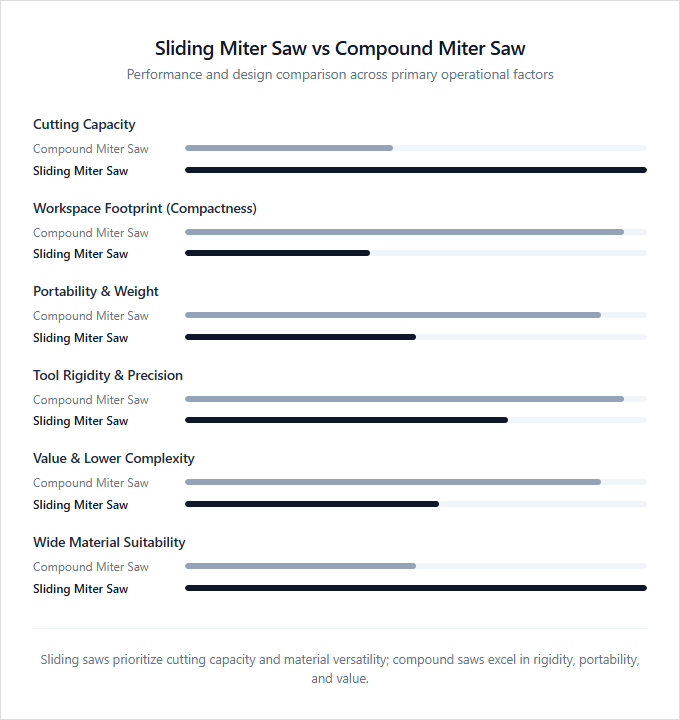
| Cutting Capacity | Sliding miter saws utilize radial guide rails to significantly increase the maximum crosscut width, whereas standard compound miter saws are limited by the physical diameter of the circular saw blade. |
| Workspace Footprint | Sliding miter saws require a substantially larger operational footprint to accommodate the rearward clearance of the guide rails during operation, unlike the compact design of a non-sliding compound miter saw. |
| Portability and Weight | Compound miter saws are inherently lighter and more portable because they lack the heavy steel rail assemblies and linear bearings found on sliding models. |
| Tool Rigidity and Deflection | Non-sliding compound miter saws offer superior rigidity and less blade deflection during bevel cuts because the motor head pivots on a fixed arm rather than traveling along rails. |
| Cost and Complexity | Sliding miter saws command a higher retail price due to the complex manufacturing tolerances required for smooth sliding carriage mechanisms and dual bevel adjustments. |
| Material Suitability | Sliding miter saws are ideal for wide dimensional lumber and crown molding lay-flat cuts, whereas compound miter saws excel at standard trim work and smaller lumber crosscuts. |
How Sliding Rails Increase Miter Saw Crosscut Capacity
When selecting between miter saws, the primary distinction lies in the cutting mechanism. Standard compound miter saws operate on a fixed pivot arm, restricting the blade's travel to a vertical and rotational arc. Sliding miter saws incorporate linear guide rails that allow the motor and blade assembly to glide forward and backward. This sliding action exponentially increases the maximum crosscut capacity, enabling the tool to handle significantly wider boards than a fixed-pivot counterpart of the same blade size.
While compound miter saws excel at precise, repetitive bevel and miter cuts on narrower stock, the sliding variant provides the versatility needed for dimensional lumber and wide shelving. Standard compound saws are ideal for trim carpenters and DIYers focusing on crown molding, whereas sliding miter saws are best suited for deck builders and woodworkers who regularly manipulate wide workpieces.
Why Sliding Saws Cut Wider Than Standard Models
When selecting a miter saw, understanding how design influences cut capacity is essential. Standard compound miter saws rely entirely on blade diameter to dictate cut width, limiting their reach to the physical size of the blade. In contrast, sliding models bypass this restriction via horizontal travel, utilizing guide rails that allow the blade assembly to move forward and backward to crosscut significantly wider boards.
This structural difference directly dictates the utility of each tool on the job site. Standard compound saws are ideal for trim carpenters and DIYers focusing on crown molding, whereas sliding miter saws are best suited for deck builders and framers who regularly handle wide dimensional lumber.
Dual-Bevel Miter Saws: Cutting Without Flipping
Choosing between a compound miter saw and a sliding miter saw depends largely on material dimensions and project complexity. Standard compound miter saws pivot to make angled cuts and bevels, making them highly efficient for standard trim work and molding.
Sliding compound miter saws incorporate a rail system that allows the blade to glide forward and backward, drastically increasing the cutting capacity for wider boards. Additionally, sliding compound miter saws often feature dual-bevel functionality to execute complex bevel angles in both directions without flipping the workpiece. This dual-bevel capability streamlines workflow and enhances precision on intricate cuts.
Standard compound saws are ideal for DIY homeowners undertaking basic molding projects, whereas sliding models are best suited for professional contractors and timber framers who regularly work with wide lumber and complex joists.
Sliding vs. Fixed Miter Saw Space Requirements
When choosing between a sliding miter saw and a compound miter saw, spatial requirements represent a critical decision factor for workshop design. A traditional compound miter saw features a fixed-head design, yielding a highly compact footprint that easily integrates into tight spaces or flush against a workshop wall. The sliding carriage assembly of a sliding miter saw projects backward during operation, demanding substantial rear clearance to accommodate the guide rails.
This physical distinction directly impacts cutting capacity. While the sliding mechanism enables the blade to travel forward to crosscut wider boards, the fixed-head design remains limited to the blade's diameter. Dedicated carpenters working with wide dimensional lumber benefit most from the sliding model, whereas mobile contractors prioritizing portability and limited bench space find the compact compound miter saw ideal.
Compound Saw Stability vs. Sliding Saw Deflection
When selecting a miter saw for professional woodworking, the choice between sliding and compound models hinges on the balance between cutting capacity and absolute precision. Sliding miter saws utilize lateral rails to extend the cutting width, allowing users to crosscut wider boards. However, this design introduces the potential drawback of rail deflection, where the guide rails flex slightly under downward pressure, which can compromise the exactness of the cut.
Conversely, the compound miter saw features a rigid pivot arm that eliminates the need for rails. This stationary mechanism provides superior stability and minimizes blade play, ensuring highly repeatable and accurate bevel and miter cuts. Precision-focused trim carpenters and cabinetmakers typically find the stable compound saw ideal, whereas general contractors and deck builders requiring maximum cutting width benefit more from the versatility of the sliding saw.
Miter Saw Detents and Sliding Angle Capacity
When selecting between a sliding miter saw and a compound miter saw, understanding how each handles angles and material width is essential. Both configurations utilize integrated miter detent plates with positive stops, allowing operators to quickly and accurately lock the blade into common angles for efficient repeat cuts. However, as cutting angles become more extreme, the structural differences become apparent. Sliding models rely on guide rails to maintain their expansive cutting capacity even at acute angles, whereas standard compound saws experience reduced width capacity when pivoted.
Choosing the right tool depends entirely on your project requirements and material dimensions. Compact compound miter saws are ideal for trim carpenters and DIYers focusing on crown molding and standard framing, while sliding miter saws are best suited for furniture makers and deck builders who regularly cut wide boards and require maximum capacity at any angle.
Why Dust Extraction Is Harder on Sliding Saws
When comparing sliding and compound miter saws, dust management represents a critical differentiator in workshop maintenance. Compound miter saws feature a stationary cutting head, allowing manufacturers to position a fixed dust chute directly behind the blade path to capture debris efficiently.
Sliding miter saws present a greater challenge for effective dust extraction. Because the cutting head travels along rails during operation, the source of the dust constantly moves relative to the collection port, which often results in more airborne debris escaping into the workspace.
Contractors requiring maximum portability and clean workshop environments typically benefit from the compound miter saw, whereas dedicated woodworkers and furniture makers who prioritize cut capacity over dust containment are better suited for the sliding miter saw.
Leave a comment