
Equipping a workshop with the right machinery often presents a frustrating dilemma for woodworkers: how to achieve flawless accuracy on both rip cuts and crosscuts without duplicating expensive machinery. Traditionally, craftsmen look to standard capital investments-such as high-end band saws or standard jobsite tools-to bridge this capability gap, yet these options often fall short of professional demands. Selecting the correct stationary saw, however, grants woodworkers the clinical precision and raw power necessary to elevate their craft to commercial standards.
As a crucial stipulation, it is important to note that while both table saws and radial arm saws can technically perform both cuts, their mechanical designs prioritize entirely different operations. Professional furniture makers and cabinet shops, for instance, carefully allocate space for each machine based on their primary workflow. In this guide, we will analyze the key mechanical differences, safety profiles, and spatial footprints of both tools to help you determine which saw best serves your workshop's needs.
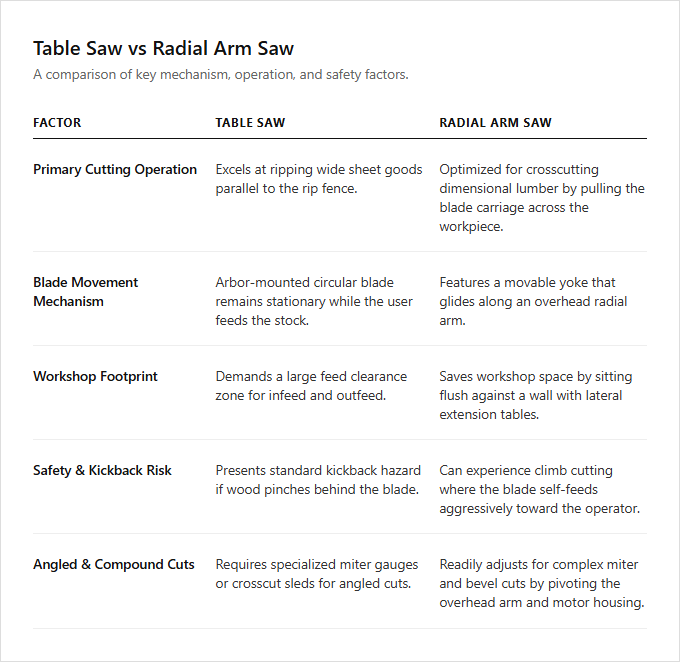
| Factor | Summary |
|---|---|
| Primary Cutting Operation | Table saws excel at ripping wide sheet goods parallel to the rip fence, whereas radial arm saws are optimized for crosscutting dimensional lumber by pulling the blade carriage across the workpiece. |
| Blade Movement Mechanism | In a table saw, the arbor-mounted circular blade remains stationary while the user feeds the stock, whereas a radial arm saw features a movable yoke that glides along an overhead radial arm. |
| Workshop Footprint | Table saws demand a large feed clearance zone for infeed and outfeed, while radial arm saws save workshop space by sitting flush against a wall with lateral extension tables. |
| Safety and Kickback Risk | Table saws present a hazard of standard kickback if wood pinches behind the blade, whereas radial arm saws can experience climb cutting where the blade self-feeds aggressively toward the operator. |
| Angled and Compound Cuts | Radial arm saws readily adjust for complex miter and bevel cuts by pivoting the overhead arm and motor housing, while table saws require specialized miter gauges or crosscut sleds for similar angles. |
Table saw rip fence alignment for precise rip cuts
When comparing stationary woodworking machinery for ripping operations, the table saw generally outperforms the radial arm saw in safety and precision. Achieving accurate rip cuts on a table saw relies heavily on precise rip fence alignment. The fence must be perfectly parallel to the blade; even a minor misalignment can cause wood binding, burn marks, or dangerous kickback. Woodworkers typically calibrate the fence using the miter slot as a reference point, measuring to the front and back of the blade to ensure parallel alignment.
While the radial arm saw excels at crosscutting and complex joinery, the table saw remains the industry standard for reliable, high-volume straight ripping. Table saws are best suited for production-oriented cabinetmakers who require highly repeatable parallel cuts, whereas radial arm saws are ideal for workshop traditionalists who prioritize versatile crosscutting and dadoing over continuous sheet goods processing.
Radial arm saw yoke rotation for complex miter cuts
While a table saw relies on moving the workpiece across a fixed blade, the radial arm saw keeps the material stationary while the blade travels. This stationary workpiece setup excels in complex joinery due to the radial arm saw's yoke rotation. By rotating the yoke horizontally and tilting the motor bevel, operators can execute highly precise, compound miter cuts from above the wood. This overhead visibility and control offer distinct advantages when crafting intricate architectural details.
Table saws execute miter cuts by using a miter gauge or specialized sled to guide the wood past the blade, which is highly efficient for repeat production but less practical for long, angled timber. Dedicated furniture makers requiring intricate, stationary joinery cuts are best served by the radial arm saw, whereas general carpenters and cabinetmakers prioritizing high-volume ripping and sheet-good processing will find the table saw more suitable.
Table saw riving knife installation to mitigate kickback
While both the table saw and the radial arm saw are workshop staples, they manage cutting forces differently. On a table saw, the blade rotates toward the operator, presenting a significant risk of kickback if the workpiece pinches. Installing a riving knife is a critical safety measure; this curved steel plate mounts directly behind the blade and moves in tandem with it, keeping the wood kerf open to prevent binding and dangerous kickback events.
Conversely, the radial arm saw pulls the blade across stationary wood, which alters the direction of force and reduces traditional kickback but introduces self-feeding risks. Dedicated furniture makers requiring precise rip cuts and sheet goods processing excel with a table saw, whereas carpenters focusing on heavy crosscutting and timber framing are better suited for a radial arm saw.
Radial Arm Saw Carriage Travel for Crosscuts
The fundamental distinction between a table saw and a radial arm saw lies in how the blade interacts with the workpiece. While a table saw requires the operator to feed moving lumber past a fixed, surface-mounted blade, the radial arm saw operates on the opposite principle during crosscuts. The wood remains completely stationary on the table surface, while the operator pulls the overhead blade carriage smoothly across the lumber, offering exceptional control and visibility during the cut.
This structural difference dictates their practical applications in a workshop. The table saw is highly versatile for ripping wide sheet goods, whereas the radial arm saw excels in dedicated crosscutting and mitering stations. The table saw is best suited for cabinetmakers needing versatile ripping and sheet-processing capabilities, while the radial arm saw is ideal for carpenters who consistently process long, heavy timber.
Table saw arbor tilt mechanism for executing bevel cuts
The table saw executes precise bevel cuts through its internal arbor tilt mechanism. This system pivots the blade assembly beneath the cast-iron table surface, typically adjusting from 90 to 45 degrees while the workpiece remains flat. This configuration ensures exceptional stability and safety, as gravity helps keep the wood secure against the rip fence and table during angled cuts.
In contrast, the radial arm saw cuts bevels by tilting the entire motor and blade carriage suspended above the stationary material. While this overhead design excels at crosscutting, it demands frequent calibration to maintain accuracy for beveling. Cabinetmakers seeking flawless, repeatable rip-bevels prefer the table saw, while contractors and workshop hobbyists needing versatile crosscutting and compound angles are best suited for the radial arm saw.
Radial arm saw climb cutting tendency during pull-stroke operations
When comparing table saws and radial arm saws, understanding their distinct mechanical behaviors is crucial for workshop safety. While a table saw feeds material against the rotation of a fixed blade, a radial arm saw operates by pulling the active blade across stationary wood. During this pull-stroke operation, the blade rotates in the direction of the cut, creating a strong tendency for climb cutting. This means the blade attempts to climb onto the workpiece and self-feed rapidly toward the operator, presenting a significant control hazard.
Managing this self-feeding behavior requires firm physical control and the installation of specialized negative-hook blades to mitigate sudden lurching. Conversely, the table saw offers a highly stable platform where the wood is pushed, minimizing the risk of the machine overriding the operator's grip. Cabinetmakers and high-volume workshops prioritizing straight, repetitive ripping find the table saw indispensable, whereas traditional carpenters and furniture makers requiring versatile crosscutting, dadoing, and complex beveling benefit most from a radial arm saw.
Table saw outfeed table integration for managing large sheet goods
When processing large sheet goods like plywood, the workshop's spatial workflow determines tool selection. A table saw excels in this domain because it allows for the seamless integration of an outfeed table, which supports the material as it exits the blade. This setup ensures continuous, stable control during long rip cuts, minimizing the risk of workpiece tipping. Conversely, a radial arm saw keeps the wood stationary while the blade moves, making the management of oversized sheets highly impractical.
While the radial arm saw remains a superb choice for dedicated crosscutting, it cannot match the high-volume panel capacity of a supported table saw. Production-oriented woodworkers prioritizing cabinet making and sheet breakdown will thrive with an integrated table saw system, whereas custom furniture makers focusing on precise crosscutting and joinery are better served by a radial arm saw.
Leave a comment