
Many woodworkers struggle with bogged-down motors, excessive tear-out, and wasted material, often blaming their skills rather than their tooling. While upgrading to high-end machinery is the standard investment path most shops take to resolve these performance issues, the real culprit is frequently the basic choice of blade thickness. Opting for the correct configuration grants woodworkers an immediate increase in feed rate and cleaner finishes without the need for costly machinery upgrades.
We must stipulate, however, that optimal cutting efficiency is strictly bound by your saw's horsepower and the specific materials you process. For example, forcing a full-kerf blade through dense 8/4 walnut on a standard 1.5 HP jobsite saw will inevitably cause burning and motor strain.
This guide examines the critical differences between thin and full-kerf blades, evaluates how horsepower dictates your choice, and provides a clear decision framework to optimize your shop's cutting efficiency.
| Factor | Summary |
|---|---|
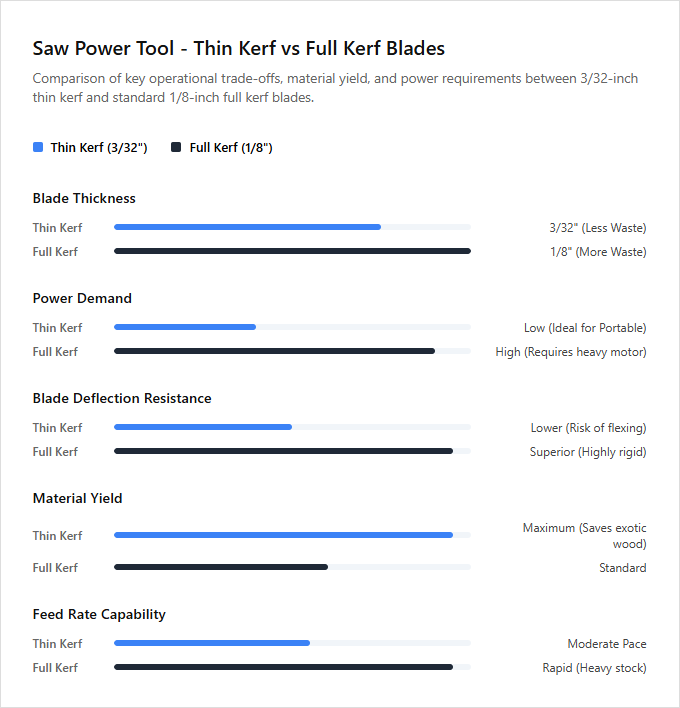
| Blade Thickness | Thin kerf blades measure approximately 3/32 inches whereas full kerf blades are a standard 1/8 inch wide, directly impacting the volume of material wasted as sawdust. |
| Power Demand | Thin kerf blades require significantly less horsepower from the saw motor because they encounter less resistance, making them ideal for jobsite and portable saws. |
| Blade Deflection | Full kerf blades offer superior resistance to blade deflection and warping, ensuring highly accurate cuts in thick, dense hardwoods. |
| Material Yield | Using a thin kerf blade maximizes material yield by minimizing the width of the cut path, which is highly beneficial when working with expensive exotic woods. |
| Feed Rate | The heavier plate of a full kerf blade allows for a faster feed rate through heavy stock without risking blade body distortion or motor stalling. |
Motor horsepower rating compatibility
When selecting between thin and full kerf saw blades, matching the blade width to your tool's motor horsepower is critical for optimal performance. Thin kerf blades, measuring approximately 3/32 inches, remove less material and require significantly less power. They are engineered specifically for portable, jobsite, or contractor saws with motors rated under 1.5 horsepower, preventing the motor from bogging down during cuts.
Conversely, full kerf blades are 1/8 inch wide and demand substantial power to drive through dense material. These thicker blades require motors rated at 1.5 horsepower or higher, typically found in stationary workshop cabinet saws, to prevent stalling and ensure a clean finish.
DIY hobbyists and mobile contractors operating light-duty power tools are best suited for thin kerf blades, whereas professional furniture makers and industrial woodworkers utilizing high-powered stationary machinery require the stability of full kerf blades.
Blade plate deflection and runout
Thin kerf blades, while conserving material and requiring less motor power, have thinner plates that are more susceptible to deflection and runout under heavy lateral loads. This inherent flexibility can lead to minor deviations in the cut path and a rougher surface finish when forcing the feed rate. In contrast, full kerf blades feature a thicker, more rigid plate that resists heat deformation and mechanical deflection, ensuring exceptional stability and superior runout control during demanding operations.
The increased mass of full kerf blades demands a high-horsepower saw to maintain optimal rotational speed without stalling. Jobsite contractors and DIYers using portable, lower-powered saws benefit most from the efficiency of thin kerf blades, whereas professional furniture makers utilizing stationary cabinet saws require the uncompromising precision of full kerf blades.
Riving knife thickness alignment
When choosing between thin and full kerf saw blades, matching the blade width to the table saw's riving knife is critical for workshop safety. The riving knife must always be thicker than the steel plate of the blade body, but slightly thinner than the teeth's cutting path. Utilizing a thin kerf blade (typically 3/32 inch) with a standard riving knife designed for full kerf blades (1/8 inch) causes the wood to bind on the splitter, creating a severe kickback hazard.
To ensure smooth material passage, a full kerf blade requires a matching thicker riving knife, whereas a thin kerf blade demands a dedicated, thinner knife. High-volume professional woodworkers using high-horsepower cabinet saws benefit most from the stability of full kerf blades, whereas DIY hobbyists and jobsite contractors using portable, lower-powered saws are best suited for thin kerf blades to conserve motor power.
Kerf loss and material yield optimization
Selecting between thin and full kerf saw blades directly impacts material yield and power tool efficiency. Thin kerf blades, typically measuring 3/32 inch, minimize kerf loss by removing less wood, making them highly efficient for maximizing yield when working with expensive hardwoods. This narrower cut requires significantly less horsepower, which reduces strain on smaller jobsite table saws and conserves valuable stock.
Conversely, full kerf blades, at 1/8 inch wide, sacrifice more material to sawdust but offer superior stability and deflection resistance during heavy-duty cutting. This extra thickness prevents blade warping in thick, dense materials and ensures perfectly flat, accurate cuts. Thin kerf options are ideal for DIY hobbyists and contractors using portable saws to maximize material yield, while full kerf blades are best suited for professional cabinetmakers and industrial shops operating high-horsepower machinery.
Cutting resistance and feed rate dynamics
Thin kerf blades, typically measuring 3/32 inches, remove less material during operation. This narrow profile significantly lowers cutting resistance, allowing saw motors to maintain high RPMs with minimal effort. This dynamic allows users to maintain a faster feed rate without bogging down lower-horsepower jobsite or cordless saws.
Full kerf blades, at a standard 1/8 inch, encounter greater cutting resistance due to increased material displacement. This requires higher torque and a more deliberate, controlled feed rate to prevent motor strain, though the thicker body provides superior stability and resists warping. Thin kerf options are ideal for DIYers and mobile contractors utilizing portable tools, whereas full kerf blades are best suited for professional cabinetmakers operating high-horsepower stationary machinery.
Thermal dissipation and plate expansion slots
Thin kerf blades, typically measuring 3/32 inches wide, generate significant heat due to their narrow profile. Because the thinner steel plate is highly susceptible to thermal warping, manufacturers incorporate engineered expansion slots. These laser-cut slots allow the metal to expand outward under thermal stress rather than buckling, which maintains cutting accuracy and prevents the blade from binding in the cut.
Standard full kerf blades feature a 1/8-inch thickness, providing a larger thermal mass that naturally dissipates heat more effectively. While they still utilize expansion slots to manage operational stress, their robust body resists deflection under heavy loads. Thin kerf blades are ideal for jobsite carpenters using portable, lower-horsepower saws, whereas full kerf blades are best suited for professional woodworkers and industrial shops operating high-powered, stationary machinery.
Carbide tip volume and resharpening lifespan
Full kerf saw blades feature significantly larger carbide tips than their thin kerf counterparts. This greater volume of carbide allows full kerf blades to withstand heavier impacts and dissipate heat more effectively during demanding cuts. Conversely, thin kerf blades utilize smaller carbide tips to minimize material waste and reduce the strain on less powerful saw motors.
The difference in carbide mass directly impacts the resharpening lifespan of each blade. Full kerf blades can be resharpened multiple times, offering long-term cost efficiency for high-volume workshops. Thin kerf blades have a limited sharpening lifespan before the tips become too thin for safe operation. Professional woodworkers operating high-powered stationary cabinet saws benefit most from durable full kerf blades, whereas jobsite contractors and DIY enthusiasts utilizing portable or cordless saws are better suited for efficient thin kerf blades.
Leave a comment