
Contractors and project managers often struggle to select the optimal framing nailer, constantly battling the realities of tight joist corners, tool weight fatigue, and strict job-site safety requirements. While standard equipment procurement budgets typically focus on upfront tool costs or brand loyalty, focusing solely on these metrics overlooks the critical impact of collation angles.
Aligning your tool selection with the demands of your specific building environment is a strategic decision that grants operators unmatched maneuverability, faster cycle times, and reduced labor costs. However, this productivity boost comes with a key stipulation: tool utility is heavily dictated by regional building codes. For example, some jurisdictions mandate paper-collated 30-degree nails over plastic-collated 21-degree alternatives to prevent hazardous job-site debris, a standard increasingly enforced by the International Code Council (ICC).
In this guide, we will break down the crucial differences between 21-degree and 30-degree framing nailers, comparing their magazine capacities, fastener types, and spatial clearance to help you make the most profitable choice for your crew.
| Factor | Summary |
|---|---|
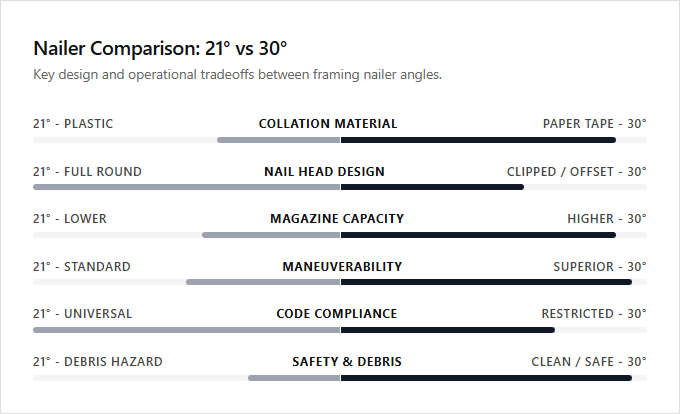
| Collation Material | While 21-degree nailers use plastic-collated fasteners that break apart upon firing, 30-degree nailers utilize paper-tape collation which holds the nails closer together and leaves less jobsite debris. |
| Nail Head Design | The 21-degree framing nailers typically fire full round head fasteners, whereas 30-degree models often use clipped head or offset-head nails to allow tighter nesting in the magazine. |
| Magazine Capacity | Due to the steeper angle and tighter spacing of paper collation, 30-degree nailers offer a higher magazine capacity compared to the lower fastener count of 21-degree plastic-strip nailers. |
| Maneuverability | The steeper magazine angle of a 30-degree nailer provides superior clearance for toe-nailing in tight joist bays compared to the bulkier profile of a 21-degree tool. |
| Building Code Compliance | Many municipal jurisdictions enforce strict shear strength structural codes that mandate full round head nails, which historically favored 21-degree nailers over clipped-head alternatives. |
| Safety and Debris | Using a 21-degree nailer produces flying plastic collation shards that can pose an eye hazard and clutter the workspace, whereas 30-degree paper tape is cleanly driven into the substrate. |
Plastic collation versus paper-tape collation media
The primary distinction between 21-degree and 30-degree framing nailers lies in their collation media. A 21-degree nailer utilizes plastic-collated nails, where plastic bands hold the fasteners. During firing, the tool shears the plastic, scattering debris across the workspace. While plastic strips are highly water-resistant and durable under rough handling, they hold fewer nails per strip, leading to more frequent reloading.
In contrast, 30-degree nailers feature paper-tape collation. These nails are bound tightly with paper and glue, allowing a higher magazine capacity and a more compact tool design. This system leaves no jobsite mess, though the paper requires protection from wet weather to prevent degradation. Outdoor contractors working in damp climates often prefer the durable 21-degree plastic system, whereas high-volume production framers seeking efficiency and clean jobsites typically opt for the 30-degree paper-tape configuration.
Full round head versus clipped head fastener geometry
The primary distinction between 21-degree and 30-degree framing nailers lies in their magazine angles and compatible fastener geometry. A 21-degree nailer utilizes plastic-collated, full round head nails. These traditional fasteners provide maximum holding power and readily comply with strict municipal building codes in high-wind or seismic regions.
The 30-degree framing nailers typically drive paper-collated, clipped head nails, though some modern designs accommodate offset round heads. This clipped geometry allows the fasteners to be packed tightly together, which significantly increases magazine capacity and reduces downtime on the job site. Structural builders requiring strict code compliance favor the 21-degree model, whereas high-production framing contractors prioritizing speed and tool maneuverability benefit most from the 30-degree system.
Toe-nailing clearance and magazine angle maneuverability
Framing nailers differ significantly in their magazine angles, which directly impacts maneuverability in tight spaces. A 21-degree nailer features a less steep angle, resulting in a longer, bulkier magazine that can restrict movement between closely spaced studs. In contrast, a 30-degree nailer offers a much steeper magazine profile, allowing the tool to fit easily into constricted joists and rafters.
When toe-nailing, the physical clearance of the tool dictates success. The compact design of the 30-degree model permits tight angling close to the wood surface without the magazine obstructing the strike path. The 21-degree models require more physical clearance, making them slightly more cumbersome for awkward angles. Heavy-duty framing contractors working in tight residential spaces prefer the agile 30-degree design, while budget-conscious DIYers and high-volume builders utilizing standard plastic-collated nails favor the stable, widely compatible 21-degree option.
International Residential Code structural fastening compliance
When evaluating framing nailers for structural carpentry, compliance with the International Residential Code (IRC) is a primary consideration. The 21-degree nailer utilizes plastic-collated, full round-head nails, which universally satisfy IRC prescriptive fastening schedules without requiring engineering documentation. In contrast, 30-degree nailers frequently use paper-collated, clipped-head or offset round-head nails. While the IRC permits clipped-head fasteners of equivalent shank diameter, certain seismically active or high-wind jurisdictions impose strict local amendments that restrict their use.
Choosing between these systems depends on regional engineering mandates and jobsite conditions. The 21-degree model is ideal for traditional framers in coastal regions who require guaranteed code acceptance, whereas the high-capacity, highly maneuverable 30-degree model best serves high-volume production carpenters working in areas with standard structural building codes.
Magazine capacity and nail loading density
The primary distinction between 21-degree and 30-degree framing nailers lies in their collation method and nail density. 21-degree nailers utilize plastic-collated nails, which require wider spacing between each fastener. This design results in a lower nail loading density within the magazine. In contrast, 30-degree nailers employ paper-collated strips that allow the nails to be nested tightly together, significantly increasing the density of the load.
Because of this difference in spacing, 30-degree nailers feature a much higher magazine capacity, reducing downtime for reloading on busy jobsites. The 21-degree models, while holding fewer nails, are preferred in regions with strict building codes regarding plastic debris. High-volume framing contractors benefit most from the compact, high-capacity 30-degree models, while residential builders in strict regulatory zones are better suited for the 21-degree systems.
Plastic projectile debris fragmentation versus clean paper shear
The choice between a 21-degree and a 30-degree framing nailer often comes down to the collation material and its impact on the workspace. 21-degree nailers utilize plastic-collated nails. During firing, the driver blade breaks the rigid plastic strip, which frequently causes sharp plastic projectile debris fragmentation to scatter across the job site, requiring additional cleanup and eye protection.
Thirty-degree nailers employ paper-collated nails. This design achieves a clean paper shear, as the paper tape is shear-cut and driven directly into the wood with the fastener, leaving no messy fragments on the floor. 21-degree models are ideal for outdoor framing carpenters who prioritize cheaper bulk fasteners, while 30-degree models best serve indoor remodelers and premium contractors who demand a pristine, hazard-free work environment.
Fastener shank diameter and withdrawal resistance specifications
The choice between 21-degree and 30-degree framing nailers depends heavily on fastener specifications. 21-degree nailers utilize full round-head nails with larger shank diameters, typically ranging from 0.113 to 0.162 inches. In comparison, 30-degree models accommodate clipped-head or offset round-head nails with slightly thinner shanks, generally between 0.113 and 0.131 inches, to facilitate tighter collation.
These physical dimensions directly dictate structural withdrawal resistance. The thicker shanks of 21-degree fasteners offer superior shear strength and higher withdrawal resistance, making them ideal for meeting strict seismic and high-wind building regulations. Heavy-duty structural framers requiring maximum holding power benefit most from the 21-degree platform, while high-volume production builders seeking maximum magazine capacity and tool maneuverability prefer the 30-degree system.
Leave a comment