
Woodworkers often struggle with securing perfectly flush, robust joints without visible fasteners ruining the workpiece surface. While standard fastening methods like pocket screws or traditional dowels offer reliable hold, they often lack the lateral flexibility needed during critical glue-up phases.
Transitioning to a plate joiner solves this, as it grants woodworkers precise alignment control and seamless, hidden strength across expansive panels. However, utilizing this tool effectively requires the stipulation that biscuit size must be carefully matched to material thickness to avoid joint failure or wood splitting.
For instance, professional cabinet makers rely on specific sizes-utilizing Size 10 biscuits for delicate face frames and Size 20 biscuits for heavy-duty shelving units. In this article, we will analyze the key differences between Size 10 and Size 20 biscuits, comparing their shear strength, depth requirements, and ideal applications to help you select the perfect joint reinforcement for your next project.
| Factor | Summary |
|---|---|
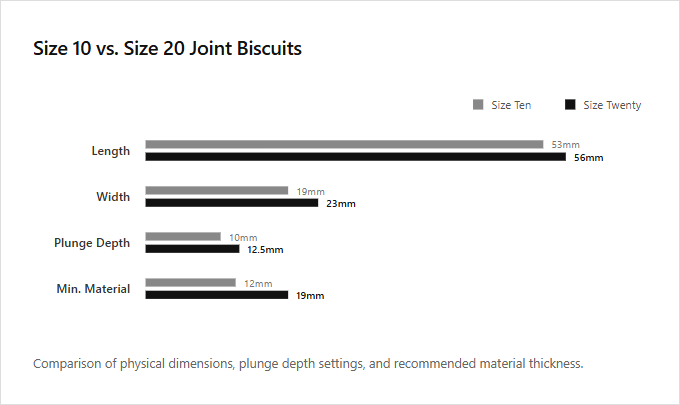
| Physical Dimensions | Size Ten biscuits measure 53mm by 19mm, whereas Size Twenty biscuits are larger at 56mm by 23mm, affecting the overall surface area. |
| Plunge Depth Setting | The plate joiner requires a specific turret depth stop setting, plunging approximately 10mm for Size Ten and 12mm to 13mm for Size Twenty. |
| Material Thickness compatibility | Size Ten biscuits are ideal for medium-thickness workpieces under 15mm, while Size Twenty biscuits are the industry standard for 19mm structural lumber. |
| Tensile and Shear Strength | Size Twenty biscuits provide a larger adhesive bonding surface, resulting in significantly higher shear resistance than Size Ten biscuits. |
| Kerf and Slot Alignment | Both sizes utilize the same 4mm thickness slot cutter, meaning the blade kerf remains constant while only the pocket width and depth change. |
Size 20 biscuits optimize glue surface area for maximum bonding
When utilizing a plate joiner for woodworking, selecting the correct biscuit size is critical for structural integrity. While Size 10 biscuits serve as a versatile option for medium-duty frames and narrower stock, larger joints require a more robust solution. Size 20 biscuits represent the industry standard for heavy-duty applications, offering a significantly larger footprint to handle increased physical stress.
Specifically, Size 20 biscuits optimize the glue surface area to achieve maximum bonding strength within the joint. Because adhesive absorption and face-to-face contact drive joint longevity, the expanded dimensions of the Size 20 biscuit provide the necessary coverage to secure substantial, load-bearing wooden components. This expansion maximizes the glue line, ensuring long-term stability.
Size 10 biscuits are ideal for detail-oriented furniture makers working with thin or delicate materials, whereas Size 20 biscuits are best suited for professional cabinet makers and carpenters constructing large-scale, heavy-use architectural fixtures.
Size 20 biscuits provide higher shear strength in structural joints
When selecting biscuits for a plate joiner, the choice between Size 10 and Size 20 directly impacts joint integrity. Size 10 biscuits are suitable for medium-duty applications in thinner stock, whereas Size 20 biscuits offer a larger surface area and deeper slot penetration. This increased footprint ensures that Size 20 biscuits provide significantly higher shear strength, making them the superior choice for reinforcing structural, load-bearing joints.
Selecting the correct size depends heavily on the thickness of the workpiece and the expected load of the finished piece. Size 10 biscuits are ideal for detail-oriented cabinetmakers working with delicate or narrow panels, while Size 20 biscuits are preferred by professional carpenters and furniture makers constructing heavy-duty, high-stress assemblies.
Prevent Breakouts: Size 10 Biscuit Thickness Limits
When utilizing a plate joiner, selecting the correct biscuit size is essential for maintaining joint integrity and material preservation. Size 10 biscuits, measuring smaller in width and depth than Size 20, are engineered specifically for thinner workpieces. By respecting the minimum material thickness limit of the stock, Size 10 biscuits prevent the cutting blade from breaching the wood surface, thereby eliminating the risk of costly breakout damage.
In contrast, Size 20 biscuits provide a larger surface area, offering maximum tensile strength for robust structural joints. Cabinetmakers and detailed woodworkers working with delicate, thin frames rely on Size 10, whereas general carpenters and furniture builders assembling heavy-duty shelving or tables utilize Size 20.
Match Blade Plunge Settings to Slot Depth
When operating a plate joiner, precise alignment requires matching the tool's plunge depth to the specific biscuit size. For Size Ten (#10) biscuits, the depth dial must be set to the corresponding "10" position to plunge the blade exactly 9.5 millimeters into the wood. Switching to Size Twenty (#20) biscuits requires adjusting the dial to "20", which increases the plunge depth to 12.5 millimeters. Mismatching these settings results in either shallow slots that prevent the joint from closing properly or excessively deep pockets that compromise the strength of the wood.
Calibrating the correct depth ensures optimal glue adhesion and joint stability. Size Ten biscuits are ideal for light framing and thin paneling favored by hobbyists, whereas Size Twenty biscuits are suited for thick tabletops and structural joints crafted by professional woodworkers.
Moisture-induced volumetric expansion of compressed beechwood secures both joint types
Plate joinery relies on compressed beechwood splints, specifically Size 10 and Size 20 biscuits, to align and strengthen wood joints. When water-based adhesive is applied, the moisture-induced volumetric expansion of the compressed beechwood secures both joint types within their mating slots. This rapid cellular swelling creates a high-friction, permanent mechanical bond that reinforces the structural integrity of the assembly.
The primary distinction lies in their physical dimensions and load capacities. Size 10 biscuits measure 53mm by 19mm for medium-duty applications, whereas Size 20 biscuits offer a larger footprint of 56mm by 23mm for maximum surface area contact. Size 10 biscuits are ideal for detail-oriented finish carpenters working with narrow frames, while Size 20 biscuits are best suited for professional cabinetmakers constructing heavy, load-bearing casework.
Size 20 biscuits offer greater lateral adjustment tolerance during assembly
Selecting the appropriate biscuit size is critical for achieving optimal joint strength and alignment. Size 10 biscuits, measuring 53mm by 19mm, are designed for thinner materials and narrower frames where physical space is limited. Size 20 biscuits, measuring 56mm by 23mm, provide a larger surface area for adhesive bonding, making them the standard for medium to heavy-duty wood joints.
A key operational benefit of the larger Size 20 biscuit is its superior lateral adjustment tolerance. The wider slot cut for this size allows for greater movement along the joint line during final glue-up. This flexibility enables precise face-alignment adjustments before clamping, reducing assembly errors compared to the tighter fit of a Size 10.
Cabinetmakers working on narrow face frames will benefit most from Size 10 biscuits, whereas general furniture makers and installers requiring forgiving tolerances and high-strength bonds are better suited for Size 20.
Biscuit Size Dictates Joint Tensile Strength
In plate joinery, selecting between Size 10 and Size 20 biscuits is a critical decision impacting structural integrity. The chosen biscuit size directly dictates the overall tensile load capacity of the joint, as a larger physical footprint allows for increased glue surface area and mechanical purchase. Size 10 biscuits measure approximately 53mm by 19mm, whereas Size 20 biscuits offer a larger 56mm by 23mm profile, providing significantly higher resistance to pulling forces under tension.
Size 10 biscuits excel in narrower stock and medium-duty shelving where material thickness is constrained. Size 20 biscuits are preferred for heavy-duty framing, tabletops, and larger cabinetry projects. Casual hobbyists working on light furniture projects frequently utilize Size 10, while professional cabinetmakers and structural woodworkers require Size 20 for maximum joint durability.
Leave a comment