
Mechanics and DIY enthusiasts frequently struggle with the physical toll and frustration of fastening in claustrophobic spaces, where every quarter-turn of a manual wrench risks busted knuckles and lost time. Traditionally, professionals relied on standard hand ratchets or bulky pneumatic air lines to navigate these tight engine bays. However, integrating a cordless power ratchet grants technicians unprecedented speed and effortless joint-running without the constraint of hoses.
Crucially, one must note the standard operational stipulation: these tools are engineered for swift rundown and accessibility rather than high-torque breakaway power, which is ideal for delicate under-dash work or timing cover replacements but unsuitable for seized suspension bolts. Understanding this boundary is key to maximizing workshop efficiency.
Below, we will analyze the critical distinctions between the power ratchet and the high-torque impact wrench, outlining their specific mechanical roles, torque limitations, and how to choose the optimal tool for your tight-space fastening applications.
| Factor | Summary |
|---|---|
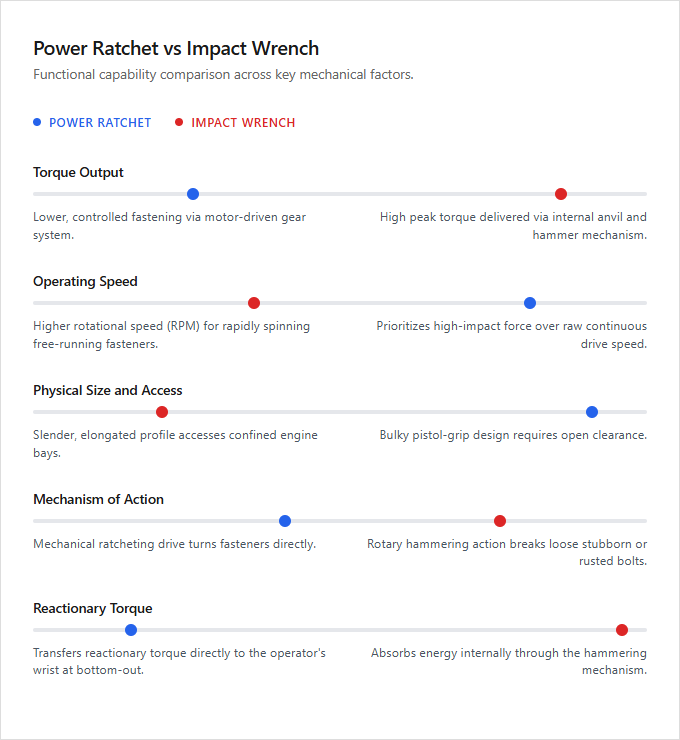
| Torque Output | Impact wrenches utilize an internal anvil and hammer mechanism to deliver high peak torque, whereas power ratchets rely on a motor-driven gear system for lower, controlled fastening. |
| Operating Speed | Power ratchets feature higher rotational speed measured in RPM for rapidly spinning free-running fasteners, while impact wrenches prioritize high-impact force over raw drive speed. |
| Physical Size and Access | The slender, elongated profile of a power ratchet allows it to access confined automotive engine bays, unlike the bulky, pistol-grip design of an impact wrench. |
| Mechanism of Action | An impact wrench uses a rotary hammering action to break loose stubborn or rusted bolts, whereas a power ratchet employs a mechanical ratcheting drive to turn fasteners. |
| Reactionary Torque | Power ratchets transfer reactionary torque directly to the operator's wrist when a fastener bottoms out, whereas impact wrenches absorb this energy internally through their hammering mechanism. |
Low-Profile Yoke Head for Superior Engine Clearance
When selecting fastening tools for automotive maintenance, the physical profile of the tool dictates its utility. A cordless power ratchet features a highly compact, low-profile yoke head design that easily maneuvers into tight engine bays and restricted spaces where hand movement is limited. In contrast, impact wrenches are engineered with bulkier housings and larger motor configurations to deliver high torque, which significantly limits their ability to access confined areas.
For tasks requiring rapid fastening in obstructed recesses, the slim architecture of the power ratchet provides superior clearance without sacrificing control. The robust power of the impact wrench remains necessary for breaking loose stubborn, heavy-duty bolts in open areas. Professional technicians performing intricate engine diagnostics benefit most from the agile power ratchet, while heavy equipment mechanics require the sheer torque of an impact wrench for structural tear-downs.
Why Ratchets Kick Back and Impact Wrenches Don't
When selecting fastening tools, understanding how torque is delivered is essential. A cordless power ratchet utilizes a direct mechanical drive that, upon the fastener seating, transfers reactionary torque directly to the operator's hand and wrist. This sudden feedback requires physical resistance from the user to maintain control and prevent strain during final tightening.
An impact wrench employs a reactionless hammer-and-anvil mechanism. This internal design delivers rapid concussive blows directly to the fastener, isolating the operator from rotational forces even at high torque levels. Power ratchets are ideal for precision mechanics working in tight engine bays, whereas impact wrenches are suited for heavy-duty technicians performing structural assembly or high-torque wheel service.
Manual Breakaway Torque in Power Ratchets
When selecting between a cordless power ratchet and an impact wrench, understanding their mechanical differences is crucial for workshop efficiency. A key advantage of the power ratchet is its ability to function as a manual hand tool. It permits manual breakaway torque application through a locked gear train to loosen stubborn bolts before power engagement. This dual-use capability protects the internal motor while offering precise control in tight, restricted engine bays.
The impact wrench delivers high-torque output through rapid internal hammering mechanisms, designed for loosening heavy-duty fasteners without manual effort. Power ratchets are ideal for automotive technicians performing detailed assembly work, while impact wrenches are best suited for heavy equipment mechanics requiring maximum fastening power.
Impact Wrenches Deliver Far More Torque Than Cordless Ratchets
When selecting fastening tools, understanding the distinction between a power ratchet and an impact wrench is essential. The primary difference lies in their torque delivery. Impact wrenches utilize an internal hammer mechanism to deliver significantly higher dynamic working torque, measured in foot-pounds, while cordless ratchets rely on a motorized gear system that yields a lower, static torque output designed primarily for speed and hand-tightening.
These mechanical differences dictate their distinct applications in automotive and industrial settings. Impact wrenches excel at breaking free stubborn, rusted bolts, while power ratchets optimize productivity in confined engine bays. Professional technicians requiring high-torque fastening are best served by impact wrenches, whereas assembly workers and light-duty mechanics benefit more from the maneuverability of power ratchets.
High-RPM Ratchets: Fast Fastening in Tight Spaces
When selecting the appropriate fastening tool, understanding the distinct mechanical advantages of a power ratchet versus an impact wrench is essential. Power ratchets excel in confined spatial environments where manual rotational clearance is highly restricted. The high no-load speed RPM of a power ratchet facilitates rapid fastener run-down in these tight spaces, allowing professionals to quickly thread bolts without the physical constraints of traditional hand tools.
In contrast, impact wrenches are engineered to deliver high torque through an internal hammering mechanism, making them ideal for loosening stubborn, rusted, or high-tolerance fasteners. While impact wrenches lack the slim, low-profile design of a power ratchet, they provide the raw power necessary for heavy-duty structural tasks. Automotive mechanics requiring speed and maneuverability in cramped engine bays are ideal users for power ratchets, whereas heavy equipment technicians and construction workers are best suited for the high-torque capabilities of impact wrenches.
Small Cordless Ratchets: Built for Precision Fastening
While both power ratchets and impact wrenches are essential fastening tools, they serve distinctly different operational purposes. Cordless power ratchets typically feature smaller 1/4-inch and 3/8-inch square drive sizes, which are engineered specifically for precision fastening and accessing tight, confined spaces. These tools prioritize speed and control over raw power, making them distinct from high-torque impact wrenches designed to loosen stubborn fasteners.
In contrast, impact wrenches utilize larger drive sizes to handle demanding applications such as heavy-duty lug nut removal. Attempting to use a compact cordless ratchet for these high-torque tasks can damage the tool's internal mechanisms. Cordless ratchets are ideal for automotive technicians performing delicate engine work under the hood, whereas impact wrenches are best suited for heavy equipment mechanics and tire service professionals requiring maximum breakaway torque.
Impact Wrenches vs. Power Ratchets: Mechanism Comparison
When selecting the appropriate fastening tool, understanding the mechanical distinction between an impact wrench and a power ratchet is essential. An impact wrench relies on high impacts per minute (IPM) to deliver sudden, concussive torque, which is highly effective for breaking loose rusted or severely seized fasteners.
A power ratchet utilizes a continuous, rotary-driven force to spin fasteners quickly. This mechanical design lacks the raw, explosive torque of an impact tool, but it excels in tight engine bays where physical clearance is limited and speed is prioritized.
Heavy-duty mechanics performing structural suspension work require the high-torque output of an impact wrench, while automotive technicians focusing on rapid disassembly in confined engine compartments are best served by a power ratchet.
Leave a comment