
Professional mechanics and industrial technicians frequently struggle with impact wrenches that fail to deliver consistent torque under load, leading to stalled workflows and damaged fasteners. Traditionally, operators attempt to resolve this by relying on standard purchasing metrics, such as generic brand reputation or advertised maximum PSI, to guide their tool selection.
However, evaluating the internal clutch mechanism grants operators the ability to match tool physics directly to their specific high-torque demands. While integrating these heavy-duty tools carries operational stipulations-such as precise lubrication schedules and dedicated air-volume requirements-the payoff in efficiency is substantial. Industrial-grade Twin Hammer and Jumbo Hammer designs serve as excellent concrete examples of how distinct internal configurations optimize power delivery.
This article provides an objective, consultative comparison of Twin Hammer and Jumbo Hammer mechanisms, analyzing their torque delivery, durability, and ideal applications to help you select the optimal tool for your workshop.
| Factor | Summary |
|---|---|
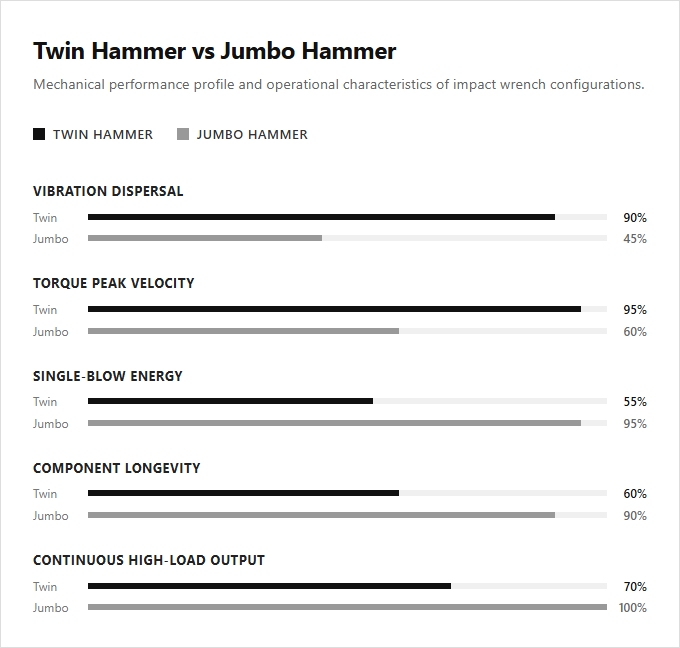
| Design Mechanism | The twin hammer design utilizes two balanced hammers for dual impact per rotation, whereas the jumbo hammer features a single, larger hammer acting directly on the anvil. |
| Torque Output | Twin hammers deliver rapid, instantaneous torque peak values, while jumbo hammers provide a more sustained, high-energy single blow optimized for loosening stubborn fasteners. |
| Vibrational Dispersal | The symmetrical layout of twin hammers inherently reduces harmonic vibration, whereas the asymmetrical mass of a jumbo hammer increases operator fatigue over extended use. |
| Component Longevity | Jumbo hammers have fewer moving parts, reducing mechanical failure rates under extreme loads compared to the more complex dual-component system of twin hammers. |
| Target Application | Twin hammers are preferred for high-speed automotive assembly, while jumbo hammers excel in heavy-duty industrial maintenance requiring maximum breakaway torque. |
Dual-hammer cage design for balanced torque distribution
The Twin Hammer mechanism employs a dual-hammer cage design that delivers two balanced impacts per rotation. This synchronized structure ensures even torque distribution across the drive anvil, reducing vibration and minimizing operator fatigue during prolonged use. The constant, rapid delivery of torque makes this design highly efficient for continuous, high-volume fastening tasks.
The Jumbo Hammer utilizes a single, larger hammer to deliver one massive blow per turn, trading the balanced smoothness of the twin-hammer design for concentrated breaking power. Automotive technicians requiring precise control and high-speed assembly work benefit most from the Twin Hammer, whereas heavy-duty industrial mechanics dealing with seized bolts favor the Jumbo Hammer.
Single massive hammer configuration optimizing raw kinetic energy transfer
In industrial fastening, selecting the correct impact mechanism dictates both efficiency and tool longevity. The Jumbo Hammer utilizes a single massive hammer configuration designed to optimize raw kinetic energy transfer. By delivering one heavy blow per rotation, this streamlined mechanism maximizes torque output for stubborn, rusted, or high-torque fasteners while minimizing internal friction.
The Twin Hammer mechanism employs two balanced hammers striking simultaneously. This design distributes the impact force evenly, providing rapid power delivery and reduced vibration during continuous use.
The Twin Hammer is ideal for automotive technicians requiring rapid, low-vibration performance during assembly, whereas the heavy-duty Jumbo Hammer is best suited for industrial maintenance professionals tackling stubborn, seized bolts.
Twin hammer mechanism yielding higher Blows Per Minute (BPM)
The twin hammer impact mechanism utilizes two identical hammers that strike the anvil simultaneously from opposite sides. This balanced design allows the tool to achieve significantly higher Blows Per Minute (BPM) compared to single-hammer configurations. The rapid succession of high-BPM impacts ensures faster energy transfer, resulting in quick run-down times and smooth, consistent torque delivery during operation.
Conversely, the jumbo hammer mechanism features a single, oversized hammer that delivers fewer but much heavier blows. While it operates at a lower BPM, the massive individual strikes are designed to break loose stubborn, high-torque resistance rather than prioritizing speed.
Twin hammer models are ideal for automotive technicians requiring rapid assembly and high-volume tasks, whereas jumbo hammer wrenches are suited for heavy-duty industrial maintenance personnel dealing with stubborn, corroded machinery.
Jumbo hammer generating superior instantaneous breakaway torque
When selecting an impact wrench, the internal clutch mechanism dictates the tool's performance profile. Twin hammer mechanisms utilize two balanced hammers that strike the anvil simultaneously, delivering a rapid succession of consistent blows. In contrast, the jumbo hammer design employs a single, larger hammer. This configuration maximizes the mass of the single strike, allowing the jumbo hammer to generate superior instantaneous breakaway torque.
This concentrated single-impact force makes the jumbo hammer exceptionally effective at shattering stubborn corrosion and loosening seized fasteners instantly. While twin hammers offer smoother operation and sustained torque over time, they require more continuous cycles to achieve the same initial loosening power.
Professional automotive technicians facing heavily rusted heavy-duty suspension components benefit most from the aggressive breakaway force of a jumbo hammer, whereas industrial assembly line operators requiring low-vibration, continuous fastening prefer the balanced delivery of a twin hammer.
Symmetric load distribution reducing rotational vibration and anvil fatigue
The choice between twin hammer and jumbo hammer impact wrenches hinges on mechanical balance and component durability. Twin hammer mechanisms employ two identical hammers striking simultaneously on opposite sides of the anvil. This configuration provides symmetric load distribution, which dramatically reduces rotational vibration and minimizes anvil fatigue during high-torque output. The balanced force ensures a smoother user experience and extends the operational lifespan of the tool's internal components.
Conversely, jumbo hammer designs utilize a single, larger hammer that delivers one massive impact per rotation. While highly effective for rapid torque accumulation, this asymmetrical strike increases vibration and puts greater stress on the anvil over time. Twin hammer models are best suited for automotive technicians requiring smooth, sustained durability for daily assembly work, whereas jumbo hammer models are ideal for industrial maintenance operators who prioritize maximum single-strike power for stubborn, heavy-duty fasteners.
Simplified jumbo hammer architecture minimizing mechanical wear and frictional loss
In pneumatic impact wrenches, the choice between twin hammer and jumbo hammer mechanisms dictates tool efficiency and longevity. The twin hammer system utilizes two symmetrical hammers for balanced, rapid torque delivery. The jumbo hammer architecture simplifies this design by employing a single, larger hammer. This streamlined configuration reduces the number of moving parts, significantly minimizing mechanical wear and internal frictional loss during operation.
This architectural simplification maximizes kinetic energy transfer directly to the anvil, ensuring high durability and consistent power output with minimal maintenance. While twin hammers offer smoother, low-vibration operation, jumbo hammers deliver high-impact single blows. Heavy-duty industrial operators requiring low-maintenance ruggedness are ideal for jumbo hammers, whereas automotive technicians performing rapid, high-precision fastening benefit most from twin hammer designs.
Pneumatic efficiency differences based on air consumption (CFM) requirements
The twin hammer mechanism utilizes a dual-anvil design that delivers two balanced blows per rotation. While this ensures rapid torque development and reduced vibration, it demands a continuous, high-volume air supply. This translates to higher CFM (cubic feet per minute) requirements, necessitating a robust, stationary compressor setup to prevent performance drops during prolonged use.
The jumbo hammer mechanism employs a single, larger hammer to strike once per revolution. This configuration offers superior pneumatic efficiency, generating high breakaway torque with significantly lower CFM requirements and operating effectively on smaller, portable compressors. Twin hammer models are best suited for high-volume automotive technicians requiring rapid, continuous assembly work, whereas jumbo hammer wrenches are ideal for mobile service operators and industrial maintenance crews working with limited air supply systems.
Leave a comment