
Selecting an impact wrench that consistently delivers the necessary torque without destroying fasteners or fatiguing the operator is a persistent challenge for technicians and industrial operators alike. Traditionally, buyers rely on standard pneumatic ratings and nominal torque specifications to guide their purchasing decisions, assuming higher advertised numbers automatically translate to better real-world performance.
However, understanding the internal striking mechanism grants users unprecedented control, optimal power delivery, and extended tool longevity. It is important to stipulate, however, that peak torque is highly dependent on operational context; a tool optimized for high-volume assembly may fail prematurely under heavy-duty fleet maintenance. For instance, demanding tasks like heavy-duty suspension teardowns require a vastly different internal architecture than precise, low-vibration assembly line applications.
In this guide, we will analyze the engineering behind Twin Hammer and Pin Clutch mechanisms, compare their torque output profiles, and outline how to select the optimal configuration for your specific operational demands.
| Factor | Summary |
|---|---|
| Impact Mechanism | The twin hammer design utilizes two balanced hammers striking simultaneously, whereas the pin clutch mechanism relies on sliding pins driven by a cage to engage the anvil. |
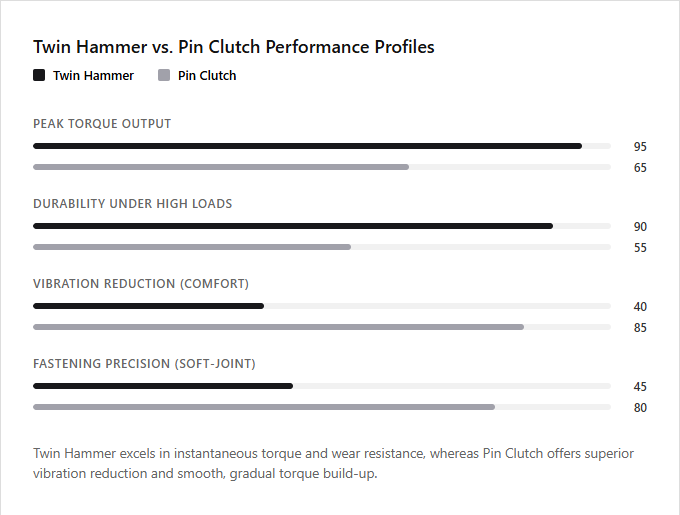
| Torque Output | Twin hammer configurations deliver a higher instantaneous peak torque, while pin clutch systems provide a smoother, more gradual torque build-up. |
| Durability | The twin hammer design offers superior wear resistance under high-impact loads, whereas the pin clutch is more susceptible to mechanical fatigue at the pin contact points. |
| Vibration Level | Pin clutch tools operate with significantly lower vibration, reducing operator fatigue compared to the aggressive, high-vibration feedback of twin hammer mechanisms. |
| Application Suitability | Twin hammer wrenches excel in heavy-duty industrial assembly, whereas pin clutch tools are optimized for precise, soft-joint fastening applications. |
Twin Hammers: Dual Contact for Peak Torque
When selecting an impact wrench, the internal mechanism dictates the tool's performance and suitability. The twin hammer design utilizes two hammers to strike both sides of the anvil simultaneously. This dual-point anvil contact delivers higher instantaneous peak torque, allowing the tool to quickly break stubborn or rusted fasteners loose under heavy loads.
The pin clutch mechanism relies on a pin and ball engagement to rotate the anvil. This configuration provides smoother, more continuous torque delivery with significantly reduced vibration, although it lacks the explosive power of the twin hammer system. High-demand automotive technicians requiring rapid, high-torque output benefit most from the twin hammer, whereas light-assembly workers seeking comfort during repetitive fastening tasks are better suited for the pin clutch.
Pin Clutches Reduce Vibration for Superior Ergonomics
Impact wrench performance is heavily influenced by its internal drive mechanism, with Twin Hammer and Pin Clutch designs representing two distinct engineering approaches. While the Twin Hammer mechanism excels at delivering rapid, high-torque blows, it often generates significant kickback. In contrast, Pin Clutch systems utilize a fluid, continuous engagement that minimizes rotational vibration during operation for superior user ergonomics and reduced physical fatigue.
The Pin Clutch relies on sliding pins to deliver smoother, more consistent torque, whereas the Twin Hammer employs two identical hammers striking simultaneously for maximum power. Heavy-duty automotive technicians requiring maximum breakaway torque benefit most from the rugged Twin Hammer, while precision assembly line operators seeking comfortable, low-fatigue handling are ideal candidates for the Pin Clutch.
Twin Hammers Accelerate Heavy-Duty Fastening
When selecting industrial impact wrenches, the internal mechanism dictates overall performance and durability. The twin hammer design utilizes two identical hammers that strike the anvil simultaneously. This balanced configuration facilitates faster kinetic energy transfer, delivering high torque outputs instantly, which makes it highly effective for heavy-duty industrial fastening and demanding assembly applications.
In contrast, the pin clutch mechanism relies on pins and a spherical ball clutch to generate torque. While this design provides a smoother power delivery with significantly lower vibration levels, it generally lacks the rapid, high-impact force characteristic of the twin hammer system.
Heavy-duty industrial mechanics and structural steel fabricators benefit most from the rapid power of twin hammer wrenches, while precision assembly technicians and light automotive service specialists requiring smooth, low-fatigue operation prefer the pin clutch design.
Precise Torque Calibration with Pin Clutches
When selecting an industrial impact wrench, the internal clutch mechanism determines both the tool's power delivery and application suitability. The twin hammer design is engineered for rapid torque output, employing two balanced hammers that strike simultaneously to loosen stubborn fasteners. In contrast, the pin clutch mechanism utilizes sliding pins to ensure precise torque calibration on sensitive joints. This sliding pin configuration delivers a smoother energy transfer with significantly reduced vibration, protecting delicate threads from over-tightening.
While the twin hammer maximizes raw power for demanding tasks, the pin clutch excels in control and repetitive accuracy. Heavy-duty automotive mechanics requiring rapid breakaway torque benefit most from the twin hammer, whereas precision assembly technicians working with delicate components or soft materials are better suited for the pin clutch.
High-Shear Fatigue Resistance of Twin Hammer Components
Impact wrench performance depends heavily on the internal clutch mechanism. The twin hammer design utilizes two identical hammers that deliver balanced, simultaneous blows to the anvil. This dual-impact configuration excels in high shear stress environments because the distributed force significantly reduces mechanical fatigue on individual internal components, ensuring long-term structural integrity during continuous, high-torque applications.
In contrast, the pin clutch mechanism relies on spinning pins to deliver smoother, more consistent torque with lower overall vibration. While this design offers excellent control, its components experience higher localized wear under extreme loads. Heavy-duty industrial technicians require the robust fatigue resistance of the twin hammer, whereas precision mechanics and light assembly operators benefit most from the smooth, low-vibration delivery of the pin clutch.
Pin Clutch Impact Wrenches Prevent Thread Stripping
Selecting the right impact wrench mechanism depends on the specific demands of the application. The twin hammer mechanism delivers rapid, high-torque blows to break loose stubborn fasteners, while the pin clutch system utilizes a smoother mechanism to minimize vibration. This pin clutch design provides highly consistent torque repeatability, which prevents the stripping of delicate threads and ensures uniform tightness across critical assemblies.
The mechanical differences dictate the ideal environments for each tool. Heavy industrial mechanics requiring maximum breakout power for stubborn bolts will benefit most from the twin hammer, whereas precision manufacturing technicians requiring delicate control and thread protection are best suited for the pin clutch.
Twin Hammers Optimize Pneumatic Motor Efficiency
The twin hammer impact mechanism is engineered for high-performance applications. By delivering two balanced blows per rotation, this design minimizes backpressure and optimizes the volumetric efficiency of the tool's pneumatic motor. Airflow translates directly into kinetic energy with minimal wastage, providing rapid torque development and superior power-to-weight ratios under heavy loads.
The pin clutch mechanism utilizes a smoother, rolling pin action to deliver torque, which reduces user fatigue but limits peak power output. This alternative configuration sacrifices some pneumatic motor efficiency in exchange for consistent, lower-impact fastening. Industrial mechanics requiring rapid, high-torque output will benefit most from the twin hammer, while assembly line technicians focusing on repetitive, precision fastening are best suited for the pin clutch.
Leave a comment