
Selecting the incorrect drive size for a cordless ratchet often leads to stripped fasteners, stalled motors, or costly project delays. When allocating standard equipment procurement budgets, teams often default to generic utility sets that fail to meet specific mechanical demands. However, optimizing your inventory with the precise power ratchet grants technicians the exact balance of speed and mechanical advantage required to maximize daily workshop throughput.
This selection process operates under the critical stipulation that raw torque output must always be balanced against physical spatial constraints. For example, while heavy-duty chassis overhaul demands the sheer force of a 1/2-inch drive, intricate engine bay diagnostics require the nimbleness of a 3/8-inch system.
In this guide, we will analyze the torque thresholds, clearance capabilities, and application profiles of both drive sizes, providing a clear framework to help you select the optimal power ratchet for your operational needs.
| Factor | Summary |
|---|---|
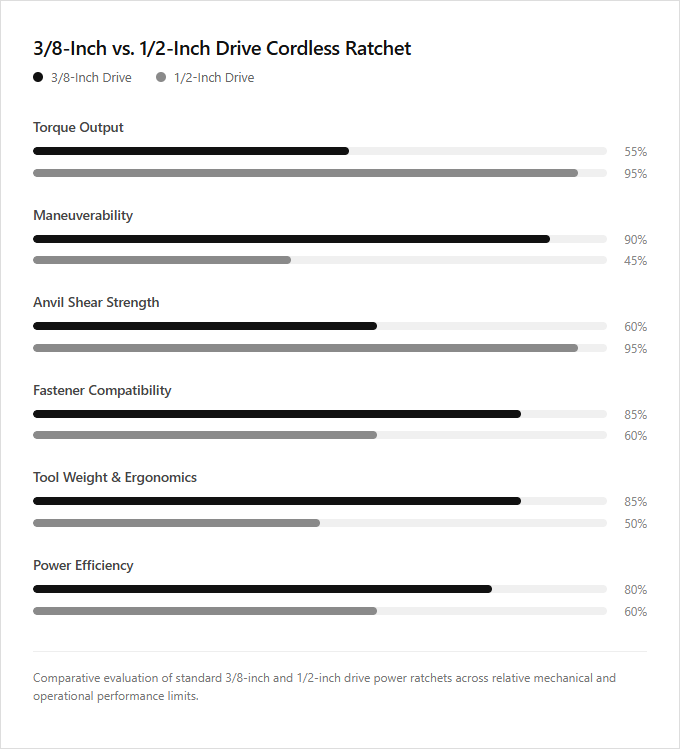
| Torque Output | The 1/2-inch drive ratchet delivers significantly higher maximum torque measured in foot-pounds compared to the 3/8-inch model, making it ideal for breaking loose stubborn fasteners. |
| Maneuverability | The 3/8-inch power ratchet features a more compact tool head, offering superior clearance and maneuverability within tight automotive engine bays. |
| Anvil Shear Strength | The larger anvil of the 1/2-inch drive provides greater torsional shear strength to withstand high rotational forces without breaking under heavy load. |
| Fastener Compatibility | The 3/8-inch drive is optimized for standard metric and SAE sockets, whereas the 1/2-inch drive is designed for heavy-duty impact sockets used on lug nuts and suspension components. |
| Tool Weight and Ergonomics | Due to its robust internal planetary gear system and larger motor housing, the 1/2-inch ratchet is heavier, which can increase operator fatigue during prolonged overhead use. |
| Power Efficiency | The 3/8-inch cordless ratchet generally consumes less battery amperage, resulting in longer runtime per charge cycle when utilizing standard lithium-ion battery packs. |
Torque output capacity in foot-pounds
A typical cordless or pneumatic 3/8-inch drive power ratchet delivers between 35 and 55 foot-pounds of torque, prioritizing speed and accessibility in tight mechanical spaces. Larger 1/2-inch drive power ratchets are engineered for high-demand applications, routinely producing 60 to over 90 foot-pounds of torque to break loose stubborn, rusted, or high-tolerance fasteners.
This performance disparity exists because the thicker anvil of the 1/2-inch drive sustains high rotational forces without shearing, whereas the smaller 3/8-inch anvil is optimized for lighter fastening tasks. Precision-focused automotive technicians working in confined engine bays benefit from the agile 3/8-inch model, while heavy-machinery mechanics and structural installers rely on the robust torque of the 1/2-inch drive.
Drive tang cross-sectional shear strength
The primary differentiator between 3/8-inch and 1/2-inch power ratchets lies in the cross-sectional area of the drive tang, which directly dictates its shear strength. Because shear resistance scales quadratically with diameter, the 1/2-inch drive possesses over 1.7 times the cross-sectional area of the 3/8-inch counterpart. This physical disparity allows the larger tang to withstand significantly higher torsional loads before reaching its yield point, preventing sudden structural failure under heavy torque.
While the 3/8-inch drive offers lower shear resistance, it provides superior maneuverability in confined spaces. Automotive technicians working on compact passenger vehicles find the agile 3/8-inch size ideal, while heavy machinery mechanics and industrial technicians require the rugged shear capacity of the 1/2-inch drive.
Anvil profile clearance and swing arc
The 3/8-inch drive ratchet offers a compact anvil profile clearance, making it highly maneuverable in confined engine bays and tight mechanical spaces. Its smaller head design allows for a tighter swing arc, enabling efficient fastening where lateral movement is severely restricted.
The 1/2-inch drive ratchet features a larger, more robust anvil profile that requires greater clearance. This size yields a wider swing arc and accommodates higher torque applications, sacrificing close-quarters accessibility for raw mechanical leverage and heavy-duty fastening capability.
Automotive technicians working on delicate engine components benefit most from the precision of the 3/8-inch model, while heavy equipment mechanics requiring maximum torque should opt for the robust 1/2-inch variant.
Socket wall thickness and fastener load distribution
When selecting between a 3/8-inch and a 1/2-inch drive power ratchet, socket wall thickness is a critical engineering differentiator. The 3/8-inch drive utilizes thinner-walled sockets, allowing superior access to confined engine bays and tight mechanical clearances where space is limited. In contrast, 1/2-inch drive sockets feature significantly thicker walls designed to withstand the high torque output of heavy-duty power tools without fracturing under stress.
This physical difference directly impacts fastener load distribution. The larger drive size of the 1/2-inch model distributes rotational force more evenly across heavy-duty fasteners, reducing the risk of slippage or socket failure under extreme load. The 3/8-inch drive optimizes load distribution for smaller, precision fasteners to prevent stripping. Precision-focused automotive technicians working in tight engine bays benefit most from the nimble 3/8-inch drive, whereas industrial mechanics and heavy-equipment technicians require the robust 1/2-inch drive for high-torque assemblies.
Brushless motor torque-to-weight ratio
Brushless motor technology has revolutionized cordless ratchet wrenches, optimizing the torque-to-weight ratio across different drive sizes. The 3/8-inch drive brushless ratchet offers an exceptional balance, delivering substantial fastening power in a compact, lightweight frame. This configuration maximizes maneuverability in confined automotive engine bays and tight structural spaces without sacrificing the necessary rotational force.
The 1/2-inch drive brushless ratchet prioritizes maximum power output, utilizing a larger motor and robust gearing to produce significantly higher torque. While this increases the overall tool weight, the resulting torque-to-weight ratio remains highly efficient for high-stress applications. The nimble 3/8-inch model is ideal for precision mechanics working on light-duty assemblies, whereas the high-torque 1/2-inch model is best suited for heavy equipment technicians managing stubborn, large-diameter fasteners.
Gear-to-pawl mechanism tooth density
The gear-to-pawl mechanism dictates the performance differences between 3/8-inch and 1/2-inch drive power ratchets. A 3/8-inch drive typically features a higher tooth density, often utilizing 72 to 120 teeth. This design provides a minimal swing arc, allowing the pawl to engage quickly in confined engine bays. Because the teeth are smaller, they excel in precision but are not designed for extreme torque applications.
The 1/2-inch drive ratchets employ a lower tooth density with larger, more robust gear teeth. This coarser mechanism maximizes surface contact between the pawl and gear, preventing slippage under high loads. Precision-focused automotive technicians working in tight spaces benefit most from the agile 3/8-inch drive, whereas heavy-duty mechanics handling industrial machinery require the high-torque capacity of the 1/2-inch drive.
Pneumatic working pressure and CFM requirement
A 3/8-inch pneumatic ratchet wrench is designed for accessibility in confined spaces, typically requiring a standard working pressure of 90 PSI. It operates efficiently with a moderate air volume requirement, generally consuming between 2.5 and 4 CFM. This lower demand makes it highly compatible with smaller, portable shop compressors.
In contrast, a 1/2-inch drive pneumatic ratchet is engineered for high-torque applications. While it also operates at 90 PSI, its robust motor demands a higher air volume, typically ranging from 4 to 6 CFM, requiring a more powerful compressor system to avoid performance drops. Professional automotive technicians tackling heavy suspension jobs require the robust 1/2-inch drive, whereas general maintenance mechanics and hobbyists are better served by the lighter 3/8-inch drive for everyday fastening tasks.
Leave a comment