
Every rotary tool enthusiast knows the frustration of a standard cut-off wheel shattering mid-cut, abruptly halting progress and risking damage to a delicate workpiece. Traditionally, craftsmen rely on the basic, brittle emery discs bundled in standard accessory kits for routine slicing tasks. Upgrading to fiberglass-reinforced wheels, however, grants users superior structural resilience and extended wheel life, preventing premature breakage under high-RPM loads.
To manage expectations, we must stipulate that the added thickness of reinforced discs can slightly widen the cut kerf, making them less suited for ultra-fine precision work. Yet, for demanding applications like cutting through hardened steel bolts or trimming rusted metal piping, their safety and speed are unmatched.
In this guide, we will analyze both abrasive types across durability, precision, and cost-effectiveness to help you select the ideal disc for your high-speed rotary tool applications.
| Factor | Summary |
|---|---|
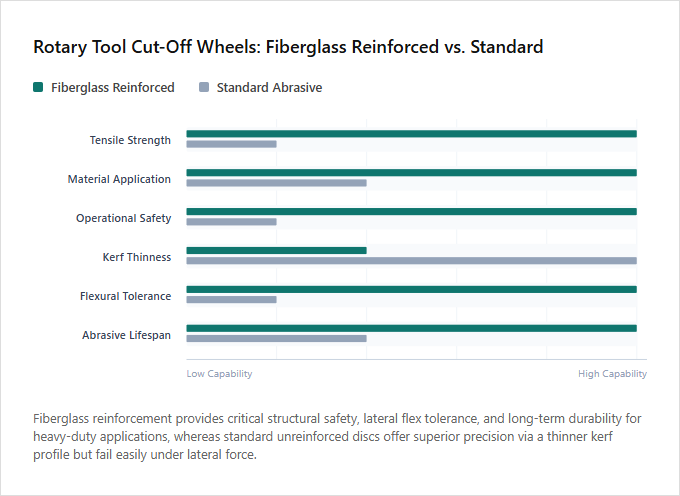
| Tensile Strength | Fiberglass reinforced wheels utilize an internal mesh matrix to provide superior tensile strength, preventing the catastrophic shattering common in unreinforced standard abrasive discs. |
| Material Application | Standard wheels are limited to light-duty cutting of plastics and soft metals, whereas fiberglass reinforced wheels are engineered for heavy-duty cutting of hard ferrous metals and stainless steel. |
| Operational Safety | The structural reinforcement in fiberglass wheels significantly mitigates the risk of centrifugal failure and dangerous projectile fragmentation during high-RPM operation. |
| Kerf Width | Standard cut-off wheels offer a much thinner kerf profile for high-precision slotting, while fiberglass wheels are thicker to accommodate the structural glass cloth layers. |
| Flexural Tolerance | Fiberglass wheels can tolerate minor lateral deflection and binding within a workpiece, whereas brittle standard wheels snap instantly under any torsional stress. |
| Abrasive Lifespan | Although standard wheels have a lower purchase price, fiberglass reinforced wheels deliver greater long-term value due to their resistance to rapid radial wear. |
Fiberglass Mesh Prevents Catastrophic Wheel Shattering
When selecting cutting accessories for rotary tools, understanding the structural differences between standard and fiberglass-reinforced cut-off wheels is essential for both safety and efficiency. Standard wheels consist of bonded abrasives without internal support, making them highly susceptible to fracturing under stress. In contrast, reinforced wheels incorporate a woven fiberglass mesh that significantly increases tensile strength. This structural reinforcement prevents catastrophic wheel shattering when the accessory encounters lateral pressure or accidental twisting during operation.
While standard wheels offer exceptionally thin, precise cuts, they require strict alignment and a steady hand to avoid breakage. Reinforced wheels provide a much higher safety margin and durability, easily enduring the rigors of heavy-duty metal cutting and slotting. Standard wheels are best suited for experienced hobbyists performing delicate, straight-line precision work, while fiberglass-reinforced wheels are ideal for general DIYers and tradespeople tackling demanding, variable-angle fabrication tasks.
Reinforced Wheels Have Higher Safe Operating Speeds
When selecting cut-off wheels for rotary tools, understanding the structural differences between fiberglass reinforced and standard discs is essential for safety and efficiency. Standard cut-off wheels consist of a brittle, unreinforced abrasive compound. These discs are highly susceptible to fracturing under lateral pressure, which strictly limits their Maximum Safe Operating Speed (MOS).
In contrast, fiberglass reinforced wheels incorporate a durable mesh core that binds the abrasive material. This structural reinforcement drastically increases tensile strength, allowing these wheels to sustain a significantly higher MOS without shattering. Operating at these elevated speeds ensures cleaner cuts and reduces the risk of dangerous wheel disintegration during heavy-duty applications.
Standard discs are best suited for hobbyists performing light, precision slicing on soft materials, whereas reinforced wheels are ideal for trade professionals requiring high-speed, demanding metal fabrication.
Thermally Stable Resinoid Bond Matrix
Standard cut-off wheels offer a cost-effective solution for light-duty slicing tasks, though they are prone to shattering under high lateral stress. In contrast, premium fiberglass reinforced cut-off wheels integrate a synthetic resinoid bond matrix that secures the abrasive grain and reinforcement layers for optimal thermal stability. This advanced construction allows the reinforced wheels to withstand intense heat and structural load during demanding operations without fracturing.
While standard wheels excel in precision cutting of softer materials, the reinforced alternatives provide the structural integrity needed for severing hardened steels and alloys. Standard wheels are ideal for hobbyists performing delicate, light-tension detail work, whereas fiberglass-reinforced wheels are best suited for tradespeople and DIYers tackling high-torque, heavy-duty metal fabrication.
High Fracture Resistance Prevents Explosive Plunge-Cut Failure
Standard abrasive cut-off wheels are highly effective for straight, shallow scoring but remain brittle and prone to shattering under lateral stress. In contrast, fiberglass-reinforced wheels integrate a woven mesh that provides exceptional structural integrity. This reinforcement delivers high fracture resistance under angular deflection, effectively preventing explosive failure during demanding deep plunge cuts where wheel twisting or binding frequently occurs.
While standard wheels offer thinner profiles for precise, delicate slices in soft materials, they demand a perfectly steady hand. Fiberglass-reinforced options withstand heavy-duty loads and minor operational errors, ensuring a safer workspace under high RPMs. Standard wheels are best suited for hobbyists performing light, straight-line crafting, whereas fiberglass-reinforced wheels are ideal for professional tradespeople and DIYers tackling deep, heavy-duty metal fabrication.
Structural Reinforcement Boosts Abrasive Cutting Efficiency
Selecting the right rotary tool cut-off wheel depends on the workpiece material and the required durability. Standard cut-off wheels are typically unreinforced, making them susceptible to fracturing under lateral pressure. In contrast, fiberglass reinforced wheels incorporate a structural mesh that supports the abrasive matrix. Aluminum oxide and silicon carbide abrasive grains achieve higher cutting efficiency when backed by structural reinforcement, as it allows the grains to fracture and self-sharpen under optimal pressure without premature wheel failure.
This added stability enables faster, safer cuts through tough metals and plastics. Standard wheels remain useful for light-duty precision tasks where thin kerf cuts are necessary and minimal force is applied. Standard wheels are ideal for hobbyists performing delicate detailing on soft materials, whereas fiberglass reinforced wheels are suited for tradespeople and DIYers undertaking heavy-duty metal fabrication.
Fiberglass Grids Maintain Kerf Stability Under High Torque
When selecting cutting accessories for rotary tools, the choice between standard and fiberglass reinforced cut-off wheels significantly impacts precision and safety. Standard wheels, while economical, are prone to flexing and shattering under pressure. In contrast, fiberglass reinforced wheels incorporate an internal structural mesh that resists bending. This anti-flex property ensures that kerf width stability is maintained under high-torque applications, preventing the wheel from binding or deviating from the intended cut line.
The structural integrity of reinforced wheels allows them to consistently slice through tough materials like stainless steel and hardened plastics. Standard wheels remain highly effective for light-duty, intricate tasks on softer materials where minimal resistance is encountered. Professional fabricators requiring dependable durability under heavy workloads will benefit most from fiberglass reinforced wheels, whereas DIY hobbyists performing occasional, delicate slicing are well-suited for standard options.
Superior G-Ratio and Reduced Wear in Reinforced Wheels
When selecting cutting accessories for rotary tools, the structural differences between fiberglass reinforced cut-off wheels and standard wheels significantly impact performance. Standard wheels, which consist of non-reinforced organic-bonded abrasives, tend to degrade rapidly under high rotational stress. Fiberglass reinforced wheels incorporate a robust woven mesh that strengthens the entire disc structure. This structural support drastically reduces the volumetric wear rate, yielding a superior G-ratio compared to non-reinforced organic-bonded wheels.
This enhanced durability prevents premature shattering and maintains a consistent cutting diameter during demanding operations. Standard wheels are best suited for light-duty hobbyists performing delicate, precise cuts on soft plastics, whereas fiberglass reinforced wheels are ideal for industrial tradespeople requiring a durable solution for heavy metal fabrication.
Leave a comment