
Managing discharge pressure in a multi-compressor system often feels like a constant battle against pressure fluctuations and excessive energy consumption. Plant managers frequently struggle with rapid compressor cycling, which accelerates mechanical wear and inflates utility bills. Traditionally, facilities rely on standard local controller settings or basic sequential staging to manage varying demand.
However, upgrading to intelligent control topologies grants operators unprecedented pressure stability and substantial energy savings. It must be stipulated, however, that achieving these results requires a precise analysis of your facility's specific demand profile and storage capacity. For example, Tier-1 automotive suppliers use these advanced configurations to maintain a tight ±1.5 PSI pressure band under volatile loads.
In this guide, we will compare Lead-Lag and Cascade control strategies, examining their operational logic, system requirements, and efficiency outcomes to help you optimize your compressed air network.
| Factor | Summary |
|---|---|
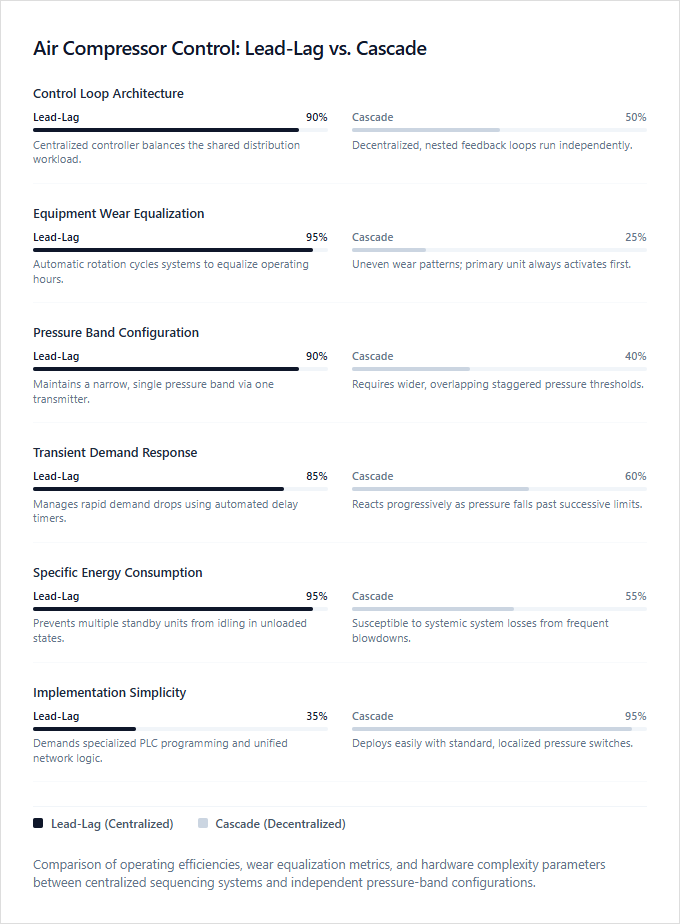
| Control Loop Architecture | Lead-lag control utilizes a centralized controller to distribute the workload, whereas cascade control relies on nested inner and outer feedback loops to regulate system pressure. |
| Equipment Wear Equalization | Lead-lag configurations employ automatic rotation schemes to balance operating hours, while cascade arrangements inherently cause uneven wear because the primary unit always triggers first. |
| Pressure Band Configuration | Cascade control requires staggered, overlapping pressure setpoints for each compressor, whereas lead-lag control maintains a single, narrow pressure band managed by a centralized transmitter. |
| Transient Demand Response | Lead-lag systems respond to sudden flow drops using a programmed delay timer, while cascade systems react sequentially as pressure falls below successive threshold limits. |
| Specific Energy Consumption | Lead-lag control optimizes energy efficiency by preventing multiple compressors from running simultaneously in unloaded states, unlike cascade control which can suffer from blowdown losses. |
| Implementation Complexity | Cascade control is easily deployed using decentralized pressure switches on each compressor, whereas lead-lag control requires a programmable logic controller to synchronize operations. |
Cascade Control Minimizes System Pressure Deadband
In industrial compressed air systems, managing multiple compressors efficiently requires precise control strategies. Traditional lead-lag control sequences multiple machines based on fixed pressure thresholds, which often demands a wide pressure deadband to prevent rapid compressor cycling. Cascade control utilizes a centralized controller that continuously adjusts individual compressor outputs based on the rate of pressure change. This dynamic matching of supply to demand significantly reduces the system pressure deadband, maintaining a much tighter and more stable pressure range.
A minimized deadband improves overall energy efficiency and reduces mechanical wear on downstream equipment. Traditional lead-lag systems are suitable for facility operators seeking straightforward, low-cost installations with flexible pressure tolerances, whereas cascade control is ideal for automation engineers who demand precise pressure stability and maximized energy savings in complex industrial environments.
Dynamic Master-Slave Coordination in Cascade Control
In industrial compressed air systems, managing pressure stability requires precise control strategies. Lead-lag control alternates multiple compressors based on predefined pressure thresholds to distribute machine wear and meet fluctuating demand. Conversely, cascade control utilizes a master-slave architecture to dynamically coordinate inner and outer control loops.
The master controller in a cascade system monitors the primary system pressure (the outer loop) and adjusts the setpoint of the slave controller, which regulates the immediate airflow or motor speed (the inner loop). This dual-loop integration proactively mitigates downstream disturbances before they affect the main header pressure, ensuring superior operational stability.
Lead-lag configurations are ideal for facility managers seeking balanced equipment run-hours in standard utility applications, whereas cascade control is suited for process engineers requiring highly stable pressure regulation in sensitive, variable-demand environments.
Precise Part-Load Modulation Using VSD Trim Compressors
In industrial compressed air systems, managing multiple units efficiently requires choosing between lead-lag and cascade control strategies. Lead-lag control alternates the sequence of fixed-speed compressors based on broad pressure thresholds, which can result in wider pressure fluctuations. In contrast, cascade control sequences multiple machines within tighter pressure bands. Integrating a Variable Speed Drive (VSD) trim compressor into a cascade system optimizes this setup, allowing the VSD unit to handle precise part-load modulation while fixed-speed units run at peak efficiency.
This VSD integration minimizes energy waste by matching system output exactly to fluctuating demand. Lead-lag control is ideal for facility managers seeking a simple, low-cost setup with stable demand, whereas cascade control with a VSD trim is best suited for energy-conscious operators managing highly variable industrial loads.
Lead-lag sequencing risks high compressor short-cycling during rapid demand fluctuations.
In managing multiple industrial air compressors, selecting the correct control strategy is vital for system reliability. Lead-lag sequencing alternates the primary and secondary units to distribute run hours evenly. However, this approach risks high compressor short-cycling during rapid demand fluctuations, as the system struggles to stabilize pressure amidst sudden flow spikes. This frequent cycling accelerates mechanical wear and reduces overall energy efficiency.
Cascade control resolves this issue by utilizing stepped pressure bands to activate additional units sequentially. This method provides superior pressure stability and prevents unnecessary machine starts during brief flow variations. Lead-lag sequencing is suitable for facility maintenance managers seeking equal wear distribution in stable operations, whereas cascade control is appropriate for plant engineers managing highly volatile production environments.
Lowering Header Pressure Reduces Demand and Leakage
In compressed air systems, choosing between lead-lag and cascade control directly impacts energy efficiency. Traditional lead-lag configurations cycle compressors based on wide pressure bands, whereas cascade control coordinates multiple units by nesting pressure setpoints. Implementing advanced cascade control allows facilities to safely lower the overall header pressure setpoint. This pressure reduction significantly decreases artificial demand and minimizes pneumatic leakage losses across the entire distribution network.
Managing these control strategies requires different operational approaches. Lead-lag setups are best suited for smaller facilities with steady demand and maintenance teams seeking straightforward, low-maintenance operations, while cascade control systems are ideal for large-scale, dynamic industrial environments managed by energy coordinators and engineers focused on precise pressure regulation and maximum energy savings.
Cascade PID Control of Flow and Pressure
In industrial compressed air systems, choosing the correct control strategy optimizes operational efficiency and system longevity. Lead-lag control manages multiple compressors by alternating their operation based on preset pressure thresholds to balance runtime. In contrast, cascade control utilizes real-time PID algorithms to stabilize mass flow rate and discharge pressure. By nesting a primary pressure control loop with a secondary flow loop, cascade systems dynamically adjust compressor output to eliminate pressure deviations before they impact downstream processes.
This advanced algorithmic adjustment ensures precise pressure regulation under volatile demand conditions. Lead-lag configuration is ideal for facility managers seeking simple, reliable wear-leveling across multiple standard machines, while cascade control is best suited for precision engineers requiring highly stable pressure for sensitive, high-tolerance manufacturing applications.
System specific power improves by avoiding overlapping load-unload blowdown events.
In multiple-compressor systems, managing how units cycle is critical for energy efficiency. Traditional lead-lag control operates on overlapping pressure bands, which often triggers concurrent load-unload cycles. This overlap results in frequent, simultaneous blowdown events where pressurized air is vented to the atmosphere, severely degrading the system's overall specific power.
Cascade control resolves this inefficiency by utilizing a single pressure transmitter and offset setpoints, ensuring only one compressor trims while others run fully loaded or remain offline. This disciplined sequencing prevents overlapping blowdown cycles, optimizing energy consumption and stabilizing plant pressure. Traditional lead-lag suits operators prioritizing simple, manual system oversight, whereas advanced cascade systems are ideal for analytical energy managers seeking automated, high-efficiency performance under fluctuating demands.
Leave a comment