
Achieving consistent pneumatic performance is a persistent challenge for workshop managers who frequently battle tool stall and sudden pressure drops during critical operations. When configuring a facility, procurement teams typically assess standard funding sources and capital equipment budgets to secure necessary machinery. However, focusing solely on initial acquisition costs overlooks the critical engineering distinction that grants sustained operational productivity: the delivery of optimal Cubic Feet per Minute (CFM).
With the stipulation that different pneumatic applications dictate unique air purity standards and duty cycle thresholds, matching the compressor pump design to your specific tool load is essential. For instance, continuous-use equipment like commercial HVLP spray guns demand vastly different CFM delivery profiles than intermittent-duty tools such as impact wrenches.
In this analysis, we will examine the technical trade-offs between oil-lubricated and oil-free air compressors, evaluate how their lubrication mechanisms directly impact CFM output, and provide a decision framework to help you select the most efficient power source for your operations.
| Factor | Summary |
|---|---|
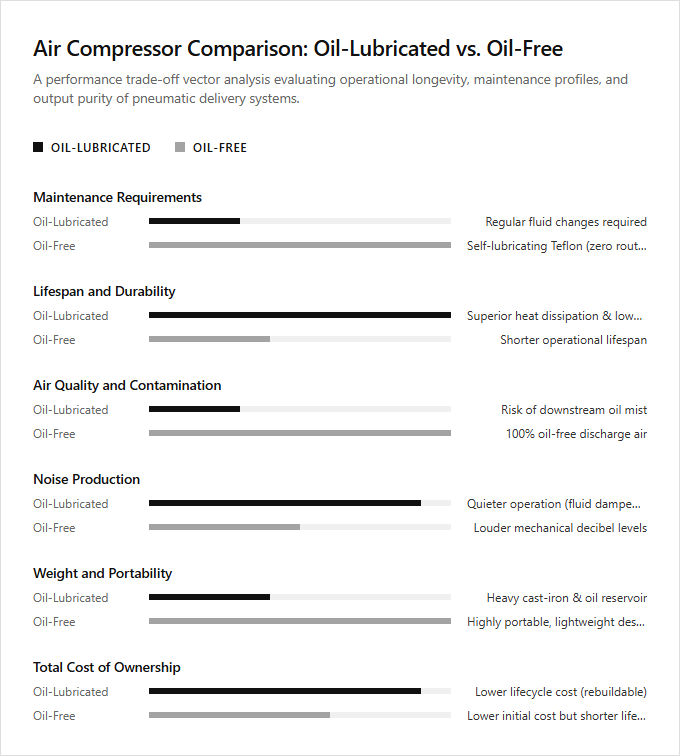
| Maintenance Requirements | Oil-lubricated compressors require regular fluid changes, whereas oil-free models utilize self-lubricating Teflon coatings on the cylinder walls to eliminate routine upkeep. |
| Lifespan and Durability | Oil-lubricated units offer superior heat dissipation and lower wear rates, resulting in a significantly longer operational lifespan compared to oil-free alternatives. |
| Air Quality and Contamination | Oil-free compressors are critical for sensitive applications like painting or food processing because they eliminate the risk of oil contamination in the discharge air stream. |
| Noise Production | Oil-lubricated compressors operate at lower decibel levels because the lubricating fluid dampens the mechanical friction of the reciprocating piston. |
| Weight and Portability | Oil-free models are lighter and more portable due to the absence of a heavy oil reservoir and cast-iron crankcase. |
| Total Cost of Ownership | Oil-free compressors have lower initial procurement costs, but oil-lubricated models offer a lower lifecycle cost due to their highly durable and rebuildable components. |
Volumetric efficiency enhancement via oil-sealed compression chambers
Oil-lubricated air compressors achieve superior volumetric efficiency compared to oil-free models. The presence of oil within the compression chamber serves a dual purpose: it lubricates moving parts and acts as a dynamic sealant between the piston and cylinder walls. This microscopic oil seal minimizes air blow-by during the compression stroke, ensuring that a higher percentage of the drawn-in air is successfully pressurized and delivered.
Oil-free compressors rely on dry, low-friction seal materials that inherently allow more micro-leakage, reducing their overall volumetric efficiency. Heavy-duty industrial operators requiring continuous, high-yield pneumatic power benefit most from the durable oil-lubricated units, whereas residential hobbyists or clean-room professionals prioritizing zero air contamination should opt for oil-free designs.
Duty cycle capabilities enabling continuous CFM delivery
When evaluating air compressors for demanding applications, the choice between oil-lubricated and oil-free models hinges on duty cycle capabilities. Oil-lubricated compressors utilize oil to reduce friction and dissipate heat, enabling a higher duty cycle that often reaches 100 percent. This superior thermal management supports continuous cubic feet per minute (CFM) delivery without the risk of overheating. Conversely, oil-free designs rely on self-lubricating synthetic coatings that generate more heat, typically restricting them to intermittent duty cycles to prevent component wear.
Selecting the appropriate technology depends entirely on the operational demands of the user. Oil-lubricated units are ideal for professional contractors and industrial workshops requiring sustained, heavy-duty pneumatic power, while oil-free models best serve residential DIYers or clean-room technicians who prioritize low-maintenance operation and contamination-free air.
Mitigating Oil Carryover for ISO Class 0 Air
Achieving ISO 8573-1 Class 0 air purity requires stringent contamination control. While oil-lubricated compressors offer high durability and thermal efficiency, they pose a constant risk of oil carryover. Mitigating this risk demands multi-stage filtration systems, including coalescing filters and activated carbon towers, alongside rigorous maintenance schedules to prevent downstream contamination.
Conversely, oil-free compressors eliminate the risk of lubricant carryover at the source, making them the preferred choice for critical applications. Although these units typically incur higher initial costs and faster wear, they provide absolute insurance against oil contamination. Industrial operators requiring ultra-clean environments, such as pharmaceuticals or electronics, favor oil-free models, whereas heavy-duty workshop technicians prioritizing mechanical longevity opt for oil-lubricated systems.
Thermal dissipation management lowering discharge temperatures
Oil-lubricated air compressors excel in thermal dissipation management because the lubricating oil acts as a highly efficient heat sink. During operation, this fluid absorbs thermal energy directly from the compression chamber and transfers it away from moving components. This continuous heat dissipation lowers discharge temperatures, which minimizes thermal stress on internal seals and extends the overall lifespan of the tool.
Oil-free compressors rely instead on cooling fins and high-velocity airflow to manage heat. Lacking a liquid cooling medium, these units generate higher discharge temperatures and typically require shorter duty cycles. Industrial professionals requiring continuous, high-volume output are best served by oil-lubricated models, whereas residential hobbyists and mobile technicians prioritizing clean, low-maintenance operation are ideal candidates for oil-free designs.
Frictional wear of PTFE cylinder coatings degrading CFM over time
Oil-free air compressors rely on polytetrafluoroethylene (PTFE) cylinder coatings to minimize friction without manual lubrication. Over time, continuous mechanical friction inevitably degrades this thin protective layer. As the PTFE coating wears down, the piston seal loses its integrity, leading to internal air bypass and a progressive decline in CFM (Cubic Feet per Minute) delivery.
Oil-lubricated compressors utilize a continuous oil bath to protect internal components from wear, ensuring stable CFM performance throughout their lifespan. Oil-free models are best suited for residential users seeking low-maintenance, contaminant-free air, whereas oil-lubricated machines are ideal for commercial operators requiring durable, high-demand equipment.
Pressure drop losses from downstream coalescing filtration
Oil-lubricated compressors introduce oil aerosols into the compressed air stream, requiring downstream coalescing filtration to achieve high air quality. These multi-stage filtration systems inherently cause a continuous pressure drop, forcing the compressor to operate at a higher discharge pressure to compensate. This compensation increases overall energy consumption and wear on the system. Oil-free compressors generate clean air at the source, eliminating the need for restrictive oil-removal filters and minimizing downstream pressure losses.
Bypassing the pressure drops associated with heavy filtration improves overall system efficiency. Oil-free units are ideal for medical professionals and food processors requiring ultra-pure, contaminant-free air, while robust oil-lubricated models suit automotive mechanics and industrial technicians who prioritize tool longevity and continuous, heavy-duty operation.
Internal air slippage compensation through higher rotational speed
Oil-free air compressors lack lubricating oil, creating wider clearances between moving parts that cause internal air slippage. To compensate for this volumetric loss, oil-free systems must operate at much higher rotational speeds to compress the air before it escapes. Oil-lubricated models utilize oil as a physical sealant, which minimizes internal slippage and allows the pump to run at lower, quieter, and more efficient speeds.
The high rotational speed of oil-free pumps increases wear and noise, whereas the slower, sealed rotation of lubricated pumps ensures long-term durability. Oil-lubricated models are best suited for industrial professionals requiring continuous, heavy-duty operation, while oil-free compressors are ideal for home hobbyists who prefer a maintenance-free tool and clean air delivery.
Leave a comment