
Woodworkers and metal fabricators frequently struggle with surface preparation, often ruining critical workpieces by applying the wrong abrasive motion. While many workshops initially rely on standard orbital sanders or hand-sanding to manage these tasks, these entry-level methods quickly bottleneck production.
Upgrading to specialized machinery grants operators unprecedented control, dramatically reducing cycle times. However, achieving peak efficiency requires understanding that no single tool is a universal savior; each operates under strict mechanical stipulations regarding material compatibility and heat dissipation. For instance, leveling a long oak tabletop demands linear belt precision, whereas shaping curved chamfers on furniture components requires rotary disc action.
This article analyzes the distinct mechanics of belt and disc sanders, comparing their material removal rates, finish characteristics, and ideal applications to help you select the optimal tool for your workshop.
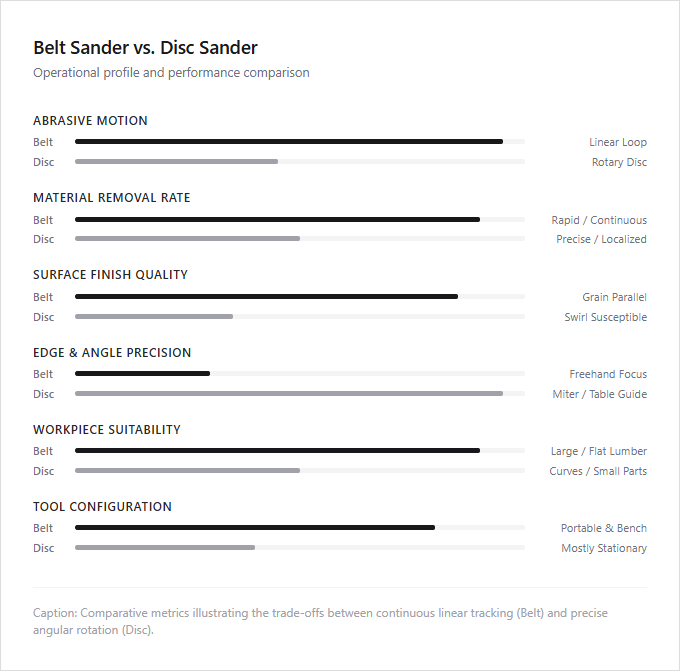
| Factor | Summary |
|---|---|
| Abrasive Motion | The belt sander utilizes a continuous looping abrasive belt that moves in a linear direction, whereas the disc sander employs a rapidly rotating circular sandpaper disc. |
| Material Removal Rate | Belt sanders excel at rapid stock removal on large, flat surfaces due to their high-speed linear tracking, while disc sanders are designed for precise, localized material extraction. |
| Surface Finish Quality | A belt sander allows for straight-line sanding parallel to the wood grain to minimize defects, whereas the rotary action of a disc sander can leave cross-grain swirl marks. |
| Edge and Angle Precision | Disc sanders offer superior precision for shaping end-grain and grinding bevels when paired with a tilting table and miter gauge, whereas belt sanders are less suited for fine angular adjustments. |
| Workpiece Suitability | Belt sanders are ideal for dimensioning long, wide lumber faces, while disc sanders are preferred for detailing curved profiles and small component parts. |
| Tool Configuration | Belt sanders are widely used as both handheld portable tools and stationary units, whereas disc sanders are predominantly configured as stationary benchtop workshop machinery. |
Belt vs. Disc Sanders: Linear vs. Rotary Abrasion
Belt sanders employ a continuous loop of abrasive paper driven by rollers. This mechanism delivers linear abrasion, aligning the sanding action parallel to the wood grain. This linear motion prevents cross-grain scratching, ensuring a smooth, uniform finish on flat timber surfaces.
Disc sanders rely on rotary abrasion, utilizing a spinning circular pad. This motion is highly efficient for rapid material removal, shaping curved profiles, and squaring end grain. Because the rotating abrasive crosses wood fibers at multiple angles, it is engineered for rapid stock removal rather than final, grain-aligned finishing.
Woodworkers requiring flawless, long-grain finishes on large panels will benefit most from a belt sander, while crafters and metalworkers focusing on intricate shaping and edge work are better suited for a disc sander.
Why Belt Sanders Deliver Faster Stock Removal
When selecting between a belt sander and a disc sander, the primary consideration is the material removal rate and the finishing requirement. Belt sanders achieve a higher stock removal rate due to the continuous loop design of the abrasive belt, which maintains constant contact with the workpiece and rapidly strips away excess material. This linear action is highly efficient for flattening large, rough surfaces and preparing timber.
Disc sanders utilize a spinning abrasive paper, making them ideal for precision shaping, smoothing end grain, and refining curved edges. While the belt sander excels at aggressive, flat-surface leveling, the disc sander offers superior control for detailed, stationary tasks. Woodworkers requiring rapid wood removal on large panels will benefit most from a belt sander, while crafters and model makers prioritizing detailed edge-work will find the disc sander more suitable.
Disc Sanders for Precision Beveling and Shaping
Belt sanders and disc sanders serve distinct, highly specialized roles in professional woodworking and metalworking workshops. While belt sanders utilize a continuous loop of abrasive paper to rapidly flatten and smooth expansive surfaces, disc sanders are engineered for meticulous, detailed edge work.
Specifically, disc sanders feature a rigid backing plate and miter gauge for high-precision angular beveling and end-grain shaping. This stationary setup supports the workpiece securely, minimizing deflection to ensure clean, flat, and perfectly angled edges that are critical for joinery.
Belt sanders are ideal for construction contractors requiring rapid stock removal on large workpieces, whereas disc sanders are best suited for luthiers and precision model makers who demand flawless angular accuracy on intricate components.
Disc vs. Belt Sanders: Surface Velocity Differences
When selecting a sanding tool, understanding the mechanics of abrasive speed is critical for achieving the desired finish. A belt sander utilizes a continuous loop of sandpaper moving over a flat platen, ensuring that the surface velocity remains completely uniform across the entire contact area to provide consistent material removal.
A disc sander operates on a rotating circle where the surface velocity varies significantly across its diameter. The outer edge of the disc travels much faster than the area near the center, which can lead to uneven sanding or burn marks if the workpiece is not managed carefully across the face.
Cabinetmakers and furniture refinishers requiring flat, uniform surfaces benefit most from the belt sander, while model makers and craftspeople shaping complex, angled edges find the disc sander to be the ideal choice.
Belt Sander Alignment: Tracking and Tensioning Mechanisms
Belt sanders and disc sanders serve distinct roles in workshop material preparation. A primary mechanical difference lies in how they handle abrasive media. Belt sanders employ a continuous loop of sandpaper driven by parallel rollers. To function safely and efficiently, these machines require a tracking adjustment mechanism and a tensioning system to keep the abrasive media aligned on the rollers. Without these critical adjustments, the belt would quickly drift off-center and damage the tool during heavy stock removal.
In contrast, disc sanders utilize a spinning circular pad mounted to a flat backing plate. This design eliminates complex tracking systems, making disc sanders highly stable for shaping end-grain and precise bevels. Belt sanders are ideal for contractors requiring rapid, large-scale flat surface smoothing, whereas disc sanders are best suited for detailers and hobbyists focusing on precise edge-shaping and contour work.
Linear Belt Sanding Prevents Workpiece Burning
When selecting between a belt sander and a disc sander, understanding their mechanical action on the workpiece is crucial. The continuous, linear movement of a belt sander draws heat away from the contact zone, which significantly improves thermal dissipation. This rapid heat dispersion prevents friction-induced burning on the wood surface, making the tool highly effective for finishing large, flat areas without leaving scorch marks.
A disc sander operates in a rotary motion, concentrating friction on a localized area and increasing the risk of surface burning if held in place too long. While the disc sander offers superior control for curving and shaping, the belt sander excels in rapid, linear stock removal. Production woodworkers needing fast, aggressive material resurfacing benefit most from the belt sander, whereas detail-oriented modelers requiring precise edge and bevel shaping are better served by the disc sander.
Disc vs. Belt Sanders: Curves vs. Flats
When selecting between a belt sander and a disc sander, understanding their distinct engineering strengths is essential for achieving professional-grade results. Belt sanders utilize a continuous loop of abrasive paper driven by dual drums, making them the optimal choice for flattening large surface areas and removing material rapidly across expansive wooden panels.
Disc sanders utilize a rapidly spinning abrasive wheel that offers exceptional control over edge work. These tools excel at shaping convex curves, smoothing end grain, and refining precise bevels with minimal effort. Large-scale furniture makers and deck builders will find the belt sander ideal for heavy-duty stock removal, while toy makers and detailed craftspeople will benefit more from the precision of a disc sander.
Leave a comment