
Selecting the wrong workshop saw often leads to ruined materials and frustrated woodworkers, especially when transitioning from rough milling to highly detailed crafting. While many makers initially rely on standard table saws or basic handheld jigsaws to bridge these capability gaps, these general-purpose options lack the specialized mechanics required for extreme curves or heavy-duty slicing.
Investing in the correct machinery grants craftsmen the exact mechanical advantage needed to elevate their output from standard carpentry to high-end artistry. However, we must stipulate that these tools are highly specialized: a heavy-duty band saw is built for raw power and straight-line thickness cutting, whereas a fine-bladed scroll saw is designed purely for intricate, closed-loop detail work.
Whether you need to resaw thick maple veneers for cabinetry or cut delicate walnut fretwork, choosing the correct tool is critical. This guide compares band saws and scroll saws, analyzing their mechanics, capacities, and ideal projects to help you select the optimal tool for your workshop.
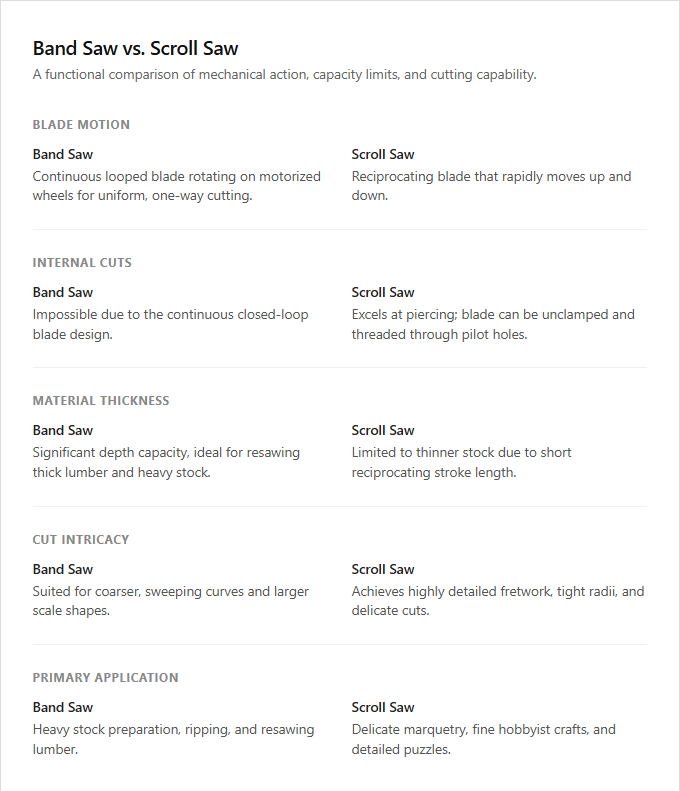
| Factor | Summary |
|---|---|
| Blade Motion | Band saws utilize a continuous looped blade rotating on motorized wheels for uniform cutting, whereas scroll saws rely on a reciprocating blade that moves up and down. |
| Internal Cuts | Scroll saws excel at piercing internal cutouts by allowing the operator to unclamp the blade and thread it through a pilot hole, a technique impossible with a band saw's continuous blade. |
| Material Thickness | Band saws offer a significant depth of cut suitable for resawing thick lumber, while scroll saws are limited to thinner stock due to their short reciprocating stroke length. |
| Cut Intricacy | Scroll saws achieve highly detailed fretwork and tight radius curves using fine-operating blades, whereas band saws are better suited for coarser, sweeping curves. |
| Primary Application | Band saws are indispensable for heavy stock preparation and ripping lumber, while scroll saws are the tool of choice for delicate marquetry and hobbyist crafts. |
Band Saws vs. Scroll Saws: Key Differences
When selecting between a band saw and a scroll saw, the primary distinction lies in their blade mechanics and cutting capacities. Band saws utilize a continuous loop blade mounted on rotating wheels, making them highly efficient for high-capacity resawing, straight cuts, and processing thick lumber. Scroll saws employ a fine, reciprocating blade action that moves rapidly up and down, which excels at executing highly intricate fretwork, tight curves, and delicate internal cutouts.
The choice between these two tools depends heavily on the scale and detail of your woodworking projects. Furniture makers and builders requiring heavy stock preparation benefit most from the band saw, while hobbyists and luthiers focusing on delicate, ornamental designs are ideal candidates for the scroll saw.
Band Saws vs. Scroll Saws: Blades and Cuts
Band saws and scroll saws serve distinct functions in woodworking, distinguished primarily by their blade types and cutting actions. The band saw utilizes a continuous, wide loop blade driven by two wheels. This configuration, paired with precise tracking adjustments, ensures high stability and power, making it the ideal choice for executing straight, heavy-duty rip cuts through thick lumber.
The scroll saw operates with a short, reciprocating, fine-toothed blade. This design allows the tool to achieve an exceptionally tight kerf radius, facilitating intricate, curved cuts and delicate internal cutouts in thinner materials. Woodworkers requiring robust resawing and lumber preparation capabilities will benefit most from a band saw, while craftspeople and artisans focused on detailed fretwork and marquetry will find the scroll saw indispensable.
Scroll Saws vs. Band Saws: Internal Cut Advantage
Band saws and scroll saws serve distinct roles in woodworking, primarily differentiated by their blade configurations. A band saw utilizes a continuous, closed blade loop that rotates on two wheels, making it highly efficient for rapid, straight cuts and resawing thick lumber. In contrast, scroll saws employ a fine, reciprocating blade that moves rapidly up and down.
The defining advantage of the scroll saw lies in its quick-release blade clamps. This mechanism allows operators to easily unclamp the blade, thread it through a pre-drilled pilot hole in the workpiece, and re-secure it to execute intricate internal piercing cuts. Because a band saw's blade is a continuous loop, it cannot perform these delicate, closed-loop internal cutouts.
Band saws are ideal for heavy-duty woodworkers and carpenters requiring powerful, straight slicing, whereas scroll saws are best suited for detail-oriented artisans and hobbyists specializing in intricate fretwork and decorative crafts.
Band Saw vs. Scroll Saw Throat Limits
Choosing between a band saw and a scroll saw depends heavily on the physical scale of your workpiece. A band saw is engineered for heavy-duty material preparation. Its throat capacity and maximum cutting height directly dictate the scale of raw lumber that can be resawed, making it indispensable for processing thick stock and slicing timber into thinner boards.
In contrast, a scroll saw is designed for intricate, low-profile cutting. Here, the throat depth limits the rotation of flat panel workpieces, defining the maximum radius of detailed internal and external cuts. Woodworkers and furniture builders requiring robust stock preparation benefit most from the band saw, while model makers and craft artisans focusing on delicate fretwork will find the scroll saw essential.
Blade Tensioning in Band Saws vs. Scroll Saws
Band saws and scroll saws serve distinct cutting purposes, primarily dictated by their mechanical design and blade tensioning systems. A band saw relies on heavy-duty tensioning mechanisms engineered to withstand immense force. This robust configuration prevents blade deflection under load, ensuring straight, uniform cuts through thick hardwoods and dense materials without bowing.
Scroll saws employ delicate tension levers optimized for highly flexible, low-gauge blades. This setup allows for rapid tension adjustments and frequent blade threading through pre-drilled pilot holes without damaging the fine, fragile steel. While the heavy-duty band saw is ideal for carpenters and furniture makers requiring straight, structural cuts, the scroll saw suits intricate crafters and hobbyists focusing on detailed, decorative fretwork.
Band Saw vs. Scroll Saw Motors
Band saws and scroll saws serve distinct roles in professional woodworking, primarily defined by their motor configurations and cutting capabilities. Band saws require high-torque induction motors to process thick stock, delivering the continuous power necessary for heavy-duty resawing and rapid, straight or sweeping cuts through dense timber.
In contrast, scroll saws utilize variable speed motors measured in strokes per minute for precise control. This design allows operators to execute intricate, delicate interior cutouts in thin materials with extreme accuracy. Band saws are ideal for furniture makers and carpenters managing heavy lumber preparation, while scroll saws are best suited for craftspeople and hobbyists focusing on detailed fretwork and delicate artistic designs.
Guided Band Saws vs. Freehand Scroll Saws
Band saws and scroll saws serve distinct roles in wood processing, primarily differentiated by their guidance mechanisms and cutting capabilities. The band saw is engineered for structural material preparation and straight-line efficiency. This tool is typically paired with a rip fence and miter gauge to ensure high linear accuracy and repeatable, controlled feeding through the vertical blade.
In contrast, the scroll saw operates without mechanical guides, relying entirely on manual feed rates and precise hand manipulation to navigate complex profiles. This setup demands a high degree of tactile control to execute delicate, tight-radius cuts. Band saws are ideal for carpenters requiring rapid, accurate timber dimensioning, while scroll saws are best suited for hobbyists and artisans specializing in intricate decorative fretwork.
Leave a comment