
For professional woodworkers and cabinetmakers, few workshop setbacks are as frustrating as discovering a misaligned biscuit joint during a critical glue-up. Even a sub-millimeter offset can ruin a workpiece, resulting in excessive sanding or wasted materials. While standard workshop funding sources are typically prioritized for foundational machinery like table saws and thickness planers, investing in high-quality joinery tools is what ultimately ensures seamless assembly. Selecting a plate joiner that grants absolute control over vertical height adjustments is the single best way to eliminate these alignment errors.
We must stipulate, however, that premium hardware cannot entirely replace proper technique; even the most advanced fence system requires consistent user calibration and stable workpiece clamping. Renowned tools like the DeWalt DW682K serve as excellent proof of how robust fence engineering translates directly to reliable, production-grade results.
To help you make an informed decision for your shop, this article provides a detailed comparison of Rack and Pinion Fences versus Pivot Fences, analyzing how each mechanism affects joint alignment, adjustment speed, and long-term accuracy.
| Factor | Summary |
|---|---|
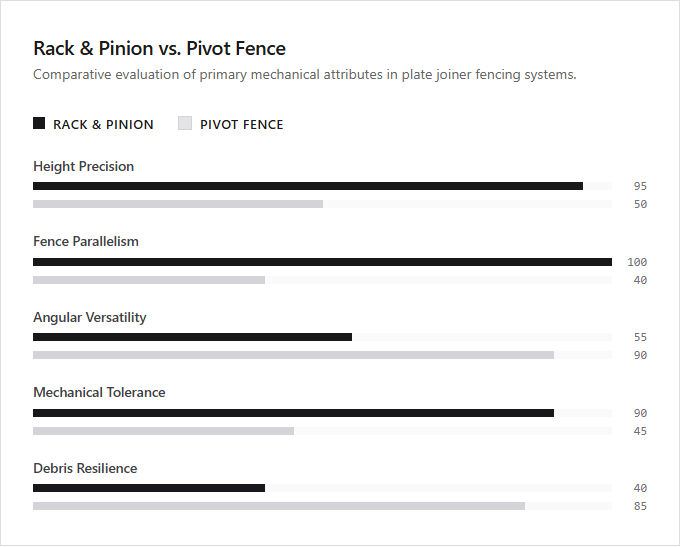
| Height Precision | Rack and pinion fences utilize a dual-gear tracking system for highly precise, repeatable height adjustments, whereas pivot fences rely on manual slide scales that are more prone to calibration drift. |
| Fence Parallelism | The gear-driven rack and pinion design ensures the fence remains strictly parallel to the blade axis, successfully eliminating the risk of coplanar joint misalignment. |
| Angular Versatility | Pivot fences rotate smoothly around a single quadrant pivot point to allow for rapid bevel angle adjustments, while rack and pinion systems prioritize vertical travel accuracy. |
| Mechanical Tolerance | Rack and pinion mechanisms minimize backlash and play through interlocking teeth, whereas pivot joints can develop structural slop over extended periods of heavy use. |
| Debris Sensitivity | Simple pivot fences are highly resilient to sawdust accumulation, whereas the fine gear teeth of a rack and pinion fence can easily bind if wood particulate is not constantly cleared. |
Rack and Pinion Parallel Height Adjustment
A rack and pinion fence system utilizes geared tracking to maintain strict parallelism between the fence and the blade during height adjustments. As the adjustment knob turns, dual gears engage synchronously on both sides of the mechanism, preventing any skewing or tilting of the fence. This rigid, mechanical synchronization eliminates the risk of human error during vertical shifting, ensuring that every slot remains perfectly parallel to the reference face of the workpiece.
In contrast, a pivot fence rotates on a single axis, which can introduce subtle angular deviations during vertical alignment if not carefully locked. While pivot mechanisms allow for rapid angle changes, they lack the geared tracking that guarantees absolute parallel consistency during height shifts. Highly precise rack and pinion fences are ideal for professional furniture makers requiring repeatable accuracy, whereas simpler pivot fences suit general hobbyists who prioritize quick bevel adjustments.
Angular deviation risks on pivot fences during vertical repositioning
When selecting a plate joiner, the fence design significantly impacts joint alignment. Pivot fences adjust height by rotating around a single pivot point, which introduces a distinct risk of angular deviation. During vertical repositioning, any slight play in the hinge mechanism can cause the fence to skew, resulting in sloped biscuit slots that compromise joint strength and flushness.
Rack and pinion fences mitigate this issue by employing a geared track system that keeps the fence strictly parallel to the blade during height adjustments. This precise, dual-guided movement eliminates the tracking errors and unintended tilt common with pivoting designs, ensuring reliable repeatability across multiple workpieces.
Simple pivot fences are best suited for casual DIYers prioritizing cost-effectiveness, whereas rack and pinion fences are the preferred choice for professional woodworkers demanding absolute accuracy for heavy-duty cabinetry.
Reference face registration consistency between successive biscuit slots
In plate joining, maintaining identical slot heights across multiple workpieces depends heavily on the fence adjustment mechanism. A rack and pinion fence system provides superior reference face registration consistency. Because the fence moves on a geared track, it remains perfectly parallel to the blade throughout height adjustments, virtually eliminating the risk of skewing or misalignment between successive cuts.
By comparison, a pivot fence rotates on a single axis, which can introduce minor angular deviations if the mechanism is not secured with absolute precision. While capable of producing accurate joints, it demands meticulous manual verification to maintain consistency across a production run. Precision-oriented woodworkers requiring rapid, highly repeatable setups benefit most from the rack and pinion design, while budget-conscious hobbyists find the simplicity of a pivot fence adequate for occasional utility joinery.
Micro-adjustment knob precision for exact slot centerline kerf alignment
When executing precise biscuit joinery, the choice of fence system dictates the accuracy of your slot centerline alignment. A rack and pinion fence maintains strict parallelism to the blade, utilizing a geared micro-adjustment knob to dial in exact vertical heights. This mechanism prevents drifting during locking, allowing woodworkers to align the blade kerf precisely with the marked centerline of mating workpieces.
In contrast, a pivot fence rotates on a single axis, which can introduce minor angular variances when adjusting height. While pivot systems are highly intuitive for quick bevel cuts, they lack the geared micro-adjustment precision required for ultra-fine alignments. The rack and pinion system is ideal for high-precision cabinetmakers requiring flawless flush joints, whereas the simpler pivot fence is best suited for general construction carpenters prioritizing speed and versatility.
Deflection resistance under plunging forces using dual-locking fence mechanisms
Rack and pinion fences offer superior parallel tracking and exceptional deflection resistance during plunge cuts. When paired with a dual-locking mechanism, this design secures both sides of the fence, effectively neutralizing the asymmetrical forces exerted when plunging the blade. This rigid configuration ensures highly consistent, repeatable slot depths and angles under heavy workload pressure.
Pivot fences operate on a single rotational axis. While dual-point clamping helps mitigate deviation, pivot designs inherently possess more potential for minor vertical deflection under high plunging forces than geared systems.
The highly rigid rack-and-pinion setup serves high-volume industrial woodworkers requiring absolute precision, whereas the more adaptable pivot fence suits general carpenters seeking rapid adjustments for versatile, on-site installations.
Perpendicularity retention relative to the blade axis at various angles
When selecting a plate joiner, the fence mechanism directly dictates joint accuracy. A rack and pinion fence system utilizes geared tracks to ensure the fence remains perfectly parallel and perpendicular to the blade axis throughout its range of motion. This mechanical synchronization prevents the fence from skewing when tightening the lock, maintaining absolute perpendicularity even during complex bevel adjustments.
Conversely, a pivot fence rotates around a single axis point. While simpler and faster to adjust, it relies heavily on manual alignment and friction locks. This design is more susceptible to slight deviations in perpendicularity relative to the blade axis if uneven pressure is applied during locking, which can introduce minor alignment errors in critical joints.
The rack and pinion fence is highly suitable for precision-oriented furniture makers requiring absolute repeatability, whereas the pivot fence serves general woodworkers seeking a cost-effective, rapid-adjustment tool for standard cabinetry.
Coplanar Joint Alignment for Flush Faces
Achieving perfectly flush coplanar joints requires absolute parallelism between the plate joiner's fence and its blade. A rack and pinion fence system provides precise, geared height adjustments that ensure the fence remains strictly parallel to the cutter throughout its travel. This mechanical synchronization eliminates the minute tilting that causes vertical offsets on flush faces, guaranteeing seamless alignment without manual recalibration.
Conversely, a pivot fence rotates around a single axis point. While highly capable, any slight play in the pivoting hinge can introduce minor angular deviations when locking in the height, which can result in stepped joints that require extra sanding. The rack and pinion fence is ideal for high-precision furniture makers requiring repeatable, error-free setups, whereas the simpler pivot fence suits general carpenters who prioritize rapid bevel adjustments and utility over absolute micro-precision.
Leave a comment