
Selecting the right air compressor drive motor often leaves workshop operators grappling with unexpected downtime and soaring energy bills. While typical equipment upgrades rely on standard capital funding sources or industrial efficiency grants, choosing the wrong motor configuration can quickly erode those initial financial advantages. Transitioning to the right drive system, however, grants unprecedented pneumatic efficiency and a dramatic reduction in lifecycle maintenance. This comes with the stipulation that brushless technology requires a higher upfront investment, demanding a clear understanding of your facility's duty cycle. For example, high-demand facilities like Precision Auto Body have successfully utilized brushless systems to sustain continuous, multi-tool operations. Below, we analyze the critical differences between brushed and brushless motors, evaluate their long-term ROI, and guide you in selecting the optimal drive for your pneumatic requirements.
| Factor | Summary |
|---|---|
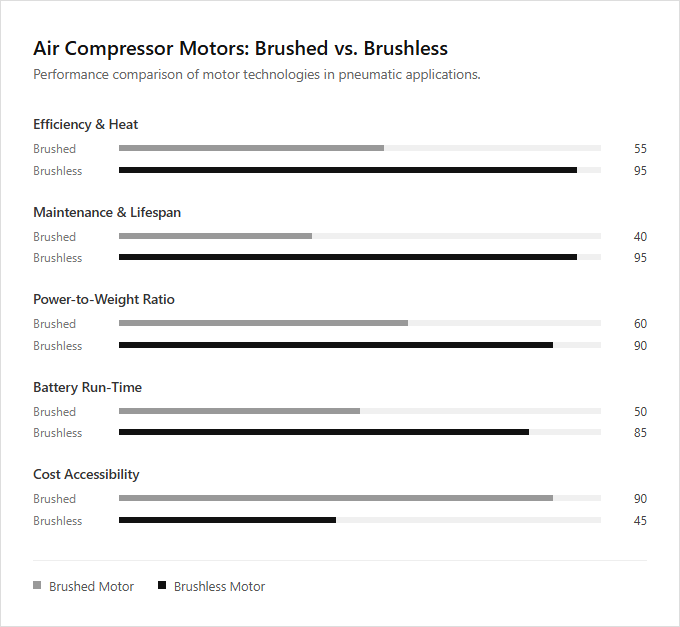
| Efficiency & Heat | Brushless motors eliminate physical friction from carbon brushes, resulting in higher thermodynamic efficiency and reduced heat generation during sustained air compression cycles. |
| Maintenance & Lifespan | Brushed motors require periodic replacement of wearing contact brushes, whereas brushless models utilize solid-state electronic commutation to significantly extend the tool's operational lifespan. |
| Power-to-Weight Ratio | Brushless air compressors deliver superior torque density and higher RPM because the copper windings are positioned on the stationary stator rather than the rotating armature. |
| Battery Run-Time | Cordless air compressors featuring brushless technology optimize energy draw from the battery pack by using microprocessors to dynamically adjust power delivery based on the load of the pneumatic pump. |
| Cost & Complexity | Brushless motors require sophisticated electronic speed controllers and sensor arrays, which increases the initial manufacturing cost compared to simple, direct-current brushed circuitry. |
Brushless Motors: Maximizing Thermodynamic Efficiency
When selecting an air compressor, the choice between brushed and brushless motors significantly impacts overall performance. Brushless motors represent a major technological advancement by eliminating the physical contact of carbon brushes. By removing this contact, these motors eliminate frictional losses and internal heat generation, which directly maximizes the tool's thermodynamic efficiency and extends its operational lifespan.
Traditional brushed motors rely on mechanical commutation, resulting in higher wear and lower energy efficiency over time, though they offer a lower initial cost. Budget-conscious DIY enthusiasts prefer brushed models for occasional household tasks, whereas high-demand industrial professionals require the high-efficiency, low-maintenance performance of brushless air compressors.
Brushless ESCs Match Dynamic Pneumatic Demand
When selecting an air compressor, the choice between brushed and brushless motor technologies significantly impacts operational efficiency. Brushless compressors utilize advanced electronic speed controllers to continuously adjust the motor's drive frequency. This allows the system to match dynamic pneumatic demand in real time, delivering precise airflow and reducing energy waste. Conversely, traditional brushed motors operate at a fixed speed, relying on physical carbon brushes that create friction, generate heat, and limit performance adaptation.
Eliminating mechanical wear points extends the lifespan of the tool and minimizes maintenance intervals. Busy contractors requiring reliable, high-duty-cycle equipment for demanding job sites benefit most from the smart adaptability of brushless models, while budget-conscious DIY hobbyists performing intermittent, light-duty tasks are well-suited to the simplicity of traditional brushed compressors.
Brushless Motors: Higher CFM in Lighter Compressors
When selecting an air compressor, the choice between brushed and brushless motors significantly impacts job site efficiency. Brushless technology offers superior power density, allowing manufacturers to engineer highly compact tools without sacrificing performance. By eliminating friction-inducing brushes, these motors deliver higher Cubic Feet per Minute (CFM) airflow while maintaining a remarkably lightweight compressor footprint, making transport and setup effortless.
Traditional brushed motors remain a reliable, cost-effective alternative, though they require a larger physical size to achieve comparable power levels. Standard DIY hobbyists and occasional workshop users often benefit from the affordability of brushed models, whereas high-volume contractors and mobile professionals require the high-CFM efficiency of brushless systems to sustain demanding pneumatic tools.
Brushless Motor Cooling Protects Pneumatic Seals
When selecting an air compressor, the choice between brushed and brushless motors significantly impacts tool longevity and performance. Brushless motors offer a distinct engineering advantage by dissipating heat directly through the outer stator winding rather than generating internal friction. This efficient thermal management prevents heat buildup from reaching critical internal components, thereby protecting vital pneumatic seals from thermal degradation and premature failure.
Brushed motors, by comparison, rely on mechanical carbon brushes that generate substantial friction and heat within the motor core, which can accelerate seal wear over extended use. Brushed models remain a cost-effective, reliable choice for DIY enthusiasts and occasional workshop tasks, whereas brushless compressors are ideal for high-demand professionals requiring continuous runtimes and minimal maintenance.
Brushless Commutation Prevents EMI in Digital Pressure Sensors
When selecting an air compressor, the choice between brushed and brushless motors significantly impacts performance and tool longevity. Brushed motors rely on physical carbon brushes that create friction and electrical arcing during operation. In contrast, brushless motors utilize electronic commutation. The absence of arcing in brushless commutation eliminates electromagnetic interference (EMI) near sensitive digital pressure sensors, ensuring highly accurate pressure readings and stable system feedback during operation.
The lack of brushes also reduces mechanical wear, lowering maintenance requirements and increasing energy efficiency. Brushed models remain viable for straightforward pneumatic tasks where sophisticated electronic controls are unnecessary. Traditional brushed compressors are ideal for occasional DIY hobbyists seeking budget-friendly tools, whereas advanced brushless models are suited for industrial professionals who require precise digital monitoring and high-duty cycle performance.
Brushless Drives: Wear-Free Continuous Operation
When selecting an air compressor, the choice between brushed and brushless motors significantly impacts performance and longevity. Brushless motors represent a major technological advancement, utilizing electronic controllers instead of physical carbon brushes to manage electrical current. Because they eliminate internal friction, brushless drives sustain a continuous duty cycle without the risk of armature wear or thermal degradation. This efficient operation ensures consistent pressure delivery during prolonged tasks and drastically extends the tool's lifespan.
Traditional brushed air compressors rely on physical contact to power the motor, which leads to gradual wear and heat buildup over extended use. While these units are more budget-friendly initially, they require periodic maintenance and are best suited for intermittent applications. Lightweight brushed models are ideal for DIY hobbyists requiring occasional tire inflation, whereas robust brushless systems are suited for professional contractors needing reliable, non-stop pneumatic power on busy jobsites.
Brushless Motor Torque Overcomes Compressor Head Pressure
When selecting an air compressor, the choice between brushed and brushless motors significantly impacts performance under load. Traditional brushed motors rely on physical carbon brushes, which often struggle against the high static head pressure inherent in compressed air systems. In contrast, brushless motors utilize electronic controllers to deliver exceptional starting torque. This instantaneous power easily overcomes initial resistance, allowing the compressor to start smoothly and reliably even when the tank is already partially pressurized.
By eliminating physical friction and heat buildup, brushless designs also offer superior energy efficiency and a longer operational lifespan. Budget-conscious DIY enthusiasts will find affordable brushed compressors suitable for occasional garage inflation and light nailing, whereas professional contractors and industrial operators require the robust starting power and durability of brushless models for demanding, continuous job site work.
Leave a comment