
Selecting the right cutting wheel for your concrete cut-off saw is a constant source of frustration on busy job sites, often leading to ruined materials, stalled timelines, and blown tool budgets. While standard equipment procurement budgets typically treat frequent blade replacement as an unavoidable operational cost, accepting this overhead is rarely necessary. Taking a strategic approach to your consumables "grants" your crew unmatched cutting efficiency, safer operating conditions, and a drastically reduced cost-per-cut ratio.
However, unlocking these benefits comes with the stipulation that blade performance is strictly dictated by matching the wheel's physical properties to your specific workpiece-as demonstrated when comparing the rapid degradation of silicon carbide abrasive discs against the sustained cutting power of premium diamond blades on heavy-duty saws like the Stihl TS420.
This article will compare diamond and abrasive blades across durability, cutting speed, safety, and upfront cost, providing a clear decision framework to optimize your cut-off machine's performance.
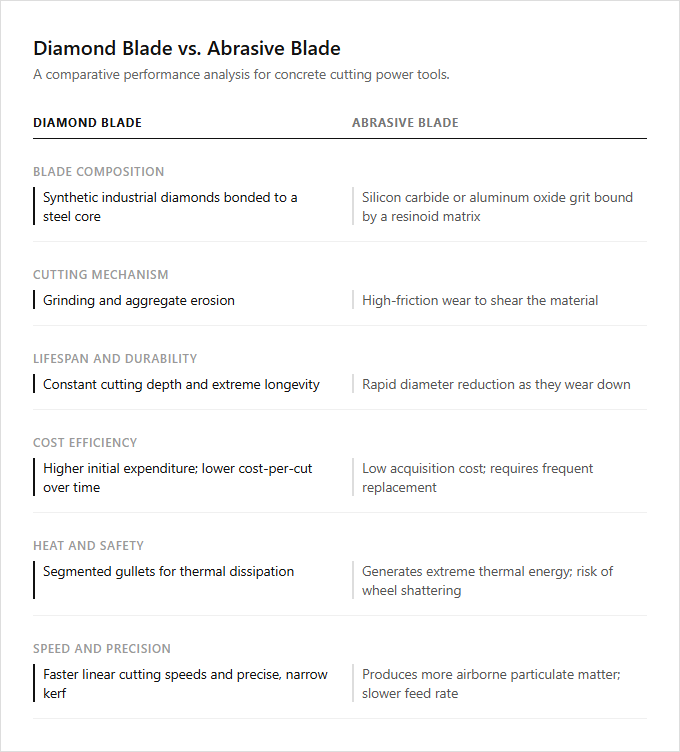
| Factor | Summary |
|---|---|
| Blade Composition | Diamond blades utilize synthetic industrial diamonds bonded to a steel core, whereas abrasive blades are composed of silicon carbide or aluminum oxide grit bound by a resinoid matrix. |
| Cutting Mechanism | Diamond blades cut through concrete via grinding and aggregate erosion, while abrasive blades rely on high-friction wear to shear the material. |
| Lifespan and Durability | Diamond blades maintain a constant cutting depth and offer extreme longevity, whereas abrasive blades experience rapid diameter reduction as they wear down during operation. |
| Cost Efficiency | Diamond blades require a higher initial capital expenditure but offer a lower cost-per-cut over time, unlike abrasive blades which have a low acquisition cost but require frequent replacement. |
| Heat and Safety | Diamond blades often utilize segmented gullets for thermal dissipation, while abrasive blades generate extreme thermal energy and carry a risk of catastrophic wheel shattering. |
| Cutting Speed and Precision | Diamond blades deliver faster linear cutting speeds and a precise, narrow kerf, whereas abrasive blades produce more airborne particulate matter and a slower feed rate. |
Laser-Welded Diamond vs. Silicon Carbide Composition
Selecting the optimal concrete power tool blade requires a thorough understanding of their structural engineering. Premium diamond blades utilize industrial-grade synthetic diamond segments laser-welded to a hardened steel core. This robust metallurgical bond provides exceptional thermal resistance, preventing segment loss and maintaining a constant cutting depth throughout the tool's extended lifespan under heavy workloads.
In contrast, abrasive blades consist of a fiberglass-reinforced silicon carbide matrix designed to wear away incrementally during operation, which continually exposes fresh cutting surfaces. Professional contractors requiring long-term durability and high-speed precision on major job sites benefit most from diamond blades, while occasional DIYers or budget-conscious operators undertaking quick, light-duty masonry repairs are better suited for abrasive options.
Blade Degradation: Constant Diameter vs. Rapid Radial Wear
Diamond blades feature a steel core with segmented diamond rims, allowing them to retain a constant outer diameter throughout their operational lifespan. As the blade cuts, the metal matrix slowly wears away to expose new, sharp diamond grits, maintaining a consistent cutting depth and precise speed without sacrificing structural integrity.
In contrast, abrasive blades experience rapid radial wear. Composed of bonded abrasive grains, these wheels break down continuously during use, resulting in a rapidly shrinking diameter that progressively limits the maximum depth of cut and requires frequent blade changes.
High-volume masonry contractors requiring precise, long-term efficiency benefit most from diamond blades, while budget-conscious operators performing occasional, light-duty utility cuts are better suited for abrasive options.
Tensile Strength Limits and Centrifugal Fracture Risks
When selecting cutting wheels for concrete power tools, understanding the material integrity of diamond blades versus abrasive blades is critical for job site safety. Diamond blades utilize a solid steel core, providing high tensile strength that easily resists the extreme centrifugal forces generated at high rotational speeds. Conversely, abrasive blades consist of bonded organic materials and fiberglass reinforcement, which possess significantly lower tensile limits. This structural vulnerability increases the risk of catastrophic centrifugal fracturing, where the blade shatters under high stress and poses severe hazards to operators.
Choosing the appropriate blade depends on the specific operational demands and user expertise. Heavy-duty industrial contractors requiring long-term durability and maximum safety margins benefit most from diamond blades, while occasional DIY users seeking a cost-effective solution for short-term projects typically utilize abrasive blades.
Variations in Material Removal and Cutting Efficiency
Selecting cutting attachments for concrete power tools significantly impacts operational productivity. Diamond blades utilize industrial-grade diamond crystals bonded to a steel core, delivering rapid material removal rates and maintaining a consistent cutting depth. This design ensures superior efficiency, as the blade diameter remains constant, allowing for fast, continuous cutting through dense masonry and reinforced concrete.
Abrasive blades, composed of bonded silicon carbide, wear down during use, which progressively reduces their cutting efficiency and slows material removal. Professional masonry contractors requiring high-speed, continuous production benefit most from durable diamond blades, while occasional DIY users performing light-duty, budget-conscious tasks are better suited for abrasive blades.
Coolant Flow and Thermal Limits: Wet vs. Dry Cutting
Diamond blades require consistent coolant flow rates during wet-cutting operations to dissipate extreme frictional heat and prevent segment loss. Sustained wet cutting typically demands a continuous water supply of at least 0.5 to 1 gallon per minute to maintain core structural integrity and flush out abrasive slurry from the cut path.
Silicon carbide abrasive blades rely on high dry-cutting thermal tolerance. These blades utilize organic bonds that break down purposefully under heat, allowing new cutting edges to expose without the need for liquid cooling. Operating these blades dry avoids electrical hazards and messy runoff, though it subjects the blade matrix to rapid wear.
Industrial contractors requiring high-precision, dust-free deep cuts benefit most from diamond blades, while utility workers performing quick, intermittent outdoor cuts are better suited for abrasive blades.
Initial Cost vs. Lifetime Cost-per-Cut
Abrasive blades offer a low initial capital outlay, making them attractive for immediate, short-term budget constraints. These blades wear down rapidly, requiring frequent replacements that escalate the cumulative cost per cut over time. Conversely, diamond blades demand a significantly higher upfront investment but deliver extreme durability, maintaining their diameter and cutting speed over hundreds of deep concrete cuts.
Analyzing lifetime metrics reveals that diamond blades drastically reduce the overall cost-per-cut ratio and minimize labor downtime associated with blade changes. Over an extended operational window, the initial premium of diamond technology yields substantial financial savings compared to the recurring expense of consumable abrasive discs. High-volume commercial contractors requiring maximum efficiency benefit most from diamond blades, whereas DIY homeowners or occasional users on tight project budgets are better served by inexpensive abrasive blades.
Concrete Suitability: Compressive Strength and Aggregate Hardness
When cutting high-compressive-strength concrete containing hard aggregates like quartz or granite, diamond blades are the industry standard. These blades utilize industrial-grade diamond grit embedded in a metal bond, which grinds through dense materials without losing cutting depth. They deliver exceptional longevity and speed, maintaining efficiency even when encountering steel reinforcement or highly abrasive aggregate mixes.
Silicon carbide or aluminum oxide abrasive blades are suited for lower-strength concrete and softer aggregates like limestone or sandstone. These blades function by wearing away during the cut, making them ideal for shallow penetrations where blade wear is less of a financial factor. Professional contractors requiring high-speed production and long-term durability should invest in diamond blades, while budget-conscious DIYers or occasional users undertaking light masonry tasks will find abrasive blades more practical.
Leave a comment