
Finding the right oscillating multi-tool blade can be an incredibly frustrating experience. Tradespeople and workshop managers frequently waste time and budget on accessories that slip, transfer power inefficiently, or simply do not fit their specific machine. While standard tool procurement budgets and project funding sources readily cover the initial cost of high-quality multi-tools, the ongoing expense of incompatible accessories can quietly drain operational resources.
Selecting the optimal mounting interface grants professionals vastly superior torque transfer, hands-free blade changes, and maximized accessory lifespan. It is important to stipulate, however, that compatibility is not universal; legacy OIS accessories will not fit on high-performance Starlock Max tools, such as those manufactured by Bosch or Fein. Managing these interface limitations is crucial to maintaining job site productivity.
This article provides an objective comparison between the traditional OIS and modern Starlock mounting platforms. We will analyze their design differences, backward compatibility, and real-world performance to help you choose the right standard for your toolkit.
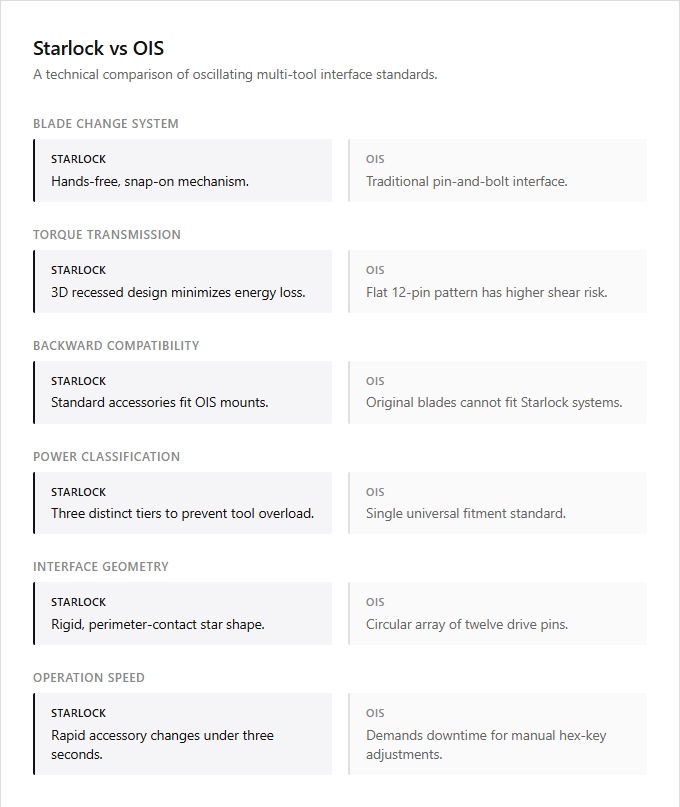
| Factor | Summary |
|---|---|
| Blade Change System | Starlock features a patented hands-free, snap-on mechanism, whereas OIS relies on a traditional pin-and-bolt interface that requires manual tightening tools. |
| Torque Transmission | The 3D recessed design of Starlock minimizes energy loss and slippage, while the flat 12-pin OIS pattern has a higher risk of pin shear under high-torque applications. |
| Backward Compatibility | Standard Starlock accessories are backward compatible with OIS mounts, but original OIS blades cannot fit onto Starlock-exclusive locking systems. |
| Power Classification | Starlock is divided into three distinct power tiers (Starlock, StarlockPlus, and StarlockMax) to prevent tool overload, whereas OIS utilizes a single universal fitment standard. |
| Interface Geometry | The Starlock interface utilizes a highly rigid, perimeter-contact star shape, whereas OIS uses a circular array of twelve drive pins to transfer rotational energy. |
| Operation Speed | Starlock enables rapid, tool-less accessory changes in under three seconds, unlike the OIS standard which demands downtime for manual hex-key adjustments. |
Starlock Maximizes Torque Transfer Over Flat OIS
When comparing oscillating multi-tool interfaces, the distinction between the Starlock system and the traditional Oscillating Interface System (OIS) centers on power transmission. The Starlock design features a recessed, three-dimensional interface geometry that securely grips the tool. This rigid contact maximizes torque transfer and eliminates slippage by distributing the motor's rotational force far more effectively than flat alternatives.
Conversely, the older OIS standard relies on a flat, twelve-pin pattern to secure the accessory. This flat configuration concentrates stress on individual pins, which increases vibration and limits energy transfer during heavy-duty applications. Standard OIS tooling remains practical for budget-conscious DIYers tackling light, occasional sanding, while the high-torque Starlock system is essential for trade professionals requiring rapid blade changes and maximum productivity on demanding jobsites.
Starlock Snap-On vs. Traditional Manual OIS
The evolution of oscillating multi-tools has introduced distinct accessory mounting standards, primarily the traditional Oscillating Interface System (OIS) and the modern Starlock system. The legacy OIS design requires users to manually tighten an arbor screw using a hex key to secure the blade, a process that can be time-consuming and prone to loose connections during heavy use.
In contrast, the Starlock system features a patented hands-free snap-on mounting design that allows users to simply press the tool onto the accessory to lock it instantly into place, utilizing a lever release to eject the blade without direct contact. High-volume professionals requiring rapid, tool-free blade changes benefit most from Starlock, whereas occasional DIY hobbyists may find the cost-effective and highly compatible OIS system sufficient for basic tasks.
Starlock Fits OIS, But Not Vice Versa
Oscillating multi-tool interfaces have evolved significantly, shifting from the traditional Oscillating Interface System (OIS) to the advanced Starlock mounting standard. Understanding the compatibility between these designs is crucial when purchasing replacement blades. Standard Starlock accessories feature a versatile design that maintains backward compatibility, allowing them to fit seamlessly onto older OIS-compatible multi-tools.
In contrast, OIS accessories do not share this forward compatibility. They remain physically incompatible with Starlock-only mounts because of the proprietary, three-dimensional snap-in design that prevents flat OIS blades from seating correctly. While budget-conscious DIYers seeking widely available, legacy blades prefer OIS-compatible tools, heavy-duty professionals requiring rapid, hands-free blade changes will find Starlock systems far more suitable.
Starlock's Three Power Tiers Match Tool Wattage
The evolution of oscillating multi-tool accessories is defined by the transition from the legacy Oscillating Interface System (OIS) to the advanced Starlock standard. While the traditional OIS relies on a flat, pin-based connection prone to slippage, the Starlock system features a rigid, three-dimensional snap-in interface that maximizes torque transfer and efficiency.
To optimize performance, the Starlock system utilizes three distinct power tiers, including Starlock, StarlockPlus, and StarlockMax, to match tool wattage. This backward-compatible tiered design prevents underpowered tools from operating heavy-duty accessories, protecting the motor while ensuring maximum cutting speed.
OIS remains suitable for budget-conscious DIYers performing light, occasional home maintenance, whereas the tiered Starlock system is ideal for trade professionals who require maximum power transfer, safety, and rapid blade changes on demanding jobsites.
Starlock Minimizes Vibration and Energy Loss Over OIS
Selecting the right interface for oscillating multi-tools depends on understanding the mechanical efficiency of the accessory connection. The traditional Oscillating Interface System (OIS) relies on a flat, pin-based engagement that depends heavily on friction to transfer power. In contrast, the Starlock system utilizes a three-dimensional, recessed socket design. This rigid connection significantly minimizes kinetic energy loss and reduces tool vibration, ensuring direct power transfer from the motor to the blade.
The elimination of play in the Starlock interface prevents mounting wear and improves cutting precision during heavy-duty applications. OIS remains a widely compatible, cost-effective standard for lighter tasks, though it lacks the torque transmission efficiency of the newer design. OIS is best suited for occasional DIYers seeking budget-friendly blade compatibility, while Starlock is ideal for professional contractors requiring high-torque efficiency and rapid, tool-free accessory changes.
OIS 12-Point Star and 10mm Pin Configuration
Oscillating multi-tool accessory interfaces are primarily divided into the legacy OIS (Oscillating Interface System) and the modern Starlock standard. The traditional OIS utilizes a flat twelve-point star configuration with a standardized ten-millimeter pin circle diameter. This design relies on a central fixing screw to clamp the accessory securely to the tool flange, providing reliable torque transfer across standard applications.
In contrast, the Starlock system features a three-dimensional, cupped recess that enables a snap-in, hands-free blade change while eliminating slippage. Budget-conscious DIY enthusiasts requiring occasional use and wide accessory compatibility often prefer OIS, whereas high-volume contractors needing rapid, tool-less blade changes and maximum power transfer are best suited for Starlock.
StarlockMax Mechanical Lockout Prevents Tool Overload
The oscillating multi-tool market features two prominent accessory mounting systems: the traditional Oscillating Interface System (OIS) and the modern Starlock system. While OIS utilizes a flat, pin-based interface requiring manual tools for blade changes, Starlock features a three-dimensional, snap-in design that maximizes torque transfer and efficiency. The Starlock ecosystem is divided into three performance tiers to ensure operational safety across different tool capacities.
Crucially, StarlockMax incorporates a mechanical lockout mechanism to prevent overloading on lower-wattage OIS or standard Starlock tools. This physical restriction ensures high-torque blades cannot be fitted onto underpowered machines, protecting the tool's motor from burnout. Standard OIS is best suited for casual DIY hobbyists performing light-duty detail work, while StarlockMax is designed for industrial trade professionals executing heavy-duty cutting and demolition.
Leave a comment