
Production managers and workshop operators frequently struggle with premature tool failure and inconsistent fastening depths during high-volume assembly tasks. While standard equipment procurement budgets and traditional tooling funding sources are designed to address basic capacity needs, they often overlook the critical nuance of tool duty cycles.
Investing in the correct actuation mechanism grants operations a significant competitive advantage in throughput and operator comfort. However, this performance boost comes with the stipulation that peak efficiency is only achieved when the tool's inner mechanics precisely align with your specific material density. For example, high-speed industrial packaging lines require a vastly different power delivery profile than intricate furniture upholstery.
In this article, we will examine the engineering behind solenoid-driven and motor-driven electric staplers. We will compare their cycle speeds, impact forces, and maintenance requirements to help you select the ideal tool for your operational needs.
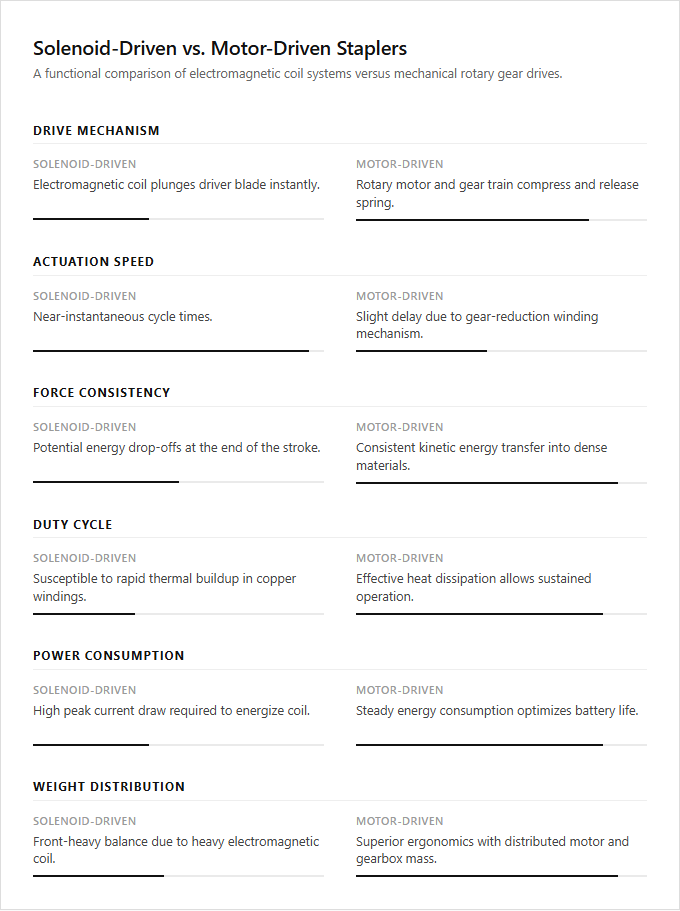
| Factor | Summary |
|---|---|
| Drive Mechanism | Solenoid-driven staplers use an electromagnetic coil to plunge the driver blade instantly, whereas motor-driven models utilize a rotary motor and gear train to compress and release a spring. |
| Actuation Speed | Solenoid staplers offer near-instantaneous cycle times, while motor-driven alternatives experience a slight delay due to the gear-reduction system winding the firing mechanism. |
| Force Consistency | Motor-driven staplers leverage mechanical advantage to deliver consistent kinetic energy transfer into dense materials, whereas solenoid units can experience drop-offs in driving force at the end of the stroke. |
| Duty Cycle | Solenoid staplers are susceptible to rapid thermal buildup in their copper windings during continuous use, whereas motor-driven designs manage heat dissipation more effectively for sustained operation. |
| Power Consumption | Solenoid-driven tools require a high peak current draw to energize the electromagnet, while motor-driven staplers optimize battery efficiency through steady energy consumption. |
| Weight Distribution | The heavy electromagnetic coil of a solenoid creates a front-heavy tool balance, whereas the distributed mass of a brushless motor and planetary gearbox provides superior ergonomics. |
Solenoid Direct Actuation vs. Motor Gear Reduction
Solenoid-driven electric staplers employ direct electromagnetic linear actuation to propel the staple. When the electrical circuit closes, a magnetic field instantly forces a metal plunger downward, achieving near-instantaneous cycle times and high impact force. This streamlined mechanism eliminates complex moving parts, resulting in a highly responsive tool optimized for rapid-fire applications.
Motor-driven systems rely on rotational-to-linear gear reduction, where an electric motor drives a series of gears to compress a spring before releasing the firing pin. This mechanical translation provides a smoother, more controlled stroke and allows for adjustable depth of drive across varying material densities. Solenoid models are ideal for high-speed packaging workers requiring rapid, repetitive fastening, while motor-driven units best suit carpentry and upholstery professionals who need precise power control on diverse substrates.
Solenoid Impulse Force vs. Motor-Driven Torque
Electric staplers utilize distinct mechanical designs to drive fasteners, primarily categorized into solenoid-driven and motor-driven systems. Solenoid mechanisms rely on an electromagnetic coil to plunge a driver blade, delivering a high-velocity peak impulse force. This rapid action results in instantaneous firing, making them highly efficient for quick, repetitive tasks on standard media.
Motor-driven models employ a motorized gear assembly to compress a powerful spring or drive a cam, providing a consistent, high-torque progressive mechanical advantage. This engineered approach ensures uniform penetration depth even through dense materials. Solenoid-driven models are ideal for office administrative staff requiring rapid document binding, while motor-driven staplers suit industrial upholstery and construction professionals tackling heavy-duty substrates.
Solenoid Inrush vs. Rotary Motor Sustained Current
Solenoid-driven electric staplers utilize an electromagnetic coil to propel the driving pin instantly. This actuation method requires a high transient inrush current to generate the necessary force, placing a brief but significant load on the electrical circuit. While highly responsive, this design demands robust power delivery to handle the sudden electrical spikes.
Conversely, motor-driven staplers employ a rotary motor to gradually compress the firing spring through a gear train. This mechanism results in a sustained, lower-amplitude current draw over a slightly longer cycle, reducing stress on batteries and power supplies. Solenoid models are ideal for high-speed industrial operators needing immediate cycle times, while motor-driven units best serve mobile contractors and DIY users who prioritize battery longevity and portable power consistency.
Solving Solenoid Force Decay in Motorized Staplers
Solenoid-driven electric staplers rely on direct electromagnetic force to propel the driver, but they suffer from rapid force decay as the stroke distance increases, which can limit penetration depth in dense materials. To overcome this limitation, motor-driven staplers employ a cam-and-spring or lead screw mechanism. This engineering approach bypasses the physical decay of magnetic force by converting rotational motor power into stored mechanical energy, delivering consistent and high-impact driving force throughout the entire stroke.
This difference in power delivery dictates the operational efficiency of each tool across different work environments. Solenoid staplers are ideal for office professionals requiring rapid, repetitive paper fastening, while motor-driven models are best suited for construction contractors and upholsterers who require deep, reliable penetration into hardwood and dense substrates.
Solenoid vs. Geared Motor Acoustic Comparison
Electric staplers utilize distinct mechanical designs that dictate their acoustic performance and operational feel. Solenoid-driven models employ an electromagnetic coil to rapidly propel a plunger, delivering instantaneous driving force. This mechanism generates a sharp, high-amplitude impact noise upon sudden plunger deceleration at the end of the stroke.
In contrast, motor-driven electric staplers utilize a geared rotary system to compress a drive spring or actuate the firing mechanism. This design produces a lower-decibel, continuous rotational sound rather than a sudden concussive report. Solenoid models are ideal for high-volume industrial workers requiring instantaneous firing speed, while motor-driven systems best serve office professionals and craftspeople prioritizing a quieter, more controlled working environment.
Solenoid Impact Fatigue vs. Motor Gear Wear
Solenoid-driven electric staplers utilize an electromagnetic coil to rapidly propel a metal plunger, delivering instantaneous driving force. This high-impact kinetic energy creates immediate, concentrated mechanical stress, which accelerates component fatigue over time. While highly efficient for rapid-fire applications, the repetitive shocks subject the internal striker assembly to significant wear.
In contrast, motor-driven systems employ an electric motor to compress a drive spring through a series of reduction gears. This rotational mechanism distributes mechanical wear gradually across the gear train, reducing localized peak stress and extending the tool's operating lifespan. High-volume production workers requiring instantaneous speed benefit from solenoid models, whereas contractors seeking tool longevity and controlled placement prefer motor-driven alternatives.
Motor Closed-Loop vs. Solenoid Open-Loop Control
Electric staplers utilize distinct actuation mechanisms that dictate their performance and control complexity. Solenoid-driven models employ electromagnetic coils, relying on simple, open-loop pulse-width excitation to rapidly propel the firing pin. While this design delivers high-velocity impact, it lacks real-time adjustments. In contrast, motor-driven units integrate microcontrollers with closed-loop feedback systems to manage the stroke cycle. By continuously monitoring spindle position and resistance, these systems dynamically adjust power to ensure precise, consistent staple depth across varying material densities.
Solenoid-driven units are ideal for administrative personnel requiring rapid, light-duty paper binding, whereas motor-driven staplers are best suited for craftspeople and upholstery professionals who demand controlled, heavy-duty fastening into diverse substrates.
Leave a comment