
Securing exterior sheathing efficiently without tearing the weather-resistant barrier (WRB) is a constant struggle for residential contractors, often leading to failed inspections and costly rework. When allocating your crew's equipment budget, the default choice typically lands on traditional, high-volume pneumatic fastening options already in your tool crib. However, selecting the right specialized tool-like a dedicated cap stapler-grants unparalleled holding power and watertight integrity that standard fasteners simply cannot match.
To be clear, while building codes stipulate specific minimum penetration depths, the physical surface area of your fastener is what ultimately prevents wind blow-offs. Leading builders utilizing systems like DuPont Tyvek or ZIP System sheathing increasingly rely on tools like the Bostitch Cap Stapler to meet rigorous manufacturer specifications.
In this guide, we will compare the holding capacity, speed, and cost-efficiency of Cap Staplers versus Standard Crown Staplers to help you select the ideal pneumatic tool for your next envelope installation.
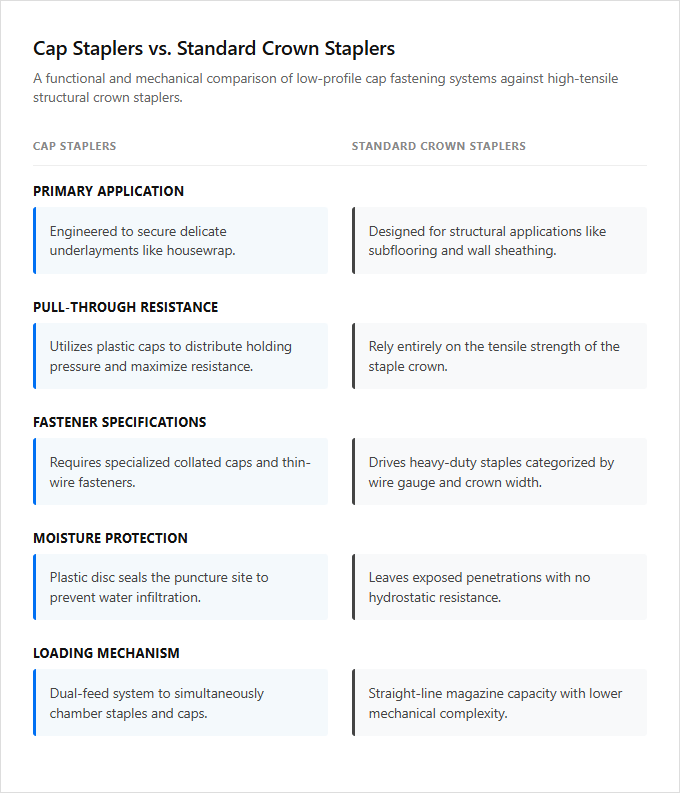
| Factor | Summary |
|---|---|
| Primary Application | Cap staplers are engineered to secure delicate underlayments like housewrap, whereas standard crown staplers are designed for structural applications like subflooring and wall sheathing. |
| Pull-Through Resistance | Cap staplers utilize plastic caps to distribute holding pressure and maximize pull-through resistance, while standard crown staplers rely entirely on the tensile strength of the staple crown. |
| Fastener Specifications | Cap staplers require specialized collated caps and thin-wire fasteners, whereas standard crown staplers drive heavy-duty staples categorized by wire gauge and crown width. |
| Moisture Protection | The plastic disc of a cap stapler seals the puncture site to prevent water infiltration, whereas standard crown staples leave exposed penetrations with no hydrostatic resistance. |
| Loading Mechanism | Cap staplers utilize a dual-feed system to simultaneously chamber staples and caps, which increases mechanical complexity compared to the straight-line magazine capacity of standard crown staplers. |
Cap Staplers: Boosting Weather Barrier Holding Power
When securing exterior building materials, choosing between cap staplers and standard crown staplers directly impacts structural integrity. Cap staplers utilize plastic caps to significantly increase pull-through resistance on weather-resistant barriers and sheathing. This distribution of force prevents high winds and tension from tearing fragile house wraps and underlayments, ensuring a secure, moisture-tight seal.
In contrast, standard crown staplers drive bare metal fasteners directly into the substrate. While highly efficient for securing rigid materials, they lack the surface area protection required for synthetic membranes. Standard crown staplers are best suited for framing contractors requiring high-speed wood-to-wood fastening, while cap staplers are the industry standard for envelope specialists installing delicate moisture barriers.
16-Gauge Staples for Structural Sheathing Strength
Standard crown staplers and cap staplers serve distinct, specialized roles in modern construction. When structural integrity is the primary objective, standard crown staplers firing 16-gauge heavy wire staples are the industry standard. These heavy-duty fasteners deliver the critical shear strength required for securing structural sheathing, subfloors, and roof decking, ensuring the building envelope can withstand lateral forces and shear stress.
For non-structural barriers, cap staplers utilize plastic caps to distribute holding pressure over a wider surface area, preventing tearing in delicate materials like housewrap and roofing felt. Standard crown staplers are ideal for structural framers and carpenters requiring maximum holding power, whereas cap staplers are best suited for exterior envelope specialists and roofing contractors prioritizing moisture protection.
How Plastic Stapler Caps Prevent Moisture Infiltration
Standard crown staplers and cap staplers serve distinct roles in construction and remodeling. While standard crown staplers drive bare metal fasteners directly into materials, cap staplers distribute a plastic disc along with each staple. The plastic cap in cap staplers acts as a gasket to prevent moisture infiltration at the fastener penetration point, sealing the hole against water and wind damage.
Standard crown staplers offer rapid fastening for general framing, sheathing, and crates where weather protection is not a priority. Standard crown staplers are ideal for high-volume framing contractors, whereas cap staplers are suited for roofing and housewrap installers requiring superior weatherproofing.
7/16-Inch Crown Staplers for Structural Panels
When selecting professional fastening tools, understanding the distinction between cap staplers and standard crown staplers is essential for code compliance and structural integrity. Standard crown staplers typically use a 7/16-inch medium crown width required by building codes for fastening structural panels. These robust tools provide the necessary holding power and shear resistance for heavy-duty structural applications.
Cap staplers distribute holding pressure over a larger surface area by driving a plastic cap alongside the fastener. This design prevents tearing through delicate materials, making them highly effective for securing housewrap, roofing felt, and vapor barriers. Residential roofing contractors and moisture-barrier installers benefit most from cap staplers, whereas framing crews and general contractors require standard crown staplers for structural sheathing.
Crown Staplers: Faster Speed and Lower CFM
In pneumatic fastening, choosing between cap staplers and standard crown staplers involves evaluating efficiency and air consumption. Standard crown staplers generally require lower CFM consumption than cap staplers. Because they do not need to feed and shear a plastic cap with every shot, crown staplers operate with simpler mechanics, preserving compressor capacity on busy jobsites.
Standard crown staplers also offer faster cycle times, allowing operators to drive fasteners in rapid succession without waiting for a cap-delivery mechanism. Cap staplers, while slower, provide essential water-resistance and pull-through resistance for securing underlayment and housewrap. High-volume framing and trim contractors benefit most from the speed of standard crown staplers, whereas residential roofing and siding installers require the protective hold of cap staplers.
Cap Staplers Engineered for Hurricane Wind Uplift
In residential and commercial construction, selecting the appropriate fastening system is critical for structural integrity and building code compliance. Cap staplers are specifically engineered to distribute holding power over a wider surface area by depressing a plastic cap alongside the fastener. This design is crucial for meeting stringent wind uplift ratings in high-velocity hurricane zones (HVHZ), where standard fasteners risk tearing through underlayment and house wraps under extreme atmospheric pressure.
In contrast, standard crown staplers drive metal staples directly into substrates without a protective cap. While they offer excellent holding power and rapid firing for framing, subflooring, and cabinetry, they lack the surface-area coverage needed to secure external barriers against severe weather. Roofing contractors operating in coastal, storm-prone regions require the specialized, code-compliant wind resistance of cap staplers, whereas finish carpenters and general remodelers are best suited to the speed and versatility of standard crown staplers.
Why Cap Staplers Require More Frequent Reloads
When selecting professional fastening equipment, understanding the mechanical differences between cap staplers and standard crown staplers is essential for operational efficiency. Cap staplers utilize a specialized dual-feed mechanism that simultaneously dispenses both a protective plastic cap and a wire staple. This complex design requires additional internal housing space, which limits the overall magazine capacity and increases the frequency of reloading during extended applications.
In contrast, standard crown staplers feature a streamlined, single-feed system. This simpler configuration allows for larger magazine capacities and fewer work interruptions, maximizing job site productivity. Standard crown staplers are ideal for high-speed framing and sheathing contractors who prioritize rapid, continuous fastening, while cap staplers are suited for roofing and housewrap installers who require maximum moisture protection and pull-through resistance.
Leave a comment