
Finding your workflow restricted by a short power cord, or experiencing adhesive cooling mid-bond due to a rapidly depleting battery, remains a persistent bottleneck for industrial operators and artisans alike. Traditionally, facilities and workshops address these thermal demands through standard utility infrastructures, relying strictly on standard AC grid connections or basic pneumatic-assist setups.
However, optimizing your power delivery system grants your operation a critical competitive advantage-uncompromised thermal recovery and true location flexibility-stipulated, of course, on aligning the tool's continuous wattage with your specific adhesive melt-rate demands. From high-output packaging assembly lines to precision onsite cabinetry repairs, the choice between power sources dictates output quality.
This article evaluates the technical performance of AC-powered versus DC-powered hot melt adhesive glue guns. We examine key criteria, including heat-up times, volumetric flow rates, and mobility, to guide your procurement for stationary production or mobile crafting.
| Factor | Summary |
|---|---|
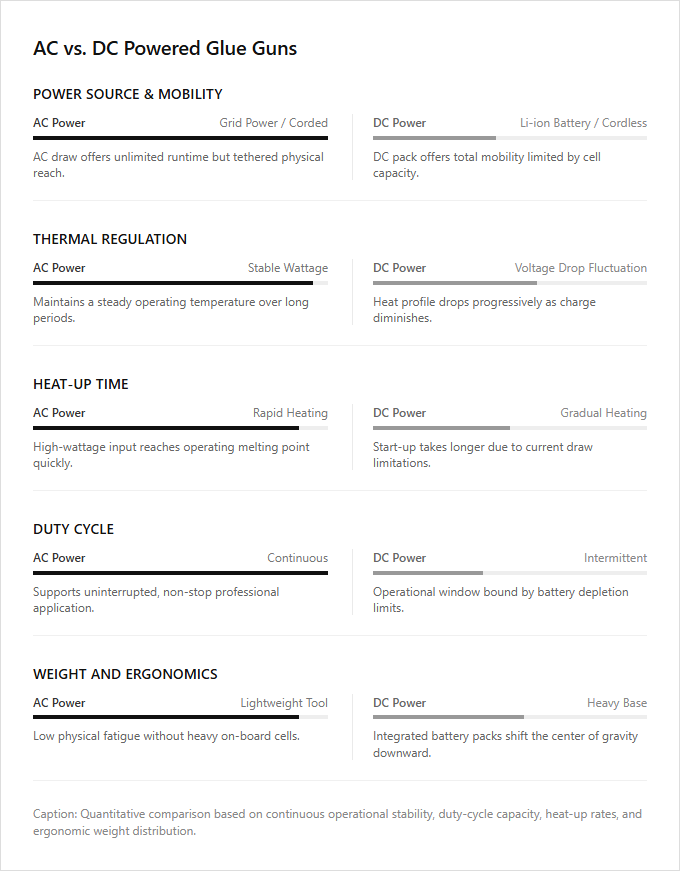
| Power Source & Mobility | AC-powered glue guns draw electricity directly from the grid for unlimited runtime, while DC-powered models utilize rechargeable lithium-ion battery packs to offer cord-free portability. |
| Thermal Regulation | AC models deliver consistent wattage to maintain steady operating temperatures, whereas DC models may experience temperature fluctuation as battery voltage drops. |
| Heat-up Time | High-wattage AC heating elements allow the tool to reach its melting point rapidly, whereas DC-powered units often require more start-up time due to current limitations. |
| Duty Cycle | AC glue guns support an uninterrupted continuous duty cycle, whereas DC alternatives are limited by the milliampere-hour capacity of their batteries before requiring a recharge. |
| Weight and Ergonomics | AC-powered units remain lightweight because they lack heavy internal components, whereas the integrated battery cells in DC models shift the center of gravity and increase user fatigue. |
AC Grid Power vs. Cordless Lithium-Ion Batteries
AC-powered glue guns draw continuous electrical energy directly from the grid, ensuring unlimited runtime and highly consistent thermal performance for demanding applications. In contrast, DC-powered cordless models utilize integrated lithium-ion batteries, offering unmatched portability and freedom of movement by eliminating the constraints of a power cord.
While AC units maintain peak operating temperatures during prolonged use, modern DC alternatives heat up rapidly and deliver sufficient wattage for most standard bonding tasks. High-volume industrial operators requiring uninterrupted production benefit most from the constant power of AC models, whereas mobile technicians, field installers, and DIY enthusiasts prioritizing maximum maneuverability are best suited for cordless DC systems.
PTC Heating Element Efficiency and Thermal Recovery
AC-powered glue guns draw electricity directly from the mains, allowing their PTC (Positive Temperature Coefficient) heating elements to operate at peak efficiency. This direct power supply ensures rapid thermal recovery, as the PTC element quickly self-regulates to maintain a high, consistent temperature even during continuous adhesive extrusion. The uninterrupted current prevents the heating chamber from cooling down, making these tools highly reliable for demanding applications.
In contrast, DC-powered glue guns utilize battery power, requiring highly efficient PTC designs to maximize runtimes while managing limited energy reserves. While their thermal recovery is slightly slower due to battery voltage limitations, modern DC units manage heat distribution effectively for intermittent use. High-volume industrial operators requiring non-stop production benefit most from the rapid recovery of AC models, whereas mobile technicians and hobbyists value the cordless flexibility of DC models for quick, remote repairs.
Adhesive Extrusion and Melt Capacity (g/min)
AC-powered glue guns deliver sustained thermal energy, translating to a superior continuous extrusion rate. Operating directly from mains electricity, these units maintain a stable heating element temperature, enabling an adhesive melt capacity that often exceeds 25 grams per minute. This constant thermal recovery ensures uninterrupted adhesive flow during intensive applications.
DC-powered glue guns offer greater mobility but operate at lower wattages. This design results in a lower adhesive melt capacity, typically ranging between 5 to 15 grams per minute, as the heating element relies on finite battery reserves and experiences longer thermal recovery periods.
AC-powered models are ideal for industrial manufacturers requiring high-volume, uninterrupted bonding, while DC-powered units best suit mobile technicians and hobbyists prioritizing portability for quick, localized repairs.
Infinite duty cycle versus limited ampere-hour (Ah) battery runtimes
AC-powered glue guns draw continuous electricity from a standard mains outlet, offering an infinite duty cycle. This constant power supply ensures consistent heating temperatures and adhesive flow rates without interruption, making them highly reliable for stationary, high-volume assembly tasks where any operational downtime is costly.
DC-powered cordless models rely on rechargeable batteries, where runtime is strictly limited by the ampere-hour (Ah) capacity of the pack. While these units provide unmatched mobility and safety on remote jobsites, they require periodic battery swaps or recharging cycles that can disrupt prolonged workflows. Stationary production line fabricators requiring uninterrupted operation benefit most from corded AC models, whereas mobile contractors and crafters prioritizing portability are better suited for cordless DC alternatives.
Thermostatic temperature control and dual-temperature heating circuit stability
AC-powered glue guns deliver continuous, high-wattage energy, ensuring exceptional thermal stability for demanding projects. Their robust dual-temperature heating circuits maintain highly consistent temperatures without fluctuations, making them incredibly reliable during prolonged use. Advanced AC models often feature sophisticated thermostatic controls that prevent overheating, preserving adhesive integrity and securing strong, uniform bonds over long periods of operation.
In contrast, DC-powered glue guns prioritize mobility, utilizing efficient battery systems. While their dual-temperature circuits must manage power consumption carefully, modern DC units integrate precise thermostatic regulators to prevent voltage drops from affecting heat output. High-capacity AC models are ideal for industrial craftsmen requiring uninterrupted, high-volume bonding, whereas lightweight DC models best serve mobile field technicians and hobbyists seeking cordless convenience for quick, on-site repairs.
Maximum wattage rating and high-voltage power delivery for industrial throughput
AC-powered glue guns represent the standard for high-volume industrial environments where continuous adhesive throughput is critical. Operating directly on utility grid power, these tools leverage consistent high-voltage delivery to support maximum wattage ratings often exceeding 300 to 500 watts. This unlimited power source allows the internal heating elements to maintain peak operating temperatures continuously, facilitating rapid adhesive melting and uniform extrusion during heavy-duty manufacturing cycles.
In contrast, DC-powered glue guns utilize rechargeable battery systems, which inherently limits their maximum wattage capacity and thermal recovery rates. While advances in lithium-ion technology provide sufficient energy for light to medium tasks, they cannot match the sustained high-voltage throughput required for dense, high-viscosity industrial adhesives.
Stationary assembly-line operators requiring relentless, high-volume output will benefit most from heavy-duty AC models, whereas field technicians and mobile maintenance professionals are better suited to the portable, cord-free convenience of DC-powered units.
Nozzle check-valve mechanism design and drip-free thermal chamber insulation
AC-powered glue guns leverage high-wattage ceramic heating elements and dense thermal chamber insulation to maintain a constant melt rate. This continuous thermal reservoir works in tandem with robust, spring-loaded ball check-valves in the nozzle, preventing adhesive backflow and ensuring a highly reliable, drip-free seal during extended operational periods.
DC-powered models utilize low-inertia heating cartridges enclosed in lightweight, high-efficiency insulation to maximize battery life. Their nozzle check-valves feature precision-engineered, lower-tension springs optimized for the reduced delivery pressure of portable systems, preventing material ooze without restricting flow.
High-volume industrial fabricators requiring continuous, high-temp output benefit most from heavy-duty AC-powered units, whereas mobile technicians and hobbyists are best suited for the agile, cord-free maneuverability of DC-powered alternatives.
Leave a comment