
Fumbling with a slipping drill bit mid-project is a frustrating bottleneck that interrupts workflow and compromises precision. While operators often default to standard manual torque sources and basic hand-tightening to secure their accessories, relying solely on physical grip strength has its limits.
Upgrading to an advanced keyless chuck system grants users unparalleled efficiency and slip-free torque transfer, drastically reducing downtime on the job. However, achieving this seamless workflow carries the stipulation that operators must align their locking mechanism with their specific application demands, as high-vibration tasks require distinct mechanical support.
For instance, undertaking heavy-duty masonry boring with a Bosch Auto-Lock system demonstrates how automated spindle locks outperform traditional manual setups under load. Below, we evaluate the mechanical differences between spindle lock and manual lock systems, analyzing their impact on bit retention, operational speed, and overall job site safety to help you optimize your tool kit.
| Factor | Summary |
|---|---|
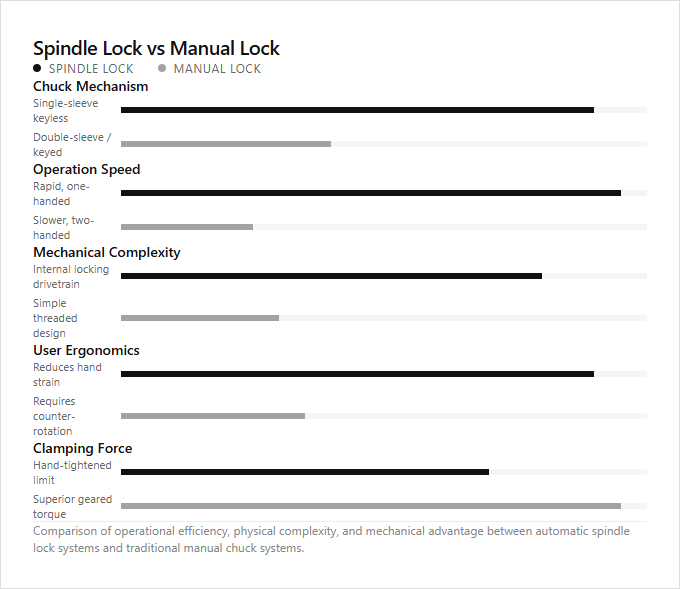
| Chuck Mechanism | Spindle lock systems utilize a single-sleeve keyless chuck, whereas manual locks rely on double-sleeve chucks or a geared chuck key for bit retention. |
| Operation Speed | Automatic spindle locks allow rapid, one-handed accessory changes, while manual locks require a slower, two-handed grip or key rotation. |
| Mechanical Complexity | Spindle lock designs incorporate an internal drivetrain locking mechanism, which increases internal complexity compared to the simpler threaded design of manual locks. |
| User Ergonomics | Spindle locks reduce operator hand strain during bit exchanges by eliminating the need to simultaneously hold and counter-rotate opposing chuck sleeves. |
| Clamping Force | Manual keyed locks can achieve superior rotational torque and tighter clamping force on the bit shank than hand-tightened spindle lock systems. |
Single-sleeve keyless chuck compatibility with automatic spindle lock mechanisms
In modern power drills, the spindle lock mechanism plays a critical role in chuck operation and user efficiency. An automatic spindle lock internally immobilizes the drivetrain when the motor is inactive, allowing for seamless compatibility with single-sleeve keyless chucks. This integration enables operators to secure or release drill bits quickly using only one hand. Conversely, manual lock systems or traditional non-locking spindles require a double-sleeve chuck, demanding one hand to hold the retaining collar while the other rotates the sleeve to tighten the grip.
The choice between these mechanisms directly impacts operational speed and convenience. Single-sleeve automatic spindle locks are ideal for high-volume professionals requiring rapid, one-handed bit changes during complex installations, whereas manual lock systems suit DIY enthusiasts or budget-conscious users who prioritize mechanical simplicity and lower maintenance costs.
Maximum torque transmission and clamping force on the accessory shank
Spindle lock mechanisms allow users to tighten the chuck with a single hand, utilizing the tool's internal gearing to resist rotation. While highly convenient, the maximum clamping force is limited by the user's manual grip on a single sleeve. In contrast, manual lock systems, often utilizing a chuck key, leverage mechanical advantage to apply significantly higher gripping force directly to the accessory shank, preventing slippage under heavy resistance.
This superior clamping force of manual locks ensures optimal torque transmission during demanding, high-resistance applications without damaging the drill bit. Automatic spindle locks, however, offer rapid accessory changes for standard drilling tasks. Manual locks are ideal for heavy-duty industrial operators requiring absolute security under extreme loads, whereas spindle locks are best suited for general contractors and DIY enthusiasts prioritizing speed and efficiency.
One-handed bit exchange facilitated by an internal mechanical interlock
Modern drills utilize either spindle lock or manual lock mechanisms to secure accessories. Spindle lock technology features an internal mechanical interlock that automatically immobilizes the drive shaft when inactive. This facilitates efficient, one-handed bit exchanges, allowing operators to easily tighten the keyless chuck with a single hand.
Manual locks require two-handed operation, demanding that the user hold the chuck base while rotating the collar, or use a traditional key. Although manual systems lack the rapid convenience of an automatic interlock, they provide robust connection security under high-torque conditions. Spindle locks are ideal for fast-paced contractors requiring rapid bit transitions, whereas manual locks are best suited for heavy-duty operators prioritizing maximum grip security.
Mitigation of chuck jaw slippage under high-load drilling operations
In high-load drilling operations, mitigating chuck jaw slippage is critical to maintaining torque transfer and preventing bit damage. Spindle lock mechanisms facilitate superior tightening torque by mechanically locking the drive shaft. This allows operators to apply maximum force to a single-sleeve keyless chuck, securing the bit shank firmly without spindle rotation.
Manual lock systems, typically utilizing a geared keyed chuck, rely on a physical key to tighten the jaws. This method delivers a high mechanical advantage, ensuring a rigid, slip-resistant grip during heavy-duty masonry or metal boring. Automatic spindle locks are ideal for maintenance professionals requiring rapid, one-handed bit changes, whereas manual keyed locks are best suited for industrial operators performing continuous, high-torque drilling.
Structural load distribution on the gearbox housing and drive spindle
An automatic spindle lock mechanism simplifies bit changes by mechanically locking the drive spindle when the motor is static. Under high torque, the stress of manual chuck tightening concentrates directly onto the internal locking pins and the gearbox housing. To prevent casing fatigue, this design requires highly robust, precision-engineered alloy housings to absorb the localized torsional load.
Conversely, manual lock systems utilize a dual-sleeve chuck that distributes physical tightening forces directly across the spindle assembly. Because the operator holds one sleeve stationary while rotating the other, the applied torque bypasses the internal gear train entirely, minimizing stress on the gearbox housing and spindle bearings. Automatic spindle locks are ideal for high-paced professional contractors demanding rapid, one-handed bit changes, while manual locks suit utility-focused DIYers prioritizing mechanical simplicity and long-term durability under manual stress.
Comparative wear-resistance of the locking pin versus double-sleeve knurling
Automatic spindle locks utilize an internal steel locking pin to halt the drivetrain, allowing for efficient, single-handed bit changes. While highly convenient, this design concentrates mechanical stress on a small contact area, making the pin and its mating gear susceptible to shear wear over time. In contrast, manual dual-sleeve systems rely on a knurled collar. This mechanism distributes the tightening force across a larger surface area of the chuck body, offering superior long-term wear resistance under heavy, repeated manual torque.
The mechanical simplicity of the double-sleeve knurled chuck ensures exceptional durability for high-vibration applications, whereas the spindle lock excels in fast-paced environments where efficiency is paramount. Heavy-duty construction professionals prioritizing tool longevity often favor the robust manual lock, while DIY enthusiasts and assembly technicians value the rapid, single-handed operation of the automatic spindle lock.
Elimination of motor rotational inertia during manual chuck tightening
An automatic spindle lock mechanically immobilizes the drivetrain when the trigger is released. This feature completely eliminates motor rotational inertia during chuck tightening, allowing operators to secure drill bits firmly with a single hand. In contrast, manual lock systems require a two-handed grip because the chuck sleeve remains connected to a free-spinning motor shaft, forcing the user to manually counteract the internal rotational resistance of the gears.
While manual systems offer mechanical simplicity and high durability under heavy loads, they lack the rapid bit-change efficiency of automatic alternatives. Spindle locks are ideal for high-paced professionals requiring quick, one-handed adjustments, whereas manual locks are best suited for traditional operators who prioritize maximum tool lifespan and budget-friendly reliability.
Leave a comment