
Few things are more frustrating than pulling out a cordless tire inflator during a roadside emergency, only to find the chuck does not fit the tire valve. While many users rely on standard gas station air compressors or traditional garage floor pumps, mobile inflation requires a more precise, compatible setup.
Selecting the correct valve design grants reliable airtight connections and prevents unnecessary battery drain during operation. However, it is important to stipulate that while brass adapters can bridge the gap between formats, they often introduce minor pressure leaks that complicate accurate digital readings. For example, high-pressure road bike tires typically require Presta valves, whereas standard passenger vehicles and mountain bikes use the wider Schrader design.
This guide compares Schrader and Presta valves, analyzes their compatibility with popular cordless inflators, and outlines key factors to help you choose the correct setup for your vehicles.
| Factor | Summary |
|---|---|
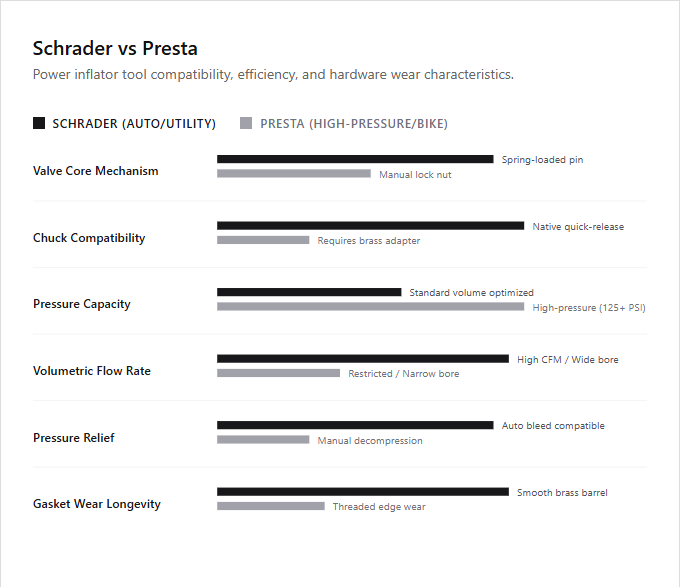
| Valve Core Mechanism | Schrader valves utilize a spring-loaded internal pin that requires physical depression to open, whereas Presta valves rely on a manual lock nut to seal pneumatic pressure. |
| Chuck Compatibility | Most power inflators feature a native Schrader-compatible quick-release chuck, requiring a brass screw-on adapter or a dual-head nozzle to connect to a Presta valve. |
| Pressure Capacity | Presta valves are engineered to withstand high-pressure limits often exceeding 125 PSI, while Schrader valves are optimized for lower-pressure, high-volume automotive tires. |
| Volumetric Flow Rate | The larger diameter of Schrader valves allows for a higher cubic feet per minute (CFM) airflow, whereas Presta valves restrict rapid air displacement due to their narrow bore. |
| Pressure Relief | Inflator power tools with integrated bleed valves can easily depressurize Schrader stems automatically, whereas Presta valves require manual decompression of the top nut. |
| Gasket Wear | The threaded exterior of Presta valves causes accelerated degradation of the rubber gaskets inside inflator chucks compared to the smooth brass barrels of Schrader valves. |
8mm Schrader vs. 6mm Presta Valve Diameters
When selecting a power inflator, understanding valve stem compatibility is essential for efficient operation. The Schrader valve features a robust stem diameter of eight millimeters. This wider profile is the standard for automotive tires and utility equipment, offering excellent structural durability that easily withstands heavy-duty pneumatic applications.
Conversely, the Presta valve utilizes a narrower stem diameter of six millimeters. This slimmer design is engineered primarily for high-pressure bicycle rims, minimizing the aperture size required in the wheel to preserve structural integrity. Modern power tools often utilize dual-head chucks or brass adapters to transition between these two distinct sizes.
Schrader valves are ideal for everyday motorists and utility users prioritizing convenience and universal compatibility, while Presta valves are suited for competitive cyclists and performance-oriented riders requiring high-pressure wheel setups.
Schrader Valve Spring-Loaded Core Pin Mechanism
When selecting an inflator power tool, understanding the mechanical differences between valve interfaces is essential for efficient operation. The Schrader valve features a robust, spring-loaded core pin mechanism nested within its wider stem. To facilitate airflow, the inflator chuck must physically depress this internal pin, mechanically overcoming the spring tension to open the airway. This design provides a reliable, self-sealing closure but requires a compatible chuck that can securely engage and actuate the pin during connection.
In contrast, the Presta valve utilizes a slender profile sealed by a manual threaded nut, relying on pressure differential rather than a spring-loaded pin to open. Schrader valves are ideal for everyday motorists and utility users seeking rugged, highly compatible systems, whereas Presta valves are best suited for competitive cyclists and high-performance riders requiring narrow rim profiles and precise high-pressure retention.
Presta Valve Lock Nut: Unscrew Before Inflating
When operating a power inflator, the primary distinction between Schrader and Presta valves lies in their preparation. Schrader valves utilize a spring-loaded pin that opens automatically upon chuck connection. In contrast, Presta valves require manual intervention before initiating the inflation duty cycle. Operators must unscrew the small knurled lock nut at the top of the valve stem to allow air passage. Failing to loosen this knurled nut prevents airflow, which can overpressurize the power tool connector and stall the inflation process.
Once the Presta nut is released, the tool can safely deliver the required pressure. Schrader valves are suitable for general motorists and casual commuters seeking quick, plug-and-play convenience, while Presta valves are ideal for competitive road cyclists and high-performance enthusiasts prioritizing lightweight, high-pressure wheel systems.
Brass Presta-to-Schrader adapter requirement for standard cordless inflator hose compatibility
Standard cordless power inflators typically feature a chuck designed for Schrader valves, which are the wider, robust valves commonly found on automotive tires and utility bicycles. In contrast, high-performance road and gravel bikes utilize the narrower Presta valve, which is designed to hold higher pressures in slim rims. To bridge this compatibility gap, a brass Presta-to-Schrader adapter is an essential accessory for any digital or analog power inflator kit.
This small brass adapter screws securely onto the Presta valve stem, temporarily converting it to match Schrader dimensions. This allows the standard cordless inflator hose to lock onto the valve without air leakage, ensuring accurate pressure readings and swift inflation. Schrader valves are ideal for daily commuters and utility cyclists who value rugged convenience, while Presta valves are best suited for competitive cyclists and road enthusiasts who require high-pressure performance and lightweight wheel setups.
Thread-On Pumps Can Accidentally Remove Valve Cores
When utilizing power inflators, the mechanical interface between the nozzle and the valve stem is a critical factor in efficiency. Thread-on inflator nozzles provide a highly secure, leak-free connection, but they introduce a specific vulnerability to Presta valves with removable cores. As the threaded nozzle is unscrewed after inflation, it can bind to the valve core and accidentally extract it, causing immediate and complete deflation. Schrader valves, with their wider, robust brass casings and recessed, spring-loaded cores, are structurally immune to this issue, ensuring reliable detachment every time.
Understanding these distinct mechanical behaviors helps operators select the appropriate valve system for their specific applications. Schrader valves are highly suited for daily commuters and utility users seeking durable, hassle-free operation, while Presta valves remain the choice for competitive cyclists and high-pressure enthusiasts who demand specialized rim profiles and accept the necessity of precise tool management.
Presta vs. Schrader: High-Pressure Valve Comparison
When selecting cordless inflator power tools, understanding valve compatibility is essential for achieving optimal pneumatic performance. Presta valves feature a narrow diameter and a threaded locking nut, allowing them to reliably sustain the high-PSI pressures-often exceeding 100 PSI-required by high-performance road bike tires. This specialized design minimizes air loss under extreme tension, making it highly efficient for high-pressure, low-volume applications.
Schrader valves utilize a wider body with a spring-loaded internal check valve, engineered primarily for high-volume, lower-pressure inflation such as automotive and standard utility tires. Everyday commuters and utility vehicle drivers are best suited for the robust and highly accessible Schrader valve, whereas dedicated road cyclists and racing enthusiasts require the specialized high-pressure capability of the Presta system.
Seal Integrity: Quick-Release vs. Screw-On Valve Connectors
Schrader and Presta valves interact differently with inflator connectors due to their distinct thread designs. Robust Schrader valves accommodate both quick-release and screw-on connectors easily. In contrast, narrower Presta valves have delicate external threads that require precise engagement. Quick-release chucks on Presta valves can suffer from air leakage if misaligned, whereas threaded screw-on connectors establish a superior, positive mechanical lock that prevents pressure loss.
While quick-release chucks allow rapid deployment, they rely on internal gaskets that degrade over time. Threaded connectors physically secure onto the valve stem, ensuring a zero-loss seal during high-pressure inflation. Screw-on connectors are ideal for high-pressure road cyclists and technicians demanding maximum seal integrity, whereas quick-release chucks are best suited for everyday commuters and motorists prioritizing rapid operation.
Leave a comment