
Selecting the wrong equipment for masonry and concrete work is a common frustration, often resulting in shattered substrates, ruined bits, and blown project budgets. While standard inventory workarounds-such as relying on basic workshop drills or general-purpose rental fleet options-are the typical fallback paths, they rarely suffice for specialized tasks.
Aligning the right tool to the specific application grants operators unmatched precision and preserves critical material integrity. However, an important educational stipulation remains: raw impact energy must never be confused with controlled, high-speed rotary action. For example, anchoring hardware into delicate brickwork requires the precise, rapid striking of an SDS-Plus rotary drill, whereas fracturing a thick concrete slab demands the raw, non-rotary demolition force of a dedicated jackhammer.
This article provides a comprehensive comparative analysis of these two essential powerhouses. We will examine their internal mechanical differences, analyze specific application thresholds, and deliver a clear decision framework to help you choose the exact tool required for your next precision task.
| Factor | Summary |
|---|---|
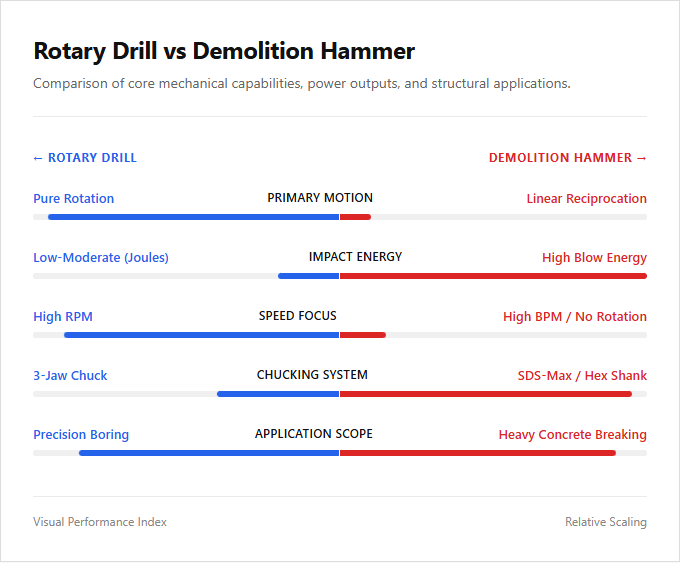
| Primary Function | A rotary drill uses rotational force to create holes in various materials, whereas a demolition hammer utilizes high-impact linear force to break concrete and masonry. |
| Operating Mechanism | Rotary drills rely on a gear-driven spindle rotation, while demolition hammers employ an electro-pneumatic piston system to deliver heavy blows. |
| Chuck Type | Rotary drills typically use a keyed or keyless three-jaw chuck, whereas demolition hammers require an SDS-Max or hex shank system to withstand intense vibrations. |
| Impact Energy | Rotary drills have low to moderate impact energy measured in Joules for drilling, while demolition hammers feature exceptionally high blow energy specifically designed for chiseling. |
| RPM and BPM | Rotary drills operate at high RPM (revolutions per minute) for efficient boring, whereas demolition hammers focus on high BPM (blows per minute) without any rotational movement. |
| Key Applications | Rotary drills are ideal for anchoring, boring holes, and light fastening, while demolition hammers are utilized for heavy-duty concrete slab demolition, tile removal, and trenching. |
Rotary Drills vs. Demolition Hammers: Torque vs. Impact
Rotary drills and demolition hammers serve distinct functions based on their mechanical design. Rotary drills utilize continuous rotational torque for clean, precise hole creation in wood, metal, and masonry. This rotational action allows the cutting bit to shave away material efficiently, ensuring clean entry points without damaging the surrounding structure.
Conversely, demolition hammers employ pure impact energy measured in Joules, operating entirely without rotation. These tools rely on rapid, linear hammering forces to fracture heavy concrete and stone, prioritizing raw power over precision for breaking tasks.
Precision-focused tradespeople like electricians require rotary drills for neat anchoring, while demolition contractors and masonry specialists need demolition hammers for heavy-duty tearing and concrete removal.
SDS-Plus vs. SDS-Max: Rotary and Demolition Chucks
Rotary drills and demolition hammers serve distinct roles on construction sites, primarily differentiated by their chuck systems and motion mechanics. The rotary drill utilizes an SDS-plus chuck system, providing the precise bit retention necessary to support efficient, high-speed rotary action and hammering. This configuration ensures accurate drilling through tough masonry while maintaining optimal tool control.
Demolition hammers are engineered strictly for heavy-duty breaking and chiseling. These tools employ larger SDS-max or hex shanks designed solely to withstand intense, linear reciprocating motion without rotation. General contractors performing precise anchoring and light remodeling tasks will find the rotary drill indispensable, while specialized masonry demolition crews require the robust, heavy-impact capability of a demolition hammer.
Drill RPM Shears, Hammer BPM Shatters
Rotary drills and demolition hammers utilize distinct mechanical actions to manipulate tough materials. Rotary drills rely on high RPM (revolutions per minute) ratings to ensure clean shearing of material, using rapid rotation to carve precise holes without fracturing the surrounding area. Demolition hammers bypass rotation entirely, employing high BPM (blows per minute) ratings to deliver rapid, heavy impacts that shatter dense concrete and masonry substrates.
Choosing between these tools depends on the required precision and material density. Professional remodelers and electricians need the controlled drilling of a rotary drill for anchoring, while concrete contractors and demolition crews require the raw fracturing power of a demolition hammer.
Rotary Drill Spindle Precision Prevents Oversized Holes
When selecting professional concrete equipment, understanding tool holder engineering is essential for project success. Rotary drills are engineered with a precise spindle concentricity design. This specialized alignment minimizes spindle runout to prevent oversized holes, ensuring high-precision drilling during critical anchoring installations. Conversely, demolition hammers utilize loose-tolerance tool holders designed specifically to maximize impact energy transfer rather than dimensional accuracy.
This mechanical divergence dictates their practical applications on the job site. While rotary drills excel at creating clean, exact holes, demolition hammers are built purely for rapid material destruction and concrete fracturing. Precision-focused contractors and electricians require rotary drills for exact anchoring, while demolition crews and masonry specialists rely on demolition hammers for heavy-duty breaking.
Safety Clutches: Rotary Drills vs. Demolition Hammers
When selecting heavy-duty concrete equipment, understanding the distinct mechanical behaviors of rotary drills and demolition hammers is vital for operator safety. Rotary drills utilize a combined rotational and hammering action to bore holes, exposing operators to intense torque if the bit binds in concrete. To mitigate this hazard, these tools require a mechanical safety clutch to instantly disengage the drive shaft during a stall, preventing dangerous kickback.
Demolition hammers operate purely on linear impact force without rotation, rendering a safety clutch unnecessary since there is no risk of rotational binding. Rotary drills are ideal for installers requiring precise anchoring holes, while demolition hammers are best suited for demolition contractors focused on breaking heavy masonry.
Rotary-Only Mode: Precision Wood and Metal Drilling
Rotary drills and demolition hammers represent two critical, yet functionally distinct, categories of heavy-duty power tools. A primary differentiator is the operational versatility of the rotary drill. The rotary-only selector mode on rotary drills bypasses the internal electro-pneumatic hammer mechanism, redirecting the tool's power solely to rotation for precision drilling in sensitive materials like metal and wood.
Demolition hammers do not feature a rotational mode, as their engineering focuses entirely on delivering maximum linear impact energy to shatter concrete, stone, and masonry. Carpentry professionals and general contractors favor the rotary drill for its multi-material adaptability, while masonry specialists and demolition crews require the focused, high-impact force of the demolition hammer for heavy breaking tasks.
Precision Depth Gauges: Rotary Drills vs. Demolition Hammers
When selecting concrete power tools, understanding the mechanical differences between a rotary drill and a demolition hammer is essential for operational efficiency. Rotary drills are equipped with adjustable depth-gauge stop rods, a critical feature that allows operators to achieve precise, repeatable depths during blind-hole drilling. This precision prevents over-drilling and ensures the structural integrity of the base material. In contrast, demolition hammers lack this depth-control mechanism, as they are engineered exclusively for heavy-duty breaking, chipping, and chiseling rather than structured hole creation.
Choosing the correct tool depends on the specific demands of the project. Rotary drills are ideal for electricians and HVAC installers who require precise anchoring capabilities, whereas demolition hammers are suited for masonry and renovation contractors tasked with bulk concrete removal.
Leave a comment