
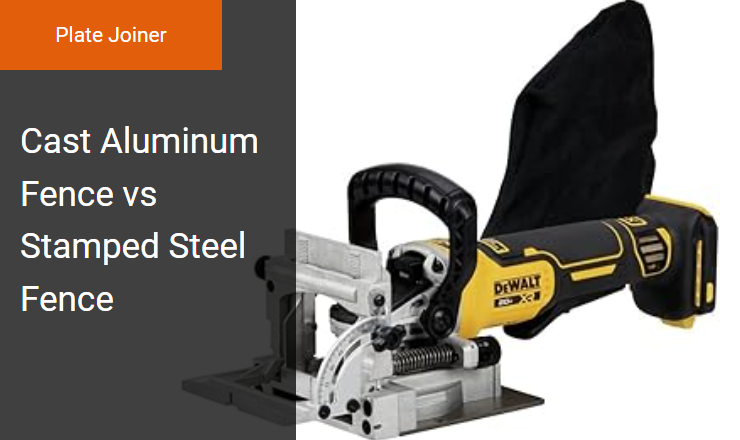
Achieving perfectly flush alignment when joining heavy cast aluminum or rigid stamped steel fence panels is a notorious challenge, often resulting in unsightly gaps and weakened structural joints. Historically, installers have relied on standard mechanical fasteners, external bracket sleeves, or field-welding to bridge these connections. While these traditional methods offer basic stability, they frequently sacrifice aesthetic precision and long-term durability.
Integrating a specialized plate joiner (biscuit joiner) into your metalworking methodology grants a level of seamless, interlocking precision that standard hardware simply cannot match. However, this advanced technique carries the strict stipulation that installers must utilize high-density, carbide-tipped blades specifically engineered for non-ferrous metals. For example, applying this method to the top-rail T-joints of a residential cast aluminum fence ensures flawless, flush connections that resist shifting over time.
Below, we will compare the structural properties of cast aluminum versus stamped steel, analyze the mechanics of the biscuit-joining process, and outline a step-by-step methodology for achieving flawless joint alignment on your next installation.
| Factor | Summary |
|---|---|
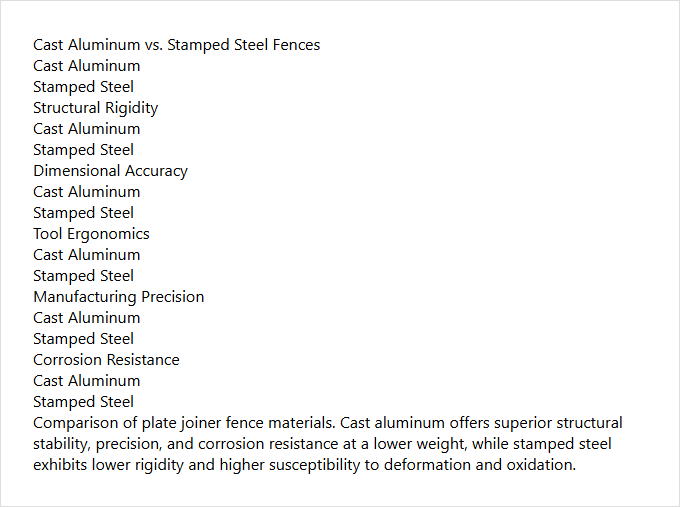
| Structural Rigidity | Cast aluminum fences exhibit superior structural rigidity that prevents deflection under clamping pressure, whereas stamped steel is more prone to temporary deformation. |
| Dimensional Accuracy | The CNC machining process applied to cast aluminum ensures precise coplanarity of the reference surfaces, while stamped steel fences often suffer from wider manufacturing tolerances. |
| Tool Ergonomics | Utilizing cast aluminum significantly lowers the tool's overall weight to improve ergonomics, while denser stamped steel can unfavorably shift the tool's center of gravity. |
| Manufacturing Method | Stamped steel fences are cold-formed using progressive die presses, whereas cast aluminum alternatives require high-pressure die casting followed by post-cast milling. |
| Corrosion Resistance | Cast aluminum naturally forms a protective passivation layer to resist rust, whereas stamped steel must rely on powder coating or plating to prevent rapid oxidation. |
Carbide vs. Cobalt Tooling for Milling Work Hardening
When operating a plate joiner, the structural rigidity of a cast aluminum fence provides superior stability compared to a flexible stamped steel alternative. This rigidity is critical when managing work hardening during slot milling, as fence deflection causes the blade to rub and overheat the workpiece. While cobalt steel tooling offers excellent shock resistance, carbide-tipped cutters provide the extreme hardness required to cleanly shear through work-hardened fibers without dulling from heat buildup.
Precision cast aluminum fences paired with carbide-tipped cutters are ideal for professional cabinetmakers requiring daily accuracy in dense materials, while budget-conscious DIY enthusiasts working primarily with softwoods will find stamped steel fences and cobalt tooling sufficient for occasional assembly tasks.
Steel Springback vs. Cast Aluminum Register Face Stability
When selecting a plate joiner, the fence construction critically impacts joint alignment. Stamped steel fences are susceptible to springback deformation, where the metal flexes under clamping pressure and fails to return to its true flat state. This deflection compromises the register face, leading to misaligned biscuit slots. Cast aluminum fences offer superior dimensional stability, resisting deflection under pressure to maintain a perfectly flat, rigid reference surface throughout the cut.
This structural difference dictates the ideal user for each tool. Casual DIY hobbyists often find the lightweight affordability of stamped steel fences sufficient for occasional projects, whereas professional cabinetmakers and precision woodworkers require the rigid reliability of cast aluminum for daily, high-tolerance production.
Preventing Galvanic Corrosion Using Composite Biscuits
When selecting a plate joiner, the choice between a precision-machined cast aluminum fence and a rugged stamped steel fence involves critical material longevity considerations. In high-humidity environments, mating these metallic fences with various workpiece fasteners or tool components can initiate galvanic corrosion, which degrades adjustment accuracy. Utilizing non-conductive composite biscuits during the joining process serves as an effective electrical barrier at the mating interfaces, successfully preventing electrochemical reactions and preserving the structural integrity of both fence types.
Cast aluminum fences offer superior flatness and lightweight rigidity, whereas stamped steel fences provide high impact resistance and cost-effectiveness. Precision furniture makers and cabinet shop professionals generally prefer the exacting tolerances of the cast aluminum fence, while job-site carpenters and budget-conscious DIY enthusiasts typically favor the drop-resistant durability of the stamped steel design.
Optimizing Wall Thickness to Prevent Stamped Steel Tear-Out
When selecting a plate joiner, the fence material directly impacts joint accuracy. Cast aluminum fences offer superior wall thickness, providing the rigidity necessary to maintain a consistent kerf depth during operation. This structural mass absorbs tool vibration and resists deflection under plunge pressure. In contrast, thin-gauge stamped steel fences face strict wall thickness constraints, making them susceptible to flexing that can result in shallow cuts or structural tear-out around the slot.
The inherent flexibility of stamped steel can cause alignment errors during repetitive clamping, compromising the integrity of the biscuit joint. Cast aluminum remains stable, ensuring highly repeatable depth control across dense hardwoods. Precision-oriented cabinetmakers and professional woodworkers benefit most from the robust accuracy of cast aluminum, whereas budget-conscious hobbyists performing light-duty utility joining are well-served by stamped steel.
Optimizing Biscuit Joint Tensile Strength with Anaerobic Adhesives
Optimizing the tensile strength of joints bonded with anaerobic structural adhesives inside a biscuit slot requires extreme precision. A plate joiner featuring a cast aluminum fence provides the structural rigidity and flatness necessary to prevent deflection during the plunge cut. This precision ensures a perfectly uniform gap, which is vital because anaerobic adhesives rely on tight, metal-to-metal contact-or specialized primed surfaces-with minimal clearance to polymerize effectively. Conversely, stamped steel fences exhibit greater flex and wider manufacturing tolerances, which can lead to misaligned slots and uneven adhesive distribution, ultimately compromising the joint's mechanical load capacity.
Slight variations in fence stability directly impact the overall shear and tensile performance of the cured assembly. Cast aluminum fences are ideal for precision-oriented furniture makers and industrial woodworkers who require flawless, high-strength joints under heavy loads, while stamped steel fences are better suited for casual DIY enthusiasts or general contractors focusing on utility-grade cabinetry and basic framing applications.
CTE Mismatch Effects on Biscuit Slip-Fit Tolerance
In precision joinery, the choice between a cast aluminum and a stamped steel fence on a plate joiner significantly influences joint alignment accuracy. Cast aluminum has a higher coefficient of thermal expansion compared to steel. During ambient temperature cycles in a workshop, this thermal mismatch between an aluminum fence and the tool's steel internal guide chassis can induce microscopic dimensional shifting along the mating surfaces.
These thermal fluctuations alter the plunge geometry, directly affecting the precise slip-fit tolerance required for the wood biscuit to seat correctly. While stamped steel fences match the thermal expansion of steel guide rails to maintain consistent tolerances over temperature swings, they lack the structural rigidity of cast designs. Cast aluminum fences are ideal for high-precision furniture makers working in climate-controlled shops, whereas stamped steel fences are better suited for jobsite carpenters who require durable utility across unpredictable outdoor temperatures.
Milled Edge Micro-Cracking: Cast Aluminum vs. Stamped Steel
When selecting a plate joiner, the fence material significantly impacts long-term tool integrity. Cast aluminum fences offer excellent rigidity but possess lower ductility, making them susceptible to micro-cracking along milled slot edges over extended use. The high-vibration environment of biscuit slotting concentrates stress at these milled edges, where microscopic fractures can slowly propagate and eventually compromise the fence's alignment accuracy under clamping pressure.
Conversely, stamped steel fences utilize the inherent ductility of steel to absorb operational vibrations without developing these localized micro-cracks. While steel is heavier and more prone to minor flexing under heavy force, its structural integrity remains stable under repetitive stress. Cast aluminum fences are best suited for precision-oriented furniture makers who demand absolute rigidity and climate-controlled workshop accuracy, whereas stamped steel fences are ideal for jobsite contractors who require rugged, high-impact durability.
Leave a comment