
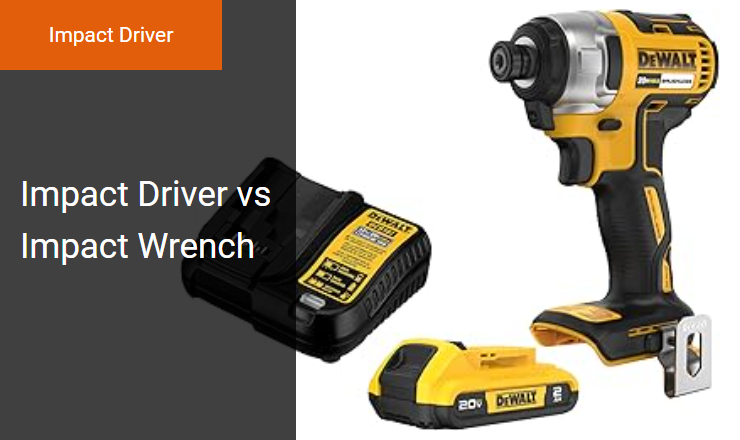
Tradespeople and serious DIYers frequently encounter the frustration of stalled drill motors, stripped fastener heads, and severe wrist strain when driving long screws into dense materials. While traditional drill-drivers serve as the standard funding sources-the primary go-to options-for rotational power in most toolboxes, they often lack the specialized delivery system required for demanding fastening tasks.
The impact driver resolves this limitation. It grants users an immense surge of targeted rotational torque, ensuring fasteners seat perfectly without slipping. As an important educational stipulation, however, operators must understand that while this tool excels at driving three-inch deck screws into pressure-treated timber, it is not engineered to replace high-torque socket tools for heavy automotive assemblies.
Below, we will explore the critical distinctions between the impact driver and the impact wrench, detailing how their respective rotational impact mechanisms define their optimal roles on the job site.
| Factor | Summary |
|---|---|
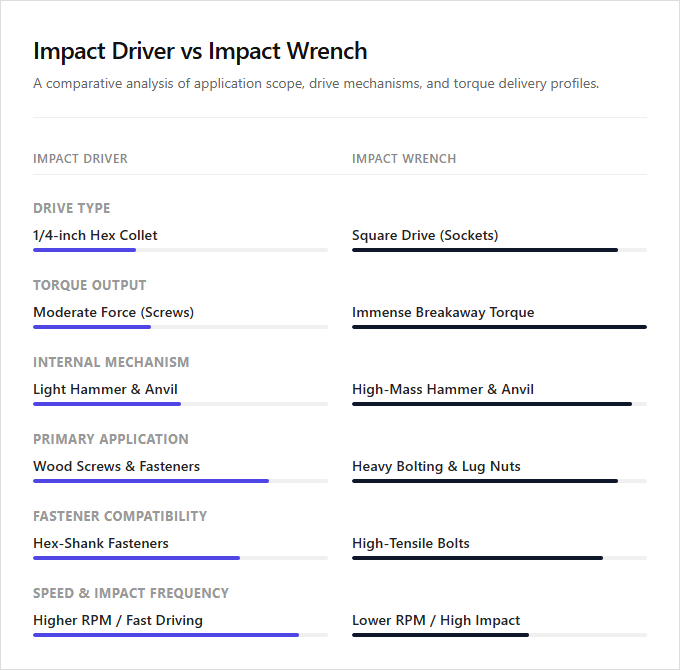
| Drive Type | The impact driver utilizes a 1/4-inch quick-release hexagonal collet to accept driver bits, whereas the impact wrench features a male square drive designed to hold impact-rated sockets. |
| Torque Output | Impact drivers deliver moderate rotational force suitable for wood screws, while impact wrenches generate immense breakaway torque measured in hundreds of foot-pounds to loosen seized automotive fasteners. |
| Internal Mechanism | Both tools use a spring-loaded hammer and anvil system, but the impact wrench employs a much larger mass to deliver heavier, high-energy concussive blows. |
| Primary Application | An impact driver is engineered for fastening long screws and self-tapping fasteners into wood or sheet metal, whereas an impact wrench is specialized for heavy-duty bolting and lug nut removal. |
| Fastener Compatibility | Impact drivers primarily drive standard hex-shank fasteners, whereas impact wrenches are designed to drive high-tensile structural bolts using heavy-walled sockets. |
| Speed and Impact Frequency | Impact drivers operate at a higher RPM (revolutions per minute) for rapid screwdriving, while impact wrenches prioritize a lower RPM paired with high IPM (impacts per minute) to maximize torque transmission. |
Impact Drivers vs. Impact Wrenches: Key Differences
Understanding the distinction between an impact driver and an impact wrench is essential for selecting the correct tool for your project. The primary difference lies in their drive designs and intended applications. Impact drivers utilize a quick-change hex collet for driving fasteners, whereas impact wrenches use a square drive anvil to secure heavy-duty sockets.
While both tools deliver rotational force combined with concussive blows, their torque outputs and fastening capabilities differ significantly. Impact drivers offer high speed and moderate torque, which prevents stripped screws during construction and remodeling. Impact wrenches prioritize maximum torque to loosen stubborn, large nuts and bolts. Woodworkers and general contractors typically rely on the precision of an impact driver, while automotive mechanics and industrial technicians require the immense power of an impact wrench.
Inside an Impact Driver's Hammer and Anvil Mechanism
While both power tools deliver high torque, they differ significantly in their internal mechanics and primary applications. The internal rotational impact mechanism of an impact driver employs a spring-loaded hammer and anvil system to deliver high-frequency rotational blows. As fastening resistance increases, the internal spring compresses and releases, driving the hammer against the anvil to generate rapid rotational force that drives screws efficiently without stripping the fastener heads.
Impact wrenches utilize a larger, heavier anvil system designed to output extreme torque for loosening stubborn bolts rather than driving screws. Impact drivers are best suited for carpenters and DIY enthusiasts requiring precision fastening, whereas impact wrenches are ideal for automotive mechanics and construction professionals handling heavy-duty structural assemblies.
Impact Wrench vs. Impact Driver Torque Comparison
When selecting high-performance fastening tools, understanding the technical distinctions between an impact driver and an impact wrench is essential for operational efficiency. The primary differentiator lies in their torque capacities and measurement scales. Impact wrenches are engineered to generate superior torque output measured in foot-pounds, making them capable of tightening or loosening large, stubborn bolts. In contrast, impact drivers produce moderate torque rated in inch-pounds, which offers the precision needed for smaller fasteners without stripping the materials.
The mechanical interfaces also dictate their specific roles, as impact drivers utilize a quarter-inch hex collet, while impact wrenches employ square drives for heavy-duty sockets. Budgeting your tool acquisition based on these specifications ensures optimal project outcomes. Woodworkers, drywall installers, and general contractors will find the control of an impact driver indispensable, whereas automotive mechanics, steel erectors, and industrial technicians require the raw power of an impact wrench.
Impact Drivers vs. Impact Wrenches: RPM vs. IPM
While impact drivers and impact wrenches appear structurally similar, they serve distinct mechanical functions. Impact drivers are engineered for high rotational speed, measured in Revolutions Per Minute (RPM), which enables them to rapidly drive screws and smaller fasteners into wood and metal with minimal effort.
In contrast, impact wrenches prioritize delivering a maximum impact rate, measured in Impacts Per Minute (IPM). This concentration of concussive force is specifically designed to generate the high torque needed to break loose rusted or seized heavy-duty fasteners. Tradespeople specializing in cabinetry or general construction rely on the speed of the impact driver, whereas automotive mechanics and industrial technicians require the brute force of the impact wrench.
Why Impact Bits and Sockets Are Built Differently
Although impact drivers and impact wrenches share rotational mechanism concepts, their force delivery and accessory requirements differ significantly. An impact driver uses a hex chuck designed for driving screws. To manage this force, the concave design of impact-rated screwdriver bits handles the torsional stress of an impact driver by flexing under load, preventing premature breakage.
In comparison, high-torque impact wrenches require thick-walled chrome molybdenum sockets to safely absorb extreme rotational energy without shattering. Impact drivers are ideal for cabinet makers and drywall installers seeking precision fastening, while impact wrenches are essential for automotive mechanics and heavy equipment technicians managing structural bolting.
Perpendicular Impact Forces Eliminate Cam-Out
While both tools utilize rotational blows to deliver high torque, the impact driver and the impact wrench serve distinct fastening purposes. The impact driver is engineered specifically for driving threaded fasteners into wood and metal. Its internal mechanism ensures that rotational impact forces are applied perpendicular to the fastener axis, which virtually eliminates cam-out during high-torque driving tasks and prevents the drive bit from slipping out of the screw head.
In contrast, the impact wrench is designed to deliver massive torque directly to heavy-duty nuts and bolts using a square drive socket. Professional woodworkers and drywall installers benefit most from the precision and slip prevention of an impact driver, whereas automotive mechanics and structural steel fabricators require the immense breakaway torque of an impact wrench.
How Impact Drivers Reduce Wrist Fatigue
While standard drill drivers transfer high reactionary torque directly to the operator's wrist, impact drivers and impact wrenches utilize a concussive mechanism that delivers rotational force in rapid pulses. This internal impacting action isolates the energy within the tool's anvil, preventing the violent twisting motion common during heavy fastening tasks. By eliminating this rotational kickback, both tools significantly reduce physical fatigue and joint strain during prolonged operation.
Despite sharing this ergonomic advantage, these tools serve distinct applications. The impact driver features a quarter-inch hex collet optimized for driving long screws into wood and metal, whereas the impact wrench employs a heavy-duty square drive designed for high-torque fastening of large nuts and bolts. Professional carpenters and renovators benefit most from the precision of the impact driver, while automotive mechanics and industrial steel assemblers require the brute power of the impact wrench.
Leave a comment