
Achieving a flawless adhesive bond is a persistent challenge for operators, often resulting in premature joint failure or ruined substrates due to improper thermal management. While many rely on standard tool acquisitions and basic workshop adhesive kits to address these issues, true assembly precision requires a deeper analysis of equipment capabilities.
Investing in the correct hardware grants operators unparalleled control over melt rates and viscosity, transforming adhesive application from a guessing game into a predictable science. However, a crucial educational stipulation must be made: higher wattage does not simply yield higher temperatures, but rather dictates thermal recovery speed under continuous use. For instance, heavy-duty carpentry demands the rapid recovery of a high-wattage tool, whereas delicate electronics assembly requires the sustained, mild output of a low-wattage alternative.
This article analyzes the critical distinctions between high-wattage and low-wattage glue guns, evaluating thermal output, recovery times, and material compatibility to help you select the optimal tool for your operational needs.
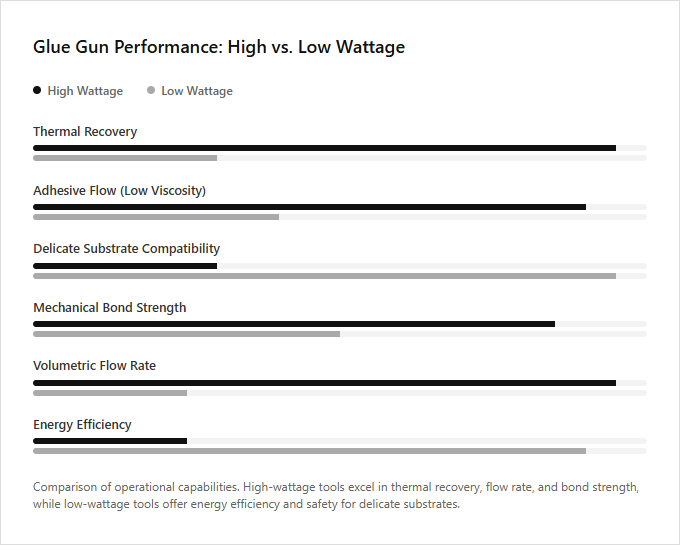
| Factor | Summary |
|---|---|
| Thermal Recovery | High-wattage glue guns exhibit significantly faster thermal recovery, allowing the heating element to quickly replenish lost heat during continuous extrusion. |
| Adhesive Viscosity | High-wattage tools heat glue to higher temperatures to decrease its viscosity, ensuring a smoother flow, whereas low-wattage guns keep the adhesive thicker. |
| Substrate Compatibility | Low-wattage models prevent the thermal degradation of delicate substrates like paper, fabrics, or thin plastics by operating at a lower temperature range. |
| Bond Strength | High-wattage guns facilitate superior mechanical interlocking on porous materials because the polymer adhesive remains in a molten state longer. |
| Volumetric Flow Rate | High-wattage devices offer a superior volumetric flow rate of molten adhesive, making them ideal for large-scale, continuous bonding applications. |
| Power Consumption | Low-wattage units draw less electrical current, making them highly energy-efficient and safer for prolonged, light-duty crafting tasks. |
PTC heating element efficiency and thermal recovery rate
High-wattage glue guns utilize advanced PTC (Positive Temperature Coefficient) heating elements to deliver rapid thermal recovery rates. When cold adhesive is fed into the chamber, these high-power systems quickly restore the optimal operating temperature, ensuring a continuous and uninterrupted flow during demanding applications. The self-regulating efficiency of the PTC element prevents the nozzle from cooling down, maintaining consistent viscosity under heavy output.
Low-wattage models consume less energy and maintain a lower, stable temperature, though their thermal recovery rate is slower during continuous use. The PTC elements in these tools safely limit maximum heat, protecting delicate substrates from thermal damage while operating with high energy efficiency. High-wattage units are designed for industrial contractors requiring rapid, heavy-duty bonding, while low-wattage options are best suited for hobbyists and creators working with heat-sensitive materials.
Volumetric melt rate of high-wattage chambers for continuous extrusion
When selecting a professional glue gun, the wattage directly dictates the tool's thermal recovery and volumetric melt rate. High-wattage models, typically ranging from 100 to 500 watts, feature enlarged heating chambers that liquefy adhesive rapidly. This advanced thermal capacity supports continuous, high-volume extrusion without the temperature drops that cause adhesive stagnation during demanding applications.
Low-wattage glue guns, usually operating between 10 to 40 watts, utilize smaller chambers that melt adhesive at a slower, controlled pace to protect delicate materials from heat damage. High-wattage tools suit industrial operators requiring rapid, uninterrupted bonding on heavy-duty assemblies, while low-wattage models are ideal for hobbyists and detailed crafters working with heat-sensitive substrates.
Adhesive open time modification via nozzle temperature regulation
The wattage of a hot glue gun directly dictates its thermal recovery rate and nozzle temperature, which in turn regulates adhesive open time. High-wattage models maintain elevated temperatures under continuous use, keeping the adhesive in a molten state longer to permit the precise positioning of large or complex components. In contrast, low-wattage units operate at reduced temperatures, causing the extruded adhesive to cool and solidify rapidly for near-instantaneous bond strength.
This temperature regulation ensures optimal adhesion without compromising the structural integrity of the target materials. High-wattage tools suit professional contractors and woodworkers requiring extended adjustment windows on heavy assemblies, while low-wattage options are ideal for crafters and electronics technicians working with heat-sensitive substrates.
Dynamic viscosity reduction of high-temperature thermoplastic polymers
In professional adhesive applications, high-wattage glue guns are essential for processing high-temperature thermoplastic polymers. These high-output tools deliver the continuous thermal energy required to rapidly decrease the dynamic viscosity of the polymer. Driving the material efficiently past its melting point ensures a highly fluid, low-viscosity state that maximizes surface wetting and molecular bonding at the joint interface.
Low-wattage glue guns operate at reduced thermal capacities, making them unable to sufficiently lower the dynamic viscosity of engineered resins. They are designed instead for low-melt formulations, maintaining a thicker adhesive consistency that prevents runs and protects delicate substrates. High-wattage systems are engineered for industrial manufacturers and contractors requiring rapid, structural bonds, whereas low-wattage models are suited for hobbyists and electronics technicians working with heat-sensitive materials.
Substrate thermal conductivity compatibility with heat capacity output
Selecting the appropriate glue gun wattage depends on matching the tool's heat capacity output to the thermal conductivity of the substrate. High-conductivity materials, such as metals, glass, and ceramics, rapidly draw heat away from the adhesive. High-wattage glue guns supply the continuous thermal energy needed to counteract this rapid dissipation, preventing premature cooling and ensuring a robust bond.
Substrates with low thermal conductivity, such as paper, foam, and delicate textiles, require far less heat capacity. Using low-wattage tools on these materials prevents thermal distortion and adhesive scorching while maintaining sufficient bonding strength. High-wattage units are best suited for industrial contractors and heavy-duty fabricators working with dense, conductive materials, whereas low-wattage models are ideal for hobbyists and delicate crafters handling sensitive, low-density substrates.
Closed-loop temperature control to prevent thermal degradation
When selecting a professional hot melt glue gun, the choice between high and low wattage dictates the tool's thermal capacity. High-wattage models melt adhesive rapidly for high-volume delivery, while low-wattage units are tailored for delicate bonding tasks. To prevent thermal degradation of the adhesive-which compromises bond strength and causes nozzle charring-advanced tools integrate closed-loop temperature control. This circuitry monitors nozzle temperatures in real-time, regulating power to maintain a stable thermal profile.
Active thermal management ensures consistent viscosity and preserves polymer integrity during prolonged use. High-wattage tools with closed-loop systems are ideal for high-volume industrial manufacturers requiring continuous output, whereas low-wattage regulated models are perfect for electronics technicians and hobbyists working with delicate, heat-sensitive substrates.
Wattage-to-temperature transition thresholds for low-temp EVA versus high-temp polyamides
In adhesive technology, a glue gun's wattage dictates its thermal capability. Low-wattage units, operating at 10 to 40 watts, maintain temperatures of 120°C to 130°C. This thermal range is ideal for melting Ethylene-Vinyl Acetate (EVA) adhesives safely without damaging delicate substrates.
High-wattage tools, utilizing 60 to over 100 watts, reach the elevated transition thresholds of 190°C to 210°C. This energy output is necessary to liquefy high-performance polyamide adhesives, which demand greater heat to achieve proper flow and structural bond strength.
Low-wattage tools are ideal for crafters working with delicate fabrics and paper, while high-wattage systems suit industrial contractors requiring robust, structural bonds on dense materials.
Leave a comment