
PTC Heating vs. Ceramic Heating: Optimizing Thermal Efficiency in Glue Gun Heating Elements
Professionals frequently struggle with inconsistent adhesive flow and slow thermal recovery times during high-volume bonding operations, leading to weak joints and costly downtime. While relying on standard equipment procurement sources for off-the-shelf tools provides immediate short-term savings, these traditional heating systems often fail to sustain the constant temperatures required for industrial-grade polymers.
Optimizing the internal heating element grants manufacturers precise thermal control, drastically reducing adhesive waste. However, achieving this level of performance requires a key stipulation: operators must align their specific duty cycles with either Positive Temperature Coefficient (PTC) or ceramic technologies. For example, in demanding packaging and automotive assembly lines, selecting the wrong element type leads to rapid thermal decay.
This article evaluates PTC and ceramic heating elements, analyzing their thermal efficiency, ramp-up speeds, and long-term durability to help you select the optimal power tool for your production needs.
| Factor | Summary |
|---|---|
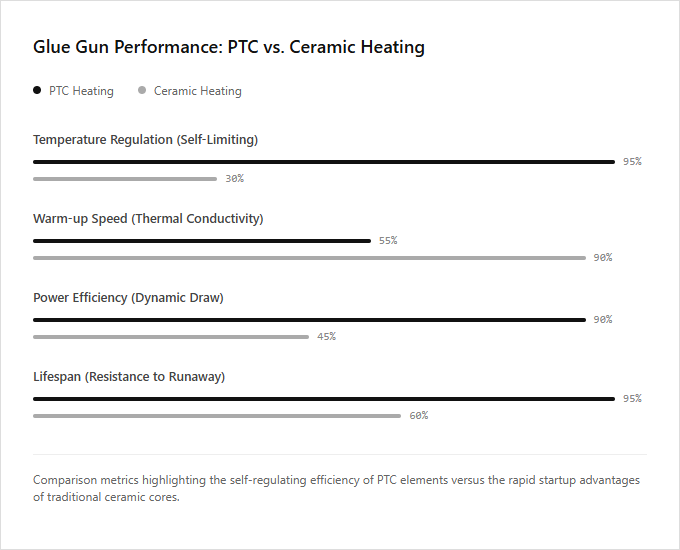
| Heating Mechanism | PTC heaters utilize positive temperature coefficient thermistors that self-regulate resistance, whereas traditional ceramic heaters rely on constant electrical resistance elements to generate thermal energy. |
| Temperature Regulation | PTC systems inherently prevent overheating via a self-limiting resistance loop, while ceramic elements require external thermostats or thermal fuses to regulate operating temperatures. |
| Warm-up Speed | Ceramic heating elements typically exhibit faster initial thermal conductivity, reaching operating temperatures quicker than PTC systems which throttle power as they warm up. |
| Power Consumption | PTC glue guns optimize power draw dynamically by reducing current as the target temperature is reached, whereas ceramic heaters maintain a relatively constant wattage draw. |
| Lifespan and Reliability | PTC heaters offer superior longevity due to the absence of moving parts and resistance to thermal runaway, while ceramic elements can degrade faster under high thermal stress. |
Positive Temperature Coefficient self-regulation based on the material's Curie temperature
In professional glue guns, the choice between Positive Temperature Coefficient (PTC) and traditional ceramic heating dictates thermal efficiency. PTC heating elements utilize specialized semi-conductive materials that self-regulate based on their Curie temperature. Once the material reaches this critical threshold, its electrical resistance rises sharply, naturally restricting current flow to prevent overheating without external sensors. This mechanism ensures consistent temperature maintenance and high energy efficiency.
Standard ceramic heaters deliver rapid, continuous heat but lack inherent thermal regulation, requiring external controls to prevent damage. PTC-heated glue guns are ideal for crafters and light assembly workers prioritizing safety and consistent warmth, whereas traditional ceramic models best serve high-volume industrial operators needing rapid heat recovery and maximum adhesive flow.
Preventing Thermal Runaway: PTC vs. Ceramic Heating
PTC (Positive Temperature Coefficient) heating elements utilize variable resistivity to inherently prevent thermal runaway. As the internal temperature rises, the electrical resistance of the PTC material increases exponentially, automatically restricting current flow and self-regulating the tool's heat output. By contrast, traditional ceramic heating elements operate on a constant-wattage design. Lacking built-in resistance variation, ceramic heaters continuously draw power at a fixed rate, which increases the risk of overheating and thermal runaway if external control components fail.
This fundamental difference dictates safety profiles and thermal stability during prolonged operation. PTC-heated glue guns are ideal for hobbyists and safety-conscious DIYers requiring intermittent, worry-free use, while constant-wattage ceramic models are best suited for high-volume industrial operators demanding rapid heat recovery and continuous adhesive flow.
Thermal Inertia Effects on Adhesive Melting Time
The choice between PTC (Positive Temperature Coefficient) and ceramic heating elements in professional glue guns depends heavily on their transient thermal response. PTC elements feature inherent self-regulating properties but carry higher thermal inertia. This thermal mass slows the initial temperature rise, resulting in a gradual heating curve and a longer wait time for the adhesive to reach its melting point.
Ceramic heating technology offers exceptionally low thermal inertia, enabling rapid heat transfer directly to the chamber. This minimal thermal lag ensures an almost instantaneous startup and swift adhesive liquefaction. PTC models suit high-volume assembly operators requiring prolonged, self-limiting thermal stability, while ceramic models are ideal for on-demand contractors and crafters who prioritize immediate tool readiness.
Dynamic PTC Resistance to Minimize Standby Power
PTC (Positive Temperature Coefficient) heating elements utilize advanced semi-conductive materials that exhibit dynamic electrical resistance modulation. As the element reaches its target temperature, its internal electrical resistance increases exponentially. This self-regulating behavior drastically restricts current flow, minimizing standby power consumption when the glue gun is idle. Conventional ceramic heating elements maintain a fixed resistance, drawing constant power regardless of thermal demand and requiring external regulation to prevent overheating.
While ceramic elements offer rapid, high-temperature output, PTC systems provide superior energy efficiency and thermal safety during intermittent use. PTC glue guns are ideal for hobbyists and packaging professionals who require prolonged standby periods, while traditional ceramic models suit high-volume assembly line operators needing constant, rapid adhesive flow.
Maximizing Heat Transfer with Alumina Ceramic Substrates
In professional glue gun applications, the choice between PTC (Positive Temperature Coefficient) and ceramic heating elements significantly impacts thermal efficiency. While PTC heaters offer reliable self-regulating safety, advanced ceramic heaters utilize high-purity alumina ceramic substrates. The high thermal conductivity of these alumina ceramic substrates maximizes direct heat transfer to the adhesive, ensuring rapid warm-up times and a highly consistent melt flow under demanding conditions.
PTC models are highly suited for hobbyists and occasional DIY users who prioritize safety and intermittent operation, whereas ceramic-heated guns are ideal for industrial professionals requiring continuous, high-volume adhesive output.
Resistance-temperature characteristic curves stabilizing adhesive viscosity during continuous extrusion
In professional glue guns, the choice between Positive Temperature Coefficient (PTC) and traditional Ceramic heating systems directly impacts adhesive viscosity during continuous operation. PTC elements feature a self-regulating resistance-temperature characteristic curve; as the element reaches its transition temperature, its resistance increases exponentially, naturally capping the thermal output to prevent adhesive degradation. In contrast, ceramic heating elements exhibit a highly linear resistance curve, requiring precise external electronic closed-loop controllers to maintain the constant temperatures necessary for stable, uniform extrusion rates.
Fluctuations in temperature alter adhesive viscosity, which can lead to uneven bonding or mechanical jamming during rapid dispensing. While PTC systems offer inherent thermal stability and safety during intermittent use, ceramic heaters deliver faster thermal recovery times under heavy, continuous extrusion demands. PTC-heated guns are ideal for light assembly workers and DIY enthusiasts seeking safe, plug-and-play reliability, whereas ceramic-heated models are suited for industrial operators requiring high-speed, high-volume production line integration.
Minimizing Heater-Nozzle Contact Resistance for Improved Heat Transfer
In professional glue gun design, optimizing the overall heat transfer coefficient relies heavily on minimizing contact thermal resistance at the interface between the heating element and the nozzle. PTC (Positive Temperature Coefficient) heaters, typically encased in aluminum blocks, rely on mechanical clamping to establish interface contact. While reliable, microscopic air gaps at this junction can restrict thermal conduction, slightly limiting heat transfer efficiency during demanding, high-volume extrusion tasks.
In contrast, ceramic heating elements feature heating resistors integrated directly into a ceramic substrate, allowing for a highly consolidated, direct-contact cylindrical interface with the nozzle. This streamlined physical connection significantly reduces contact thermal resistance, ensuring rapid thermal recovery and superior heat transfer rates. PTC-heated guns are ideal for hobbyists and general crafters seeking inherent thermal safety and budget-friendly operation, while ceramic-heated models are best suited for industrial assembly technicians requiring rapid, continuous adhesive flow under demanding schedules.
Leave a comment