
Achieving the perfect balance between high-volume adhesive delivery and delicate precision remains a persistent frustration for assembly technicians and product developers alike. Selecting the wrong tool configuration often leads to costly project delays, starved joints, or messy adhesive squeeze-out. While procurement departments typically rely on standard equipment funding sources to secure general-purpose workshop tools, treating hot melt systems as uniform assets overlooks critical operational nuances.
Optimizing your tool selection grants production lines an immediate boost in efficiency and joint integrity, with the stipulation that the gun's wattage must match the specific thermal requirements of the adhesive. For example, high-volume packaging operations rely on the heavy extrusion capabilities of 11mm systems, whereas delicate electronics prototyping demands the surgical control of a 7mm detail gun.
This article provides a comprehensive comparison of 11mm versus 7mm hot melt glue guns, evaluating their melt rates, thermal recovery, and ergonomic profiles to help you select the ideal tool for your specific application.
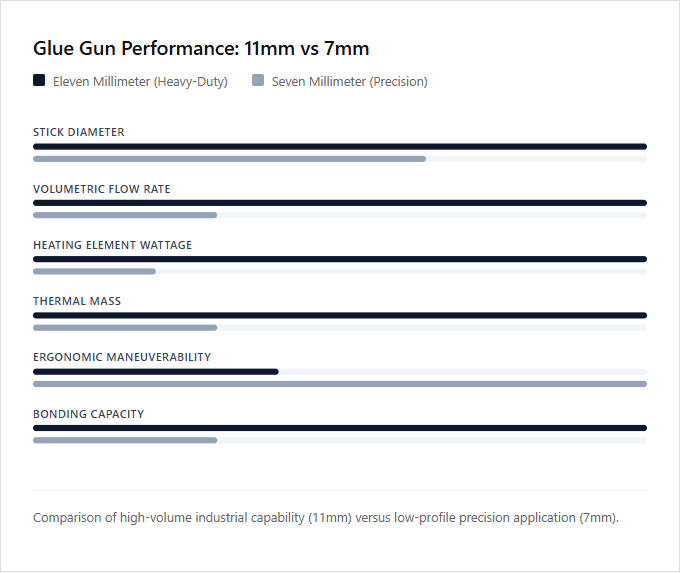
| Factor | Summary |
|---|---|
| Stick Diameter | The 11mm format accommodates heavy-duty adhesive consumables for high-volume output, whereas the 7mm diameter utilizes mini-sticks engineered for delicate, low-profile application. |
| Volumetric Flow Rate | An 11mm glue gun delivers a significantly higher rate of molten polymer extrusion per minute, whereas a 7mm gun limits flow to facilitate precise, drop-by-drop deposition. |
| Heating Element Wattage | High-wattage heating elements in 11mm tools ensure rapid thermal recovery during continuous use, while 7mm guns typically employ low-wattage PTC heaters suited for intermittent operation. |
| Thermal Mass | The larger nozzle and heater block assembly of an 11mm gun provides superior heat retention to prevent premature solidification of the adhesive extrudate. |
| Ergonomic Maneuverability | The lightweight, compact chassis of a 7mm glue gun allows for high-precision articulation in tight spaces, whereas the heavier 11mm frame is designed for high-force industrial grip stability. |
| Bonding Capacity | Large-diameter 11mm sticks provide the necessary adhesive volume for structural joint strength across wide surface areas, while 7mm sticks are optimized for rapid, light-duty spot-bonding. |
Flow Capacity: 11mm Melt vs. 7mm Precision Chambers
The volumetric flow rate of a hot glue gun is directly dictated by the volume and thermal capacity of its heating chamber. An 11mm melt chamber accommodates a significantly larger mass of adhesive, enabling a high-volume, continuous delivery of molten glue. This high flow rate prevents the temperature drops often experienced during rapid dispensing, maintaining a consistent viscosity for heavy-duty bonding. In contrast, 7mm precision chambers hold less material, restricting the maximum flow rate but allowing for immediate, low-volume adhesive delivery.
While the restricted flow of the 7mm chamber excels in detailed applications where excess adhesive can compromise the workpiece, the 11mm system is engineered to sustain rapid, high-yield output without interruption. High-capacity 11mm models are ideal for industrial packaging specialists and construction contractors requiring rapid, structural bonding, whereas the nimble 7mm units are best suited for electronics technicians and detail-oriented hobbyists performing intricate assembly work.
Reservoir Thermal Retention in High-Volume Extrusion
During continuous high-volume extrusion, the thermal mass of the adhesive reservoir is the critical factor preventing temperature drops. Eleven-millimeter glue guns feature a significantly larger heating chamber, which stores a higher volume of thermal energy. This substantial thermal reservoir ensures that as cold adhesive is fed rapidly into the nozzle, the tool maintains a consistent operating temperature, preventing adhesive cooling and ensuring a steady flow.
Smaller seven-millimeter models possess a reduced reservoir capacity, leading to rapid heat depletion during continuous use. This lower thermal mass causes the adhesive temperature to drop quickly under high feed rates, which can result in incomplete melting and increased trigger resistance. Industrial operators and packaging specialists require the robust thermal endurance of eleven-millimeter systems, whereas detailed crafters and electronics technicians are better served by the lightweight precision of seven-millimeter units.
Nozzle Size Limits 11mm Gun Micro-Bead Bonding
When selecting a professional glue gun, the choice between eleven-millimeter (11mm) and seven-millimeter (7mm) models centers on output volume and precision. Standard 11mm heavy-duty guns utilize larger heating chambers and wider nozzle orifices. While this maximizes adhesive flow for high-volume bonding, the wider nozzle orifice creates physical limitations that restrict 11mm guns from executing micro-bead detail bonding, as the larger aperture prevents the delivery of pin-point, ultra-fine adhesive lines.
Smaller 7mm glue guns feature narrower nozzles designed for delicate control. These compact tools deliver a highly restricted volume of adhesive, preventing overflow and allowing for precise placement on intricate surfaces. Heavy-duty 11mm systems are ideal for industrial packaging specialists requiring rapid, high-volume bonding, whereas 7mm precision models are best suited for electronics technicians and detailed crafters executing delicate assembly tasks.
Heater Wattage for Rapid Stick Advancement
When selecting between eleven-millimeter and seven-millimeter glue guns, the primary engineering consideration is thermal recovery. Eleven-millimeter glue sticks possess significantly more mass per unit length, which requires higher-wattage heating elements to maintain stable operating temperatures. During rapid stick advancement, an eleven-millimeter tool typically demands a heater rated between 80 and 200 watts to prevent thermal drawdown and nozzle freezing. Conversely, the lower thermal mass of seven-millimeter sticks allows compact heaters rated at 10 to 40 watts to efficiently sustain continuous extrusion.
High-volume industrial operators and contractors require the high-wattage eleven-millimeter systems for demanding bonding tasks, while detail-oriented hobbyists and electronic technicians benefit most from the precise, low-wattage delivery of the seven-millimeter models.
How Bead Thermal Volume Affects Adhesive Open Time
When selecting a hot glue gun, the choice between 11mm and 7mm stick diameters directly impacts the adhesive's open time through thermal volume. The larger 11mm system extrudes a high-volume bead that retains heat significantly longer. This increased thermal mass prevents rapid cooling, allowing operators ample time to position and adjust larger workpieces before the adhesive sets.
In contrast, the 7mm system delivers a much smaller bead with minimal thermal volume. This bead cools almost instantly upon contact with the substrate, resulting in a very short open time that requires immediate assembly. High-volume 11mm glue guns are ideal for industrial fabricators and carpenters who require extended working windows for aligning large materials, while precise 7mm models suit detailed hobbyists and electronics technicians who benefit from instant bonds on delicate components.
Feed Force Thresholds by Stick Diameter
The mechanical feed force required to advance a hot melt glue stick is directly proportional to its surface area and volume within the heating chamber. Eleven-millimeter glue guns demand a higher trigger threshold to compress and shear the larger molten mass through the nozzle. This resistance requires greater hand strength and mechanical leverage, but it yields a continuous, high-volume delivery of adhesive.
Seven-millimeter glue guns operate with a significantly lower feed force threshold. The smaller stick diameter experiences minimal friction within the sleeve, requiring very little physical effort to advance the material. High-volume industrial operators benefit from the robust output of the eleven-millimeter system, while detail-oriented hobbyists and electronics technicians are better suited to the effortless precision of the seven-millimeter model.
Viscosity Compatibility: 11mm Polyamide vs. 7mm EVA
Eleven-millimeter glue gun systems are engineered to accommodate the high melt viscosity and elevated processing temperatures of high-performance polyamide adhesives. These advanced polymers deliver exceptional thermal resistance and mechanical strength, demanding the robust heating elements and high-feed force characteristic of professional 11mm platforms.
Smaller seven-millimeter tools are optimized for standard Ethylene-Vinyl Acetate (EVA) formulations. EVA adhesives exhibit significantly lower melt viscosity and require less thermal energy to flow, aligning perfectly with the compact wattage and smaller chambers of 7mm devices. Heavy-duty 11mm systems are best suited for industrial technicians requiring structural, high-temperature bonding, whereas lightweight 7mm tools are ideal for hobbyists performing delicate, low-volume assembly work.
Leave a comment