
Many workshop operators struggle with weak suction at their machinery, often watching fine dust escape into the breathing zone despite running a heavy-duty dust collector. Typically, facilities attempt to resolve this by investing in larger ductwork or purchasing a collector with a higher nominal CFM rating.
However, optimizing your existing system grants you the ability to maximize airflow velocity and maintain a pristine workspace without unnecessary capital expenditure. This requires managing the stipulation that factory-rated CFM curves are measured under zero-resistance conditions, which rarely reflect real-world shop layouts. For example, a 12-inch disc sander or a CNC router port creates unique localized resistance that standard calculations often overlook.
This article will demystify the critical relationship between CFM and static pressure, explain how to calculate cumulative system resistance, and provide a blueprint for optimizing your dust collector's airflow performance.
| Factor | Summary |
|---|---|
| Cubic Feet per Minute (CFM) | CFM measures the volumetric flow rate of air moved by the collector, which dictates how effectively the system can capture and transport airborne particulate matter. |
| Static Pressure (SP) | Static pressure, typically measured in inches of water column, represents the resistance to airflow caused by friction within hoses, filters, and ductwork. |
| Duct and Hose Velocity | Maintaining high velocity requires balancing the cross-sectional area of the duct with the CFM to prevent dust from settling in the run due to boundary layer friction. |
| Filter Resistance | High-efficiency particulate air (HEPA) filters capture microscopic dust but introduce significant pressure drop, which reduces the system's overall volumetric flow. |
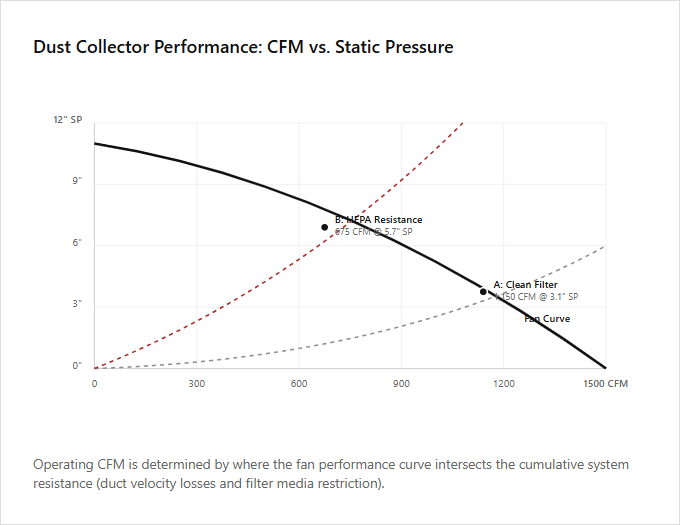
| Fan Curve Performance | The actual operating point of a dust collector is determined by the intersection of the fan curve and the system's total cumulative resistance. |
Understanding CFM for Hood Airflow
In dust collection systems, Cubic Feet per Minute (CFM) represents the volumetric airflow rate necessary at the extraction hood to capture and transport airborne particulates. This crucial metric dictates the volume of air moved per minute, which directly determines the system's ability to pull fine dust away from the woodworking or machining source before it disperses into the ambient environment. High CFM is vital for entraining light, suspended particles across a wider collection area.
Conversely, static pressure represents the resistance the blower must overcome, which is caused by ductwork, bends, and filtration media. High-CFM systems are ideal for small-scale hobbyists operating single-tool stations with minimal ducting, while high static pressure units are essential for industrial operators managing complex, multi-branch piping networks connected to heavy machinery.
Static Pressure: The Resistance Blowers Must Overcome
In dust collection, system performance relies on the balance between CFM and static pressure. Static pressure represents the resistance caused by friction loss and turbulence within the ductwork that the blower must overcome. Every bend, corrugated hose, and reduction introduces resistance that limits actual airflow.
Systems with high static pressure maintain velocity when drawing air through complex duct networks or fine filters. High-CFM collectors with low static ratings quickly lose efficiency when restricted. Matching the collector's capabilities to the shop layout ensures effective dust capture.
High-CFM, low-pressure systems suit hobbyists with short, direct hose connections to single machines, whereas high-static-pressure systems are essential for professional woodworkers managing complex, multi-branch duct networks.
Maintain Transport Velocity to Prevent Duct Clogging
In dust collection, airflow volume (CFM) and static pressure resistance must be carefully balanced. This equilibrium is critical to maintaining the minimum design transport velocity, measured in Feet per Minute (FPM), throughout the ductwork. Ensuring the velocity stays above this threshold keeps particulate matter suspended in the air stream, successfully preventing dust from settling and clogging the system.
System designers must match the collector's performance curve to the duct network's resistance. High-volume, low-pressure configurations suit large commercial operators running multiple machines simultaneously through smooth, rigid ducting, while high-static-pressure, lower-CFM units are ideal for individual hobbyists using restrictive, flexible hoses on single-station setups.
How Fan and System Curves Determine Operating Point
Selecting an effective dust collection system requires understanding the relationship between volumetric airflow (CFM) and static pressure resistance. A collector's fan performance curve illustrates its capacity, demonstrating that airflow decreases as resistance increases. Conversely, the system restriction curve represents the cumulative friction loss from ductwork, filters, and hood transitions. The actual system operating point is determined by the precise intersection of this fan performance curve and the system restriction curve, establishing the real-world performance of the machine.
Optimizing this intersection prevents inadequate suction and clogged lines. High-volume, low-resistance configurations suit commercial woodworkers operating large, multi-branch stationary machinery networks, whereas high-static pressure systems are ideal for small-shop hobbyists utilizing portable power tools with restrictive, narrow-diameter ports.
Dust Cake Build-Up Requires Static Pressure Reserve
In dust collection, Airflow (CFM) and Static Pressure are critical performance metrics. CFM determines the volume of air moved to capture dust, while static pressure represents the system's ability to overcome resistance. As the collector operates, a dust cake naturally accumulates on the filter media. This accumulation increases the pressure drop across the filter, restricting airflow unless the system possesses a sufficient static pressure reserve to overcome this resistance.
Choosing between these two metrics depends heavily on the specific workshop environment and machinery configuration. Woodworkers operating small shops with short, direct hoses benefit most from high-CFM setups, while professional CNC operators and those utilizing extensive ducted networks require high static pressure systems to sustain performance.
Calculating Total Pressure: Static and Velocity
When engineering an effective dust collection system, balancing airflow volume (CFM) and static pressure is critical. Focusing solely on static resistance is a common design misstep. To accurately determine the total pressure requirements of the system, velocity pressure must be calculated alongside static pressure. This velocity pressure represents the kinetic energy required to maintain proper transport velocity, ensuring that debris remains suspended rather than settling inside the ductwork.
Combining these metrics prevents system clogs and maintains peak suction at the tool hoods. High-airflow, low-static setups are ideal for hobbyists utilizing single-tool, short-hose connections, whereas high-static, precisely calculated systems are essential for industrial woodworkers operating complex, multi-branch duct networks.
Balancing Duct Diameter for Optimal Pressure and Velocity
Effective dust collection relies on a precise balance between air volume, measured in Cubic Feet per Minute (CFM), and resistance, known as static pressure. CFM determines the capacity of air moved, while static pressure represents the friction loss from ductwork and filters. Optimizing the duct diameter prevents excessive static pressure from choking the airflow. Appropriately sized ducts ensure the system maintains the target capture velocity necessary to keep debris suspended in the airstream.
Careful system design prevents dust accumulation in the lines and maximizes collector efficiency. High-volume CFM systems with large, rigid main lines are best suited for professional woodworkers operating multiple stationary machines, while high-static-pressure setups with smaller flexible hoses are ideal for hobbyists using single, small-port benchtop tools.
Leave a comment