
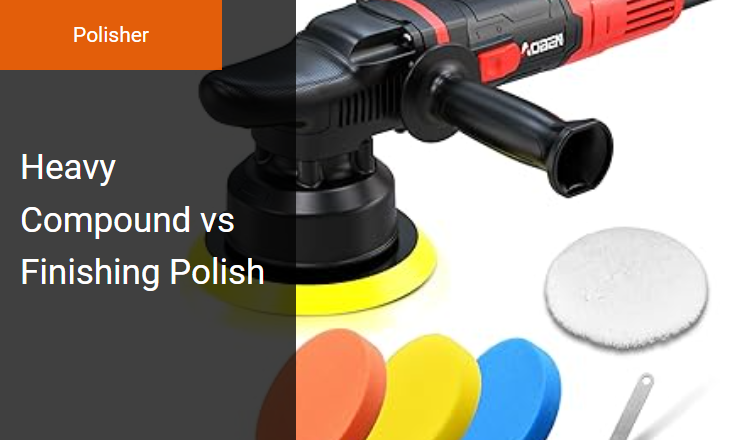
Achieving a flawless, swirl-free finish on automotive paint is notoriously frustrating, often leaving detailers staring at stubborn holograms or micro-marring. Traditionally, enthusiasts rely on standard retail glazes or manual hand-polishing methods to temporarily mask these paint defects. However, leveraging a dual-action (DA) polisher grants operators the precise mechanical safety and correction power required to actually level the clear coat, unlocking true optical clarity.
Crucially, a DA polisher is not a magic wand; professional-grade results are strictly contingent upon understanding abrasive technology. Utilizing industry-standard formulas like Meguiar's M105 Heavy Compound for severe defects versus Sonax Perfect Finish for final jeweling illustrates how specific product selection dictates your results.
Below, we will demystify the distinct roles of heavy compounding and finishing polishing, detailing when to deploy each step, and outlining the exact pad-and-product techniques needed to master your paint correction workflow.
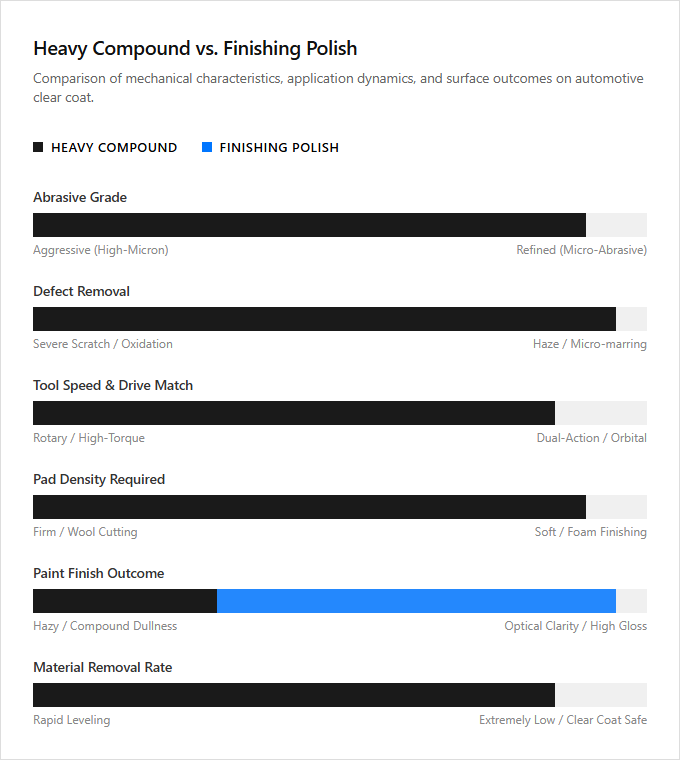
| Factor | Summary |
|---|---|
| Abrasive Grade | Heavy compound utilizes aggressive, high-micron abrasives to cut deep defects quickly, whereas finishing polish contains diminished micro-abrasives designed for final paint refinement. |
| Defect Removal | Heavy compound targets severe paint correction such as deep scratches and heavy oxidation, while finishing polish removes minor haze, holograms, and micro-marring. |
| Tool Compatibility | Heavy compounds are often paired with high-torque rotary polishers for rapid leveling action, whereas finishing polishes excel with dual-action orbital polishers to prevent paint buffer trails. |
| Pad Compatibility | Heavy compound requires firm, open-cell cutting foam or wool pads to maximize mechanical abrasion, while finishing polish utilizes soft, closed-cell finishing pads. |
| Paint Finish Outcome | The application of heavy compound often leaves a dull, hazy surface requiring a secondary step, while finishing polish achieves high gloss and optical clarity by leveling the clear coat. |
| Material Removal Rate | Heavy compound has a high rate of paint removal to level the substrate quickly, whereas finishing polish has an extremely low removal rate to preserve the clear coat thickness. |
Compounding vs. Polishing: From Correction to Reflection
Achieving a flawless paint finish requires a systematic approach to correction, utilizing distinct compounds for specific restoration stages. Heavy compounding serves as the aggressive initial phase designed to level deep defects, severe oxidation, and scratches. This process utilizes Super Micro-Abrasive Technology (SMAT), featuring advanced abrasives that maintain their cutting consistency to rapidly flatten uneven clear coat surfaces.
In contrast, finishing polishing represents the refinement stage. This step employs ultra-fine abrasives to eliminate minor hazing and maximize specular reflectance, producing a deep, mirror-like clarity. Heavy compounding is ideal for restoration technicians tackling severe paint damage, while finishing polishing is suited for detailers performing routine gloss maintenance.
Compounding with Microfiber, Polishing with Foam
Heavy compounding is the primary stage in paint correction, designed to eliminate deep scratches, severe oxidation, and pronounced surface defects. To achieve maximum efficiency, compounding requires high-cut microfiber pads to maximize aggressive leveling. The dense fibers of these pads generate the necessary friction to rapidly cut through damaged clear coat, preparing the surface for subsequent refinement.
In contrast, finishing polish serves to restore optical clarity and depth after the initial correction phase. This delicate process relies on soft open-cell foam pads for final paint jeweling. The highly pliable foam structure ensures even distribution of ultra-fine abrasives, safely removing minor haze and holograms to produce a mirror-like shine.
Heavy compounding is ideal for professional collision repair specialists restoring severely weathered clear coats, while finishing polishing is suited for detailing enthusiasts seeking a flawless, high-gloss show-car presentation.
Heavy Compound vs. Finishing Polish: Key Differences
In professional paint correction, selecting the correct abrasive grade is critical for restoring automotive finishes. A heavy compound utilizes aggressive abrasives to correct severe sub-surface defects, including deep oxidation and P2000 grit sanding scratches. This process rapidly levels the clear coat to eliminate prominent damage.
A finishing polish features ultra-fine abrasives designed to target minor imperfections such as micro-marring, light haze, and buffer trails. This step refines the paint surface to maximize clarity and depth. Heavy compounds are best utilized by restoration specialists managing neglected or freshly sanded paint, whereas finishing polishes are ideal for maintenance detailers aiming to achieve a flawless, high-gloss reflection on delicate surfaces.
Compounding vs. Finishing: Managing Paint Thickness
In professional paint correction, heavy compounding serves as an aggressive restoration process designed to eliminate deep defects, severe oxidation, and heavy swirl marks. This procedure significantly reduces the clear coat thickness of the vehicle. To ensure safety and preserve the paint, operators must carefully monitor the remaining film build using a digital paint depth gauge throughout the process.
Finishing polishing utilizes ultra-fine abrasives to refine the paint surface and maximize gloss. This milder step removes negligible film build, making it a safe option for regular paint maintenance. Heavy compounding is ideal for experienced collision repair technicians tackling severe paint damage, while finishing polish is suited for detailing enthusiasts and professionals performing routine gloss enhancement.
Compounding Heat vs. Finishing Polish Lubrication
Heavy compounding serves as the primary restorative phase in paint correction, targeting deep defects, severe oxidation, and heavy scratches. This aggressive cycle relies on fast-cutting abrasives to level the clear coat, a process that inevitably generates high surface heat and significant abrasive dusting. Operators must carefully monitor panel temperatures and manage residue to avoid marring the finish.
Finishing polishes refine the surface to a high-gloss, hologram-free shine. These formulations utilize advanced lubrication carriers to facilitate a longer working time, allowing the fine abrasives to break down smoothly with minimal heat generation. Heavy compounds are essential for collision repair technicians and restoration professionals tackling severe damage, while finishing polishes are the ideal choice for detailers and enthusiasts seeking maximum optical clarity on delicate paint surfaces.
Adjusting DA Polisher Throw for Compounding vs. Finishing
When executing heavy compounding with a dual-action polisher, utilizing a large-throw orbit is essential. This wider oscillation maximizes cutting efficiency, allowing the abrasive compounds to quickly level deep paint defects and scratches. The aggressive movement ensures rapid material removal across the clear coat surface.
Refining the paint with a finishing polish demands a different approach. Achieving a defect-free, high-gloss shine requires a smaller-throw orbit or a reduced operating speed. This configuration prevents pad stalling on curved panels, maintaining consistent rotation to gently burnish the paint without introducing new imperfections.
Heavy compounding is ideal for restoration professionals tackling severe surface oxidation, while finishing polishes are best suited for detailers and enthusiasts aiming to achieve a flawless, mirror-like final gloss.
Matching Polishing Techniques to Clear Coat Hardness
Selecting the appropriate abrasive technology for a power polisher depends heavily on the hardness of the vehicle's paint substrate. Soft clear coats are highly sensitive to friction and heat, demanding specialized finishing polishes with refined abrasives to prevent paint swelling and micro-marring. These mild formulations gently restore gloss without compromising the delicate paint structure.
Hard clear coats present a resilient surface that resists defect removal, requiring heavy compounding agents to level deep scratches and achieve necessary correction. The chemical composition of heavy compounds utilizes aggressive abrasives to shear through rigid paint layers efficiently. Heavy compounds are suited for collision repair technicians restoring severely weathered factory clears, while finishing polishes are ideal for enthusiast detailers refining soft, sensitive paint systems.
Leave a comment